Was it morally right to capture Maduro?
I woke up Saturday morning and, as I usually do, opened The Times of Israel. I wasn’t looking for anything in particular. I skimmed the headlines, read a few pieces… and then I came across one that stopped me cold.
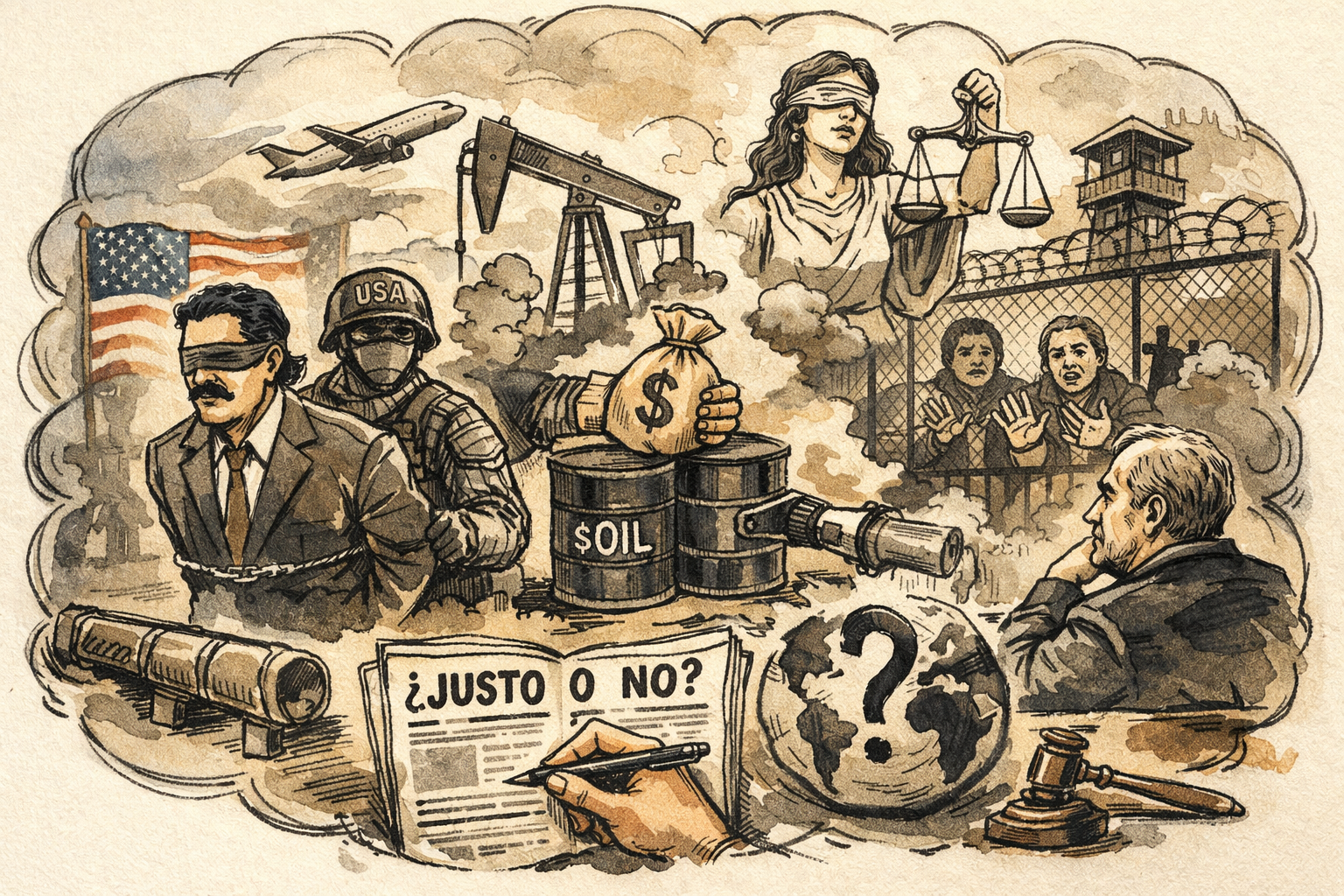
It said that Nicolás Maduro, the president of Venezuela, had been captured in an operation led by the United States. Detained outside his own country, transferred to US territory, with the promise of a trial. In the same breath, clear statements: Venezuelan oil would now return to American hands.
I read the whole article. And when I finished, I didn’t feel relief or satisfaction. I felt something else. An uncomfortable question that wouldn’t leave me alone:
Is this morally right?
I’m not talking about whether Maduro was a good president. That, to me, is clear enough. His time in power coincided with the collapse of an entire country: corruption, poverty, millions forced to flee, broken families, ruined lives. To deny that would be dishonest.
That’s not the question. The question is this: Is anything done against someone like that automatically just?
Let’s imagine something closer to home. If your neighbor is a violent criminal, can you break into his house without a warrant, drag him out by force, and, while you’re at it, take his car because he “owed it to society”? Instinctively, we know the answer is no. Even if he’s guilty. Something there doesn’t sit right.
The same thing happens with states, just on a much larger scale. That’s why sovereignty exists. Not as a legal technicality, but as a moral limit, so that the strongest party doesn’t decide, simply because it can, who deserves to be judged and how.
When one country captures the leader of another without a shared international framework, the implicit message is dangerous: force decides what justice is. And even if the person detained is guilty, that precedent reaches all of us.
There are historical precedents, of course. Eichmann. Noriega. International tribunals. Each case different, each justification distinct. But the pattern is uncomfortable: global justice is not applied equally. Some criminals are pursued to the very end; others grow old quietly in power. The difference isn’t always moral. Very often, it’s political.
And then there’s the detail I find impossible to ignore: the language. “That oil belongs to us.”
Something breaks there.
There’s no need to read anyone’s mind. Words matter. When an action presented as justice comes wrapped in appropriation, in spoils, in explicit benefit, justice becomes contaminated. It no longer revolves around the victims, but around the winner.
That doesn’t absolve Maduro. But it doesn’t absolve those who use his guilt as a licence to dominate either.
And here comes the most uncomfortable part: there is no clean way out.
If no one acts, there is impunity. If a single power acts alone, there is arbitrariness.
International trials, multilateral pressure, sanctions, waiting it out… everything has a cost. Real lives. Real suffering. There is no morally pure option waiting to be discovered.
Maybe that’s why this story didn’t leave me at ease. Because the fact that an action like this can seem necessary already says something terrible: that the system failed earlier. That a country was devastated. That the international community was unable to respond in time. That, in the end, justice arrives mixed with power.
I don’t have a perfect answer. But I do have a clear intuition:
When justice comes with an oil invoice, something is wrong.
And sitting with that discomfort — without turning it into a shout, without turning it into propaganda — may be the bare minimum we can do if we don’t want to lose our moral compass altogether.
I don’t know what you think. I’ve been turning it over in my head ever since I opened the newspaper.