


Political Advisor
Israel and Albania: An Unlikely Friendship
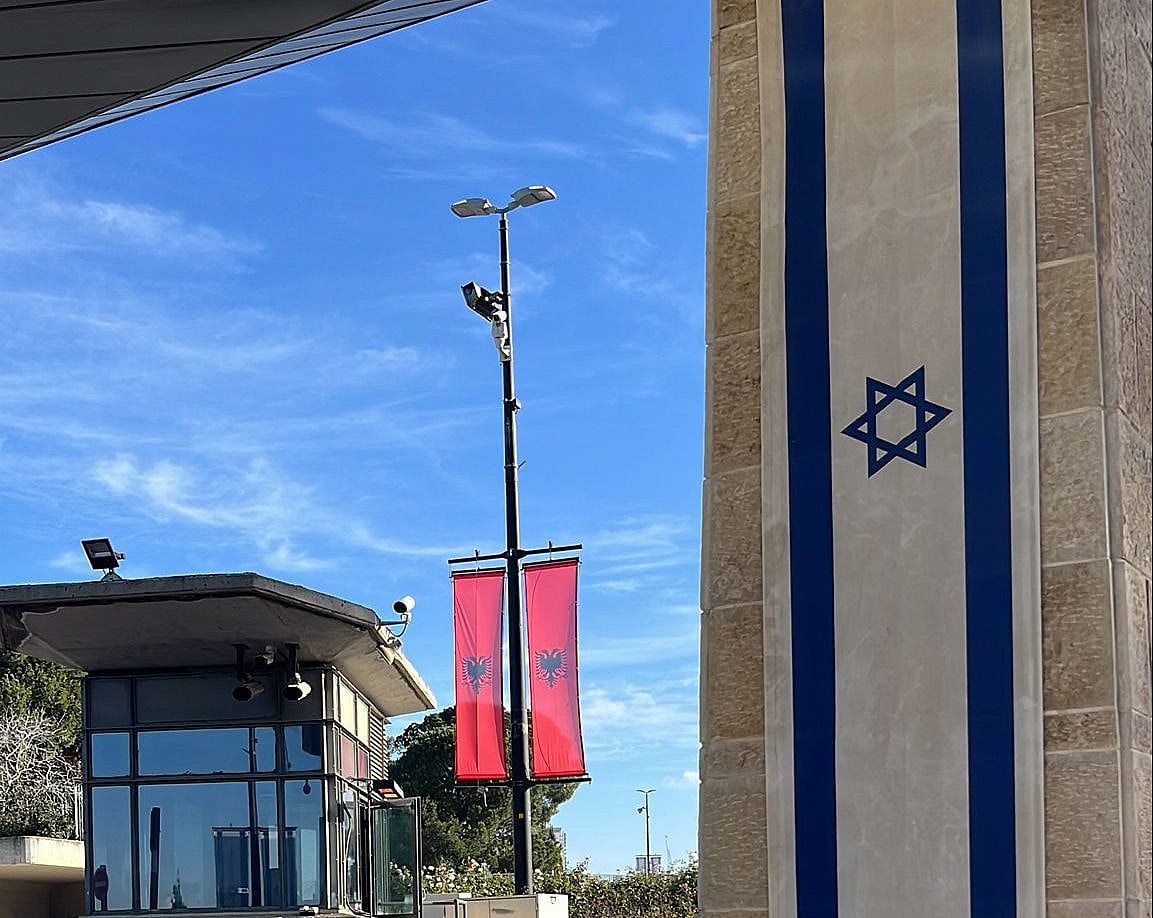
Albanian flags outside the Knesset, January 26,2026.
This week, Albanian Prime Minister Edi Rama began his official visit to Israel, and later today he is set to address the Knesset, an appearance that carries both historic and symbolic weight. The leader of a predominantly Muslim country speaking before Israel’s legislative body is a rare moment, made more significant by his participation in the international conference on combating antisemitism hosted by Minister of Diaspora Affairs, Amichai Chikli.
On paper, Israel and Albania appear an unlikely pair. One is a Middle Eastern state navigating threats on all sides while modernizing the region; the other, a small Balkan country with a complex past and a rapidly modernizing present. Yet in practice, their relationship is anchored not in convenience, but in shared values, moral clarity, resilience, and an instinct to stand on the right side of history.
That foundation was laid during humanity’s darkest chapter. During the Holocaust, Albania was the only European country to emerge with more Jews than it had before the war. Guided by Besa, an ancient Albanian code of honor meaning a sacred promise to protect others, Muslim families hid Jews, forged documents, and risked their lives without hesitation. According to Yad Vashem, Albanians sheltered approximately 2,000 Jewish refugees during World War II, and dozens have since been recognized as Righteous Among the Nations. For Albanians, saving Jews was not an act of heroism; it was a moral obligation.
That sense of responsibility did not end with the war. Albania was among the early countries to recognize the State of Israel in 1949 and maintained diplomatic ties even during periods when doing so carried political cost. For Israel, a nation built by survivors and sustained by memory, such continuity carries deep significance.
In the present day, that historical goodwill has translated into tangible cooperation. Israel and Albania maintain strong diplomatic relations and collaborate across technology, cybersecurity, agriculture, energy, and tourism. When a devastating earthquake struck Albania in 2019, Israel was among the first countries to offer assistance, dispatching rescue and humanitarian support in a moment of national crisis. Albania’s 2021 decision to open its embassy in Jerusalem was therefore not merely symbolic; it reflected a relationship defined by reciprocity, trust, and moral consistency within a European and NATO-oriented framework.
Albania offers Israel something increasingly rare in international diplomacy: a European, Muslim-majority partner that combines moral credibility with pragmatic international representation. It provides Israel with diplomatic goodwill in the Balkans, a bridge to moderate Muslim audiences, and a reliable voice in international forums that is not reflexively hostile to Israel.
The opportunity now is to elevate this relationship further. Prime Minister Benjamin Netanyahu can strengthen ties by transforming Albania from a quiet ally into a visible strategic partner, expanding economic and security cooperation, increasing high-level exchanges, and investing in cultural and educational initiatives that preserve shared historical memory. Positioning Albania as a model for constructive Muslim–Jewish relations would serve not only bilateral interests, but Israel’s broader diplomatic standing.
In a time where diplomatic friendships are fragile and increasingly transactional, the Israel–Albania relationship stands apart. It is steady, values-driven, and resilient, and it has significant potential still to grow.