
Using science background to write rationally about Israel, Jews and Academia
Israel and the Myth of Stolen Land
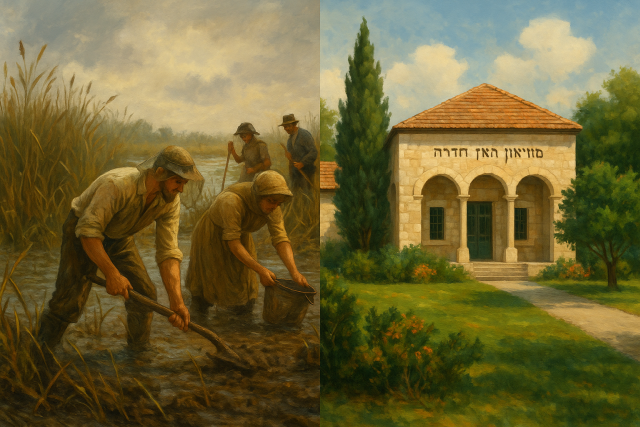
The swamps of Hadera: a reminder that Jews built, not steal
Recently, because of some glitch in Facebook algorithm or its particular sense of humor, my Facebook feed became filled with anti-Israel anti-Zionist propaganda, and I did read it out of curiosity and in order to get a better understanding of what we, supporters of Israel, are against in the field of public opinion. One of the most frequently encountered accusations, appearing especially, when the main topic is one of the Israel’s successes in medicine, science, culture, was the claim that Israel was built on stolen land. This made me think about how to counter this accusation. I do not think that references to the history, to Bible and the stories of ancient Jewish kingdoms will provide sufficient counterarguments. Indeed, while the religious, sentimental and ideological connection of Jews to this land regardless of where in the world they live, and continuity of Jewish presence in Jerusalem, Hebron, Safed, Tiberias and elsewhere is real, we have to admit that the majority of Jews populating modern Israel are immigrants from Europe, and later from other Middle Eastern countries. This is a simple and irrefutable fact. If we continue to argue our indigeneity to this land, we will always be losing this argument. So, we need a better one.
First let me point out that indigeneity itself is a broken concept. The Arabs first arrived in Palestine during the conquests of the 7th century, centuries after the ancient Israelites were exiled from this land. At that time, the land was inhabited by Byzantine Christians, Jews, Samaritans, and others. Some groups declined or disappeared, while many locals gradually adopted Arabic language and Islam. In other words, Arab identity itself was the result of conquest and assimilation, not eternal rootedness. By that measure, Arabs are no more “indigenous” to Palestine than Jews. And if we applied the same test everywhere, hardly any modern nation would survive it.
For me, Israel’s legitimacy doesn’t rest on who was here first. Instead, I prefer to look at what actually happened on the ground. So, let’s unpack the claim of stolen land, admitting that most of the Jews coming to this land as a part of Zionist movement were indeed newcomers. The old slogan that Palestine was ‘a land without people for people without a land’ was clearly inaccurate and insulting. But it was also true that Arabs who lived here had no organized national identity and no national inspirations, at least not until Zionism gained roots in the land. Benny Morris in his book Righteous Victims describes a telling episode. Delegation of Jews and Arabs in Palestine came to talk with a representative of British Crown. The Jewish delegation was greeted with Hatikvah – Israel national anthem. Arabs were offended and asked why only Jews were greeted with the music. The British representative asked, which music should we have played to greet you? The answer was embarrassed silence – they did not have any melody representing Arab Palestinian identity. Palestinian nationalism only developed later, in response to Zionism itself.
But the lack of Palestinian national identity prior to formation of Israel cannot serve as a rebuttal of the “stolen land” accusation, so this is not what I want to write about. I want to talk about the land itself, its economic rather than sentimental value, trying to figure out what exactly was there for Jews to steal.
Palestine was not rich in natural resources. It had no oil, little metal, limited timber, and only scattered pockets of fertile soil. Most of the economy rested on subsistence agriculture, precariously dependent on rainfall. Yields were low: Arab farmers typically harvested only 70–90 kilograms of wheat per dunam (a quarter acre). This was the land Jewish immigrants bought, often from absentee landlords in Beirut or Damascus.
In some places, the challenge was even worse. The Huleh Valley in the north, and parts of the coastal plain around Hadera, Caesarea, and Netanya, were covered by malaria-infested swamps. Draining them came at a terrible cost—not just in money, but in lives. Many early settlers died of malaria before the land could be cultivated. What later became some of Israel’s most productive farmland began as wasteland. The history of these communities comes alive in Khan Museum in Hadera, a visit to which left a long-lasting impression.
When Jews started farming this land, its productivity doubled or tripled. Even Palestine’s main export, citrus, only became a major industry after heavy Jewish investment in irrigation, packaging, and marketing. By 1947, Jews owned just 6–7% of the land but produced more than half of the country’s agricultural exports. The value came not from the soil itself, which was poor, but from Jewish capital, institutions, and labor. Jews cannot even be accused of exploiting Arab workers. A central principle of early Zionism was ‘Hebrew labor,’ and kibbutzim and moshavim relied overwhelmingly on the work of their own members.
And what of the cities? Tel Aviv offers the clearest answer to the stolen land libel. In 1909, sixty-six Jewish families gathered on the dunes just north of Jaffa. They had purchased the land legally from Arab owners. Nothing and no one was displaced—it was barren sand. Using seashells to draw lots, they divided the plots. From those dunes rose Tel Aviv, the first modern Hebrew city. Nothing was stolen. It was created.
Haifa tells a similar story. The old town existed, but modern Haifa—with its port, industries, and the Technion—was built in the 1920s and 30s through Jewish investment. The port, opened in 1933, made Haifa a center of commerce and science. This was development, not theft, and what is remarkable, Haifa became known as Israel’s most mixed city, where Jews and Arabs lived side by side more than in most other places. While neighborhoods were not completely integrated and economic gaps remained, Haifa stood out as a city where Arab and Jewish communities shared public life in schools, hospitals, workplaces, and cultural spaces.
Even Jerusalem, often imagined as eternal and unchanging, shows the same pattern. The Old City was shared, but modern West Jerusalem—Rehavia, Talpiot, Beit Hakerem—was built in the early 20th century with Jewish initiative, on land that was bought, not seized. And towns like Petah Tikva, Rishon LeZion, Nes Ziona, and Hadera began as Jewish farming colonies in the late 19th century, purchased from absentee landlords, later growing into thriving urban centers. Again, nothing was stolen—everything was built.
After independence, Israel absorbed waves of poor, traumatized Jewish refugees from Europe and the Middle East. Within a generation, they built modern infrastructure: ports, highways, power grids, irrigation projects. They created industries from textiles to high-tech. They turned deserts into farmland with drip irrigation. By the mid-1960s, Israel’s economy had leapt ahead. GDP per capita rose quickly, not through extracting resources, but through knowledge, labor, and grit.
Meanwhile, the land held by Arab states told a different story. The West Bank under Jordan and Gaza under Egypt remained underdeveloped. Gaza’s GDP in 1966 was only about US$40 million, dependent on remittances and UNRWA aid. In the mid-1960s, East Jerusalem under Jordan also lagged badly behind. Only about 41% of households had running water, compared to nearly universal coverage in West Jerusalem. Around 70% of East Jerusalem households had electricity, versus 100% in the West. Access to private bathrooms was just 26% in the East compared to 85% in the West, and overcrowding was worse as well — 2.4 persons per room versus 1.6 in West Jerusalem. These disparities show the sharp contrast in public investment and infrastructure and demonstrate that Israel’s growth was not the fruit of theft—it came from determination, hard work, and vision. The land itself offered little. What made the difference was what Jews built upon it.
And here is the heartbreaking part: had Arab leaders chosen coexistence in 1948 and afterward, both peoples could have shared in the prosperity. Zionist leaders hoped economic growth would be enough to persuade Arab neighbors to accept Jewish presence. But hatred, religious intolerance, and envy proved stronger than the promise of prosperity. Where peace was tried—inside Israel with Arab citizens, or abroad with the UAE, Bahrain, and Morocco—the benefits were obvious: joint ventures, rising incomes, and shared innovation.
So when critics repeat that Israel was built on stolen land, I think of Tel Aviv’s dunes, of drained swamps, of farms and factories, of new neighborhoods in Jerusalem. What was stolen? Sand, rock, and swamp. The truth is simple: Jews did not steal a country, they built one. Yes, mistakes were made, and some policies deserve criticism. But the story of Israel is not one of theft. It is the story of transformation, of turning scarcity into abundance, and despair into renewal. That is what legitimizes Israel’s existence. And that is why the charge of ‘stolen land’ collapses under its own weight.
Related Topics
Related Posts