

What the World Can Learn From Israel on Responding to Mass Shootings
Gun violence is not confined to any one country or conflict. Just a few weeks ago, a mass shooting at Bondi Beach shattered what was supposed to be a family-friendly Hanukkah celebration. That same weekend, in the United States, a gunman opened fire at Brown University. A few months before that, ten people were shot and killed at a secondary school in Austria.
In the US alone, there were 408 mass shootings in 2025 – more incidents than days in the year. Gun violence, often with mass casualties, has become a global condition—one in which Israel, unfortunately, has a lot of experience.
At Magen David Adom, Israel’s national emergency medical service, responding to mass-casualty scenes has been part of our reality for generations. Over decades of terror attacks, wars, and large-scale emergencies, one lesson has become painfully clear: the most decisive moments of a mass-casualty event are the minutes immediately after violence erupts.
What It Means to Arrive First
People often imagine that when paramedics arrive at a mass-casualty scene, the danger has passed. That is almost never the case.
For example, when MDA paramedic Fadi Dekaidek arrived at a 2023 terror attack at a synagogue in Jerusalem’s Neve Yaakov neighborhood, people were still running from an active shooter. Some were already dead. Others were bleeding heavily, lying on the street.
“It was unimaginable,” he recalled, “Whole families were gone in moments.”
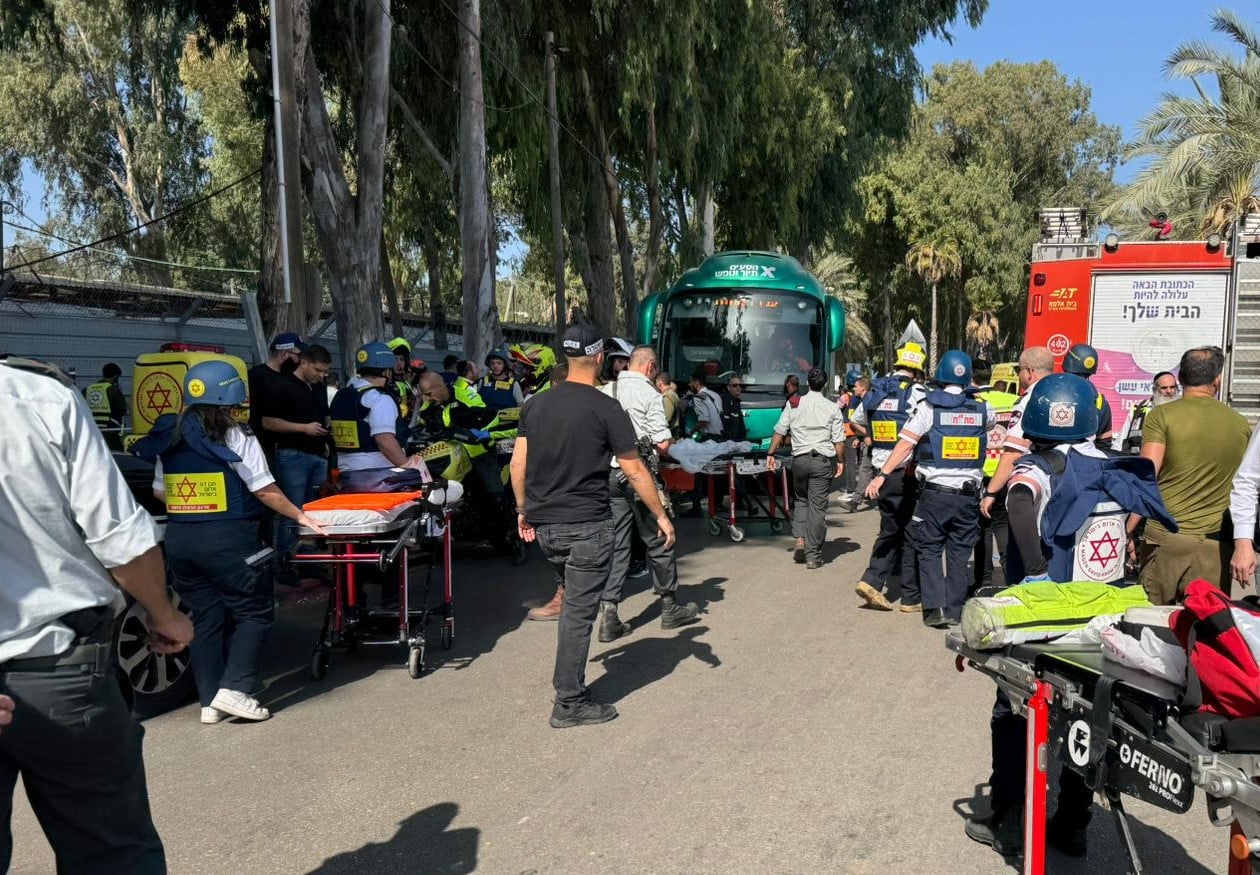
Difficult and chaotic scenes like this have to be approached methodically, or no one would be able to function. MDA paramedics are trained to coordinate lifesaving activity with police from the moment they arrive, which is often before the scene is fully secured. Our protocol is to begin treatment and continuously assess risks to both our patients and ourselves as we work. If any danger becomes imminent, we immediately alert the police and work with them to clear the scene.
Some of MDA’s unique and effective approaches include bullet-proof ambulances, as well as bullet-proof vests and helmets for medics. In addition, some medics have weapons-training and are armed.
Over the years, we have also implemented additional steps. For example, one protocol we’ve learned is not to take victims’ personal belongings with them to the hospital. Purses, backpacks, jackets—everything—stays behind. The reason is because no one knows what might be inside of them. Secondary explosives are a real concern, and every step in our training is designed to reduce risk.
Community Preparedness as a Force Multiplier
One of the reasons MDA can respond the way it does is because it is a community-based system. Alongside our professional staff, MDA relies on 35,000 trained volunteers, including trained medics and ambulance drivers. These are people who live in the neighborhoods they serve. When something happens, they run from their own homes or jobs to give lifesaving treatment.
Unlike other emergency systems, many of our drivers take their ambulances home instead of storing them in a central depot. This means MDA vehicles are already dispersed throughout the city and ready to move within seconds.
This model allows us to expand our response capacity almost immediately. In a city like Jerusalem, the presence of trained volunteer ambulance drivers means we can dramatically increase the number of intensive care units and regular ambulances on the road during a major incident.
This is a key differentiator in how Israel responds to mass-casualty events. Our system is not built only around EMS professionals and ambulance stations—our communities themselves are part of the response. That changes how fast help arrives, how many people can be treated at once, and, ultimately, how effectively a city can respond under crisis.
From Experience to Education — In Israel and Abroad
Over the years, MDA has invested heavily in educating the public, including teaching civilians what to do in those first critical minutes after an attack. We run workshops that focus on lifesaving basics: how to stop bleeding, how to call the dispatch center, how to describe what you are seeing so the right resources can be sent as quickly as possible.
After the attacks of October 7, we expanded these efforts dramatically to meet the growing demand. In many communities near the Gaza border that day, ambulances were unable to reach residents for hours due to blocked and dangerous roads. In response, we developed intensive training programs through the Magen Project, designed to help communities function independently in the immediate aftermath of violent mass-casualty events. These courses teach people how to gather the wounded into safe locations, how to use medical equipment, how to identify who in their community has professional training, and how to sustain care for 12 to 24 hours if evacuation is not possible.
MDA also travels to share its protocols and training models with EMS teams and Jewish communities around the world. We’ve trained fire departments and EMS teams in cities like New York and Boston, sharing the systems we’ve developed through decades of responding to terror and other mass-casualty incidents.
Why This Matters Now
Unfortunately, the world today is confronting a kind of violence that Israel has been forced to prepare for over generations. That doesn’t make us immune to tragedy in Israel. But it has taught us that preparedness can be the difference between life and death; and that it is teachable and replicable. Those first few minutes after violence erupts are critical – and every community has the power to take steps to be better prepared.