


Israel Is a Jewish State. But Sovereignty Belongs to Its Citizens
Rabbi Isaac Halevi Herzog, the first Ashkenazi Chief Rabbi of Israel, ultimately recognized that the sovereignty of the State of Israel rests in its citizens rather than in a theological notion of Jewish sovereignty.[1] Many contemporary disputes over democracy, minority rights, annexation, and the Temple Mount stem from a failure to understand that distinction.
Let me begin with a short anecdote.
One Shabbat morning I was walking home from synagogue in Efrat with a friend, an American-trained lawyer who had made aliyah roughly a decade earlier. In a different pre-Trump era, he may have voted Democratic, I don’t know. In passing he remarked: “Some of us were sitting around discussing the political situation, and we decided that Arabs should not have the right to vote.”
After overcoming my initial shock, I asked how he could say such a thing given democratic values and basic civil rights.
He replied, in a tone that suggested the answer should have been obvious:
“Well, it’s a Jewish state.”
This essay is an attempt to clarify what we mean, and what we do not mean, when we say that Israel is a Jewish state.
The question is not merely academic. Many of Israel’s most contentious disputes concerning minority rights, annexation, democratic institutions, freedom of religion, and even the Temple Mount rest upon competing assumptions about the nature of the state itself. Much of the confusion, I believe, stems from a failure to distinguish between two very different ideas: Israel as the nation-state of the Jewish people, and the notion of “Jewish sovereignty.”
To explore that distinction, I wish to revisit the almost forgotten debate surrounding the proposed constitution of the nascent State of Israel.
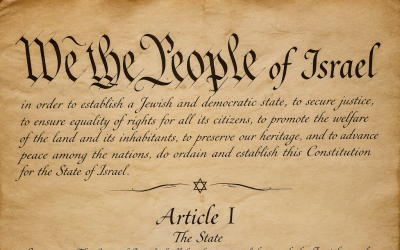 The Constitution That Never Was
In response to UN Resolution 181, which required the future Jewish and Arab states to adopt constitutions, legal scholar Dr. Leo Kohn was commissioned by the Jewish Agency in 1947 to draft a proposed constitution for the new Jewish state. The draft sought to combine Israel’s Jewish national character with modern democratic principles.[2]
Among its provisions were equality before the law regardless of race, religion, language, or sex; equal political rights for all citizens; freedom of conscience and worship; freedom of speech; and a commitment to international law.
The draft was circulated among prominent rabbinic figures, many of whom responded with detailed critiques.
Some objected to unrestricted freedom of religion, arguing that it should apply only to Judaism, Christianity, and Islam and not to religions deemed idolatrous. Others wished to restrict freedom of speech, particularly when criticism of religion, atheism, or blasphemy was involved. Some were troubled by the notion that non-Jews would be regarded as full citizens. Others objected to provisions concerning equality for women.
One rabbinic figure proposed granting Israeli citizenship automatically to Jews worldwide. Another objected to language distinguishing between the State of Israel and the Jewish national home, apparently viewing the distinction as redundant. Rabbi Ben-Zion Uziel suggested replacing references to “the Jews” with “Israel,” effectively fusing the state with the Jewish people themselves.
The rabbis evaluating the constitutional draft appear to have understood the new state as a continuation of biblical Jewish sovereignty. They viewed Israel as the political embodiment of the Jewish people as a covenantal community, a modern incarnation of the kingdom of David and Solomon. It followed naturally that Jewish law ought to enjoy constitutional supremacy and that democratic equality might have to be qualified accordingly.
The critiques surrounding the judiciary are especially enlightening.
Rabbi Meir Bar-Ilan lamented that Jewish religious courts appeared in the constitution alongside Muslim and Christian courts as merely one communal court system among others. Rabbi Herzog expressed a similar frustration. He objected that Jewish courts were not treated as the state’s authentic courts but as courts serving a religious community, as though Jews in Israel constituted merely another confessional group.
Yet it is precisely here that Rabbi Herzog, perhaps inadvertently, supplied the key to understanding the true nature of the State of Israel. He decried the possibility that the Jewish community in Israel be regarded as one community among others.
But that is, in fact, an accurate description of the legal and political reality.
A State and a People Are Not the Same Thing
The two are related, but they are not identical.
The Jewish people are a global religious and ethnic community. The State of Israel is a modern nation-state whose citizenry includes Jews, Muslims, Christians, Druze, and others. The Jewish people do not elect the Knesset. The Knesset derives its authority from the citizens of the State of Israel.
Sovereignty rests with the citizens of the state, not with the Jewish people.
Rabbi Herzog, albeit with hesitation, eventually arrived at precisely this conclusion.
Rabbi Herzog’s Insight
Rabbi Herzog initially approached the question of Jewish statehood through classical halachic categories. If the State of Israel represented the renewal of biblical Jewish sovereignty, then a host of difficult questions immediately arose. How could non-Jews vote, serve in elected office, or exercise positions of authority over Jews? How could freedom of religion be guaranteed? More broadly, how could a Jewish state conform to democratic norms that seemed, at least in certain respects, to conflict with traditional halachic categories?
Rabbi Herzog ultimately concluded that these challenges required a rethinking of the nature of the state itself.
He argued that the commandments directed toward the collective Jewish people, such as conquering the Land, appointing a monarch, and establishing a legal system, addressed the Jewish polity described in the Bible. The modern State of Israel is something else entirely. It was established through diplomacy and international recognition, operates within an international legal framework, and includes non-Jewish citizens as partners in the political order.
These commandments, which are communal commandments imposed not upon every single individual but rather upon the ruling body—upon the Jewish government in whatever form it may be, which possesses the power to fulfill them—were initially imposed only upon the Jewish people who conquer the land and receive sovereignty from themselves, without taking the gentiles into account. This is the Torah background of those commandments, and the simplicity of the matter speaks for itself. If so, then in the absence of this background, and under such conditions of reality where the state is given on this condition, these commandments do not apply, just as they do not apply in the Diaspora, or even in the Land of Israel when we do not have the authority.[3]
At one point Rabbi Herzog offers an illuminating insight. He describes the state as a partnership of sorts and shared sovereignty between the Jewish People and the Nations of the world. It is therefore fundamentally different from the sovereignty envisioned in biblical conquest narratives or embodied by the kingdoms of David and Solomon.
Is not the very foundation of the state a semblance of partnership? It is as if, through a certain mediation, gentiles—let us assume even idolaters—reached an agreement to allow us to establish a joint government in such a way that we would have a certain supremacy and that the state would be called by our name. Did this state possess the status of the Kingdom of Israel to the same extent as the Kingdom of Israel in the days of David and Solomon, [or] of the Kingdom of Israel in the sense of the kingdom that was destined to be established upon Israel’s entry into the Land of Canaan, which is the vision hovering over the entire background of the Torah of Moses in connection with those commandments? This is a different matter entirely. In essence, this is a partnership between the Jewish people and a foreign nation under such conditions, which guarantees the first partner a certain measure of supremacy.[4]
This insight amounts to a paradigm shift in the understanding of the sovereignty of the State of Israel. The sovereignty of the modern State of Israel is not the sovereignty of biblical Israel or of “the Jewish people” as a religious or ethnic collective. It is Israeli sovereignty, resting in the citizens of the state.
The State They Were Discussing Does Not Exist
I wish to make a strong claim.
The rabbinic critiques of the draft constitution were learned and passionate. Their weakness was not faulty reasoning, but a misunderstanding of the object under discussion. The state they were imagining did not, and does not, exist.
The State of Israel that actually exists is a modern nation-state. Non-Jews vote and hold public office, multiple religions enjoy legal protection, laws are enacted by elected representatives, and the state participates in international institutions and human-rights conventions.
These are not ideological claims. They are empirical facts. Any theory of Israeli statehood that cannot account for them is describing something other than the State of Israel.
To borrow a halachic analogy, it would be as if lab-grown meat, which according to the halacha is parve, was mistakenly identified as conventional meat and subjected to an elaborate discussion of the laws of meat and milk. The discussion would be irrelevant because the object under discussion had been misidentified from the outset.
So too, the modern State of Israel is often treated as though it were a reincarnated version of the biblical kingdom of David and Solomon. Questions of conquest, kingship, authority over non-Jews, and national commandments are then analyzed on that assumption. But the state that actually exists is not a revived biblical polity. It is a modern nation-state created under modern political conditions, governed by citizens and representative institutions. Once that distinction is grasped, the halachic challenges become moot.
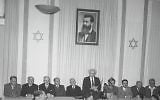 Why the Founders Matter
Even from a halachic perspective, one cannot simply dismiss these realities by asserting a nostalgic model of Jewish sovereignty.
Rabbi Naftali Zvi Yehuda Berlin of Volozhin, the Netziv, offers an important observation concerning the Torah’s commandment to appoint a king.[5]
Why, he asks, does the Torah phrase the commandment as: “When you say, ‘I shall set a king over myself'”?
His answer is that forms of government depend upon the will of the people. Political arrangements cannot simply be imposed irrespective of public consent because questions of governance concern the welfare and survival of society itself.
The implication is that political sovereignty ultimately rests with the people.
If the founders of the state established a democratic nation-state rather than a halachic monarchy or theocracy, that decision is itself constitutive of halachic reality. Whatever one’s preferred theoretical model may be, the State of Israel is a democratic nation-state because that is what was created.
That is the political fact. And according to the Netziv’s reasoning, it is also the halachic fact.
The Consequences of Confusion
The conflation of Jewish sovereignty and Israeli sovereignty is not merely an intellectual mistake. It has serious practical consequences.
My friend’s remark about denying Arabs the right to vote was not an isolated sentiment. It reflects a broader assumption: because Israel is a Jewish state, democratic principles become negotiable whenever they appear to conflict with Jewish sovereignty.
Nowhere are the muddy waters more evident when rabbis and religious Zionist lay people invoke the biblical status of Ger Toshav, “resident alien,” to showcase the tolerance that Judaism has toward non-Jews living in Israel. Non-Jews, we are told, are granted protection, dignity, and freedom to live among Jews.
This was probably light-years ahead of the morality of the second millennium BC but is entirely irrelevant in the modern nation-state which is the State of Israel. To bring home the condescending nature of applying Ger Toshav to Israel’s minorities today, it would be helpful to recall an analogous phenomenon, “People of the Book” (Ahl al-Kitab) which granted protected second-class citizen status to Christians and Jews in the medieval Muslim state. In a modern nation state, minorities are not “granted” rights by the majority, nor is the majority doing them a favor by tolerating their presence and protecting them. The minorities are not “aliens;” they are citizens, and it is the role and responsibility of the state to protect their rights. The state does not “grant” rights, it guarantees them.
Conclusion: A Positive Vision of the Jewishness of the State
The proper understanding of the nature of the State renders the halachic disputes around the Mitzva of conquering the Land and the building of the Holy Temple in Jerusalem irrelevant. The Jewish collective necessary to execute these commandments, as Rabbi Herzog pointed out, simply does not exist. The movements based upon mistaken assumptions about the nature of the State of Israel do not have a halachic leg to stand on. And the tensions between the perceived halacha and democratic principles evaporates.
When we divest ourselves of the fantasy of “Jewish sovereignty,” we will be free to embrace our remarkable country for what it truly is and to fully realize the vision of the Zionist founders: a modern nation-state grounded in the redemptive moral vision of the prophets and serving as the national home of the Jewish people.
Such a state would maintain an unbreakable bond with the Jewish diaspora, serve as a dynamic laboratory for the ongoing evolution of Jewish identity, and cultivate forms of Jewish culture, thought, and community to which Jews everywhere could feel connected and drawn. At the same time, it would guarantee democratic freedoms, equal citizenship, and equality before the law for all who inhabit the land.
[1] My primary resource is the three-volume collection of the writings of Rabbi Yitzchak Halevi Herzog, Constitution and Law in a Jewish State According to the Halacha, Mosad HaRav Kook and Yad HaRav Herzog, ed. Itamar Warhaftig, Jerusalem 1989.
[2] The entire text can be found by following this link – https://jewishvirtuallibrary.org/text-of-the-proposed-constitution-for-the-state-of-israel
[3] Constitution and Law Vol 1 p.19
חלות האיסורים כשאין ידינו תקיפה
א) המצוות הללו שהן מצוות ציבוריות, המוטלות לא על כל יחיד ויחיד אלא על הגוף השליט, על הממשלה היהודית באיזו צורה שתהא, שהכח בידה לקיימן, לא הוטלו לכתחילה אלא על העם היהודי הכובש את הארץ והמקבל את הסוברניות (Sovereignty) מעצמו, מבלי להתחשב עם הגוים. הרי זהו הרקע בתורה של אותן המצוות, ופשטות הענין מעידה על עצמה. אם כן איפוא בהעדרו של רקע זה, ובתנאי מציאות כזו שהמדינה ניתנת על מנת כך, אין חלות לאותן המצוות כמו שאין חלות לאותן המצוות בגולה, או אף בארץ ישראל כשאין ידינו תקיפה,
[4] Ibid p.20 מעין שותפות
ד) מכל האמור יש לנו להתבונן עוד. הלא יסוד המדינה מעצמו הוא מעין שותפות. הרי זה כאילו ע”י תיווך ידוע באו גוים, נניח אפילו עובדי אלילים, לידי הסכמה לתת לנו להקים ממשלה משותפת באופן שתהיה לנו עליונות ידועה וששם המדינה יקרא על שמנו. כלום היתה על מדינה זו תורת מלכות ישראל באותה המדה של מלכות ישראל כימי דוד ושלמה, של מלכות ישראל, במובן של המלכות שהיתה עומדת להיווסד בכניסת ישראל לארץ כנען, שהיא התמונה המרחפת בכל הרקע של תורת משה בקשר עם אותם המצוות? הרי זה ענין אחר. בעצם זוהי שותפות של עם ישראל ועם נכרי בתנאים כאלה, המבטיח לשותף הראשון מדה ידועה של עליונות.
[5] Deut. 17: 14