
Israel Is Not Washington’s Scapegoat
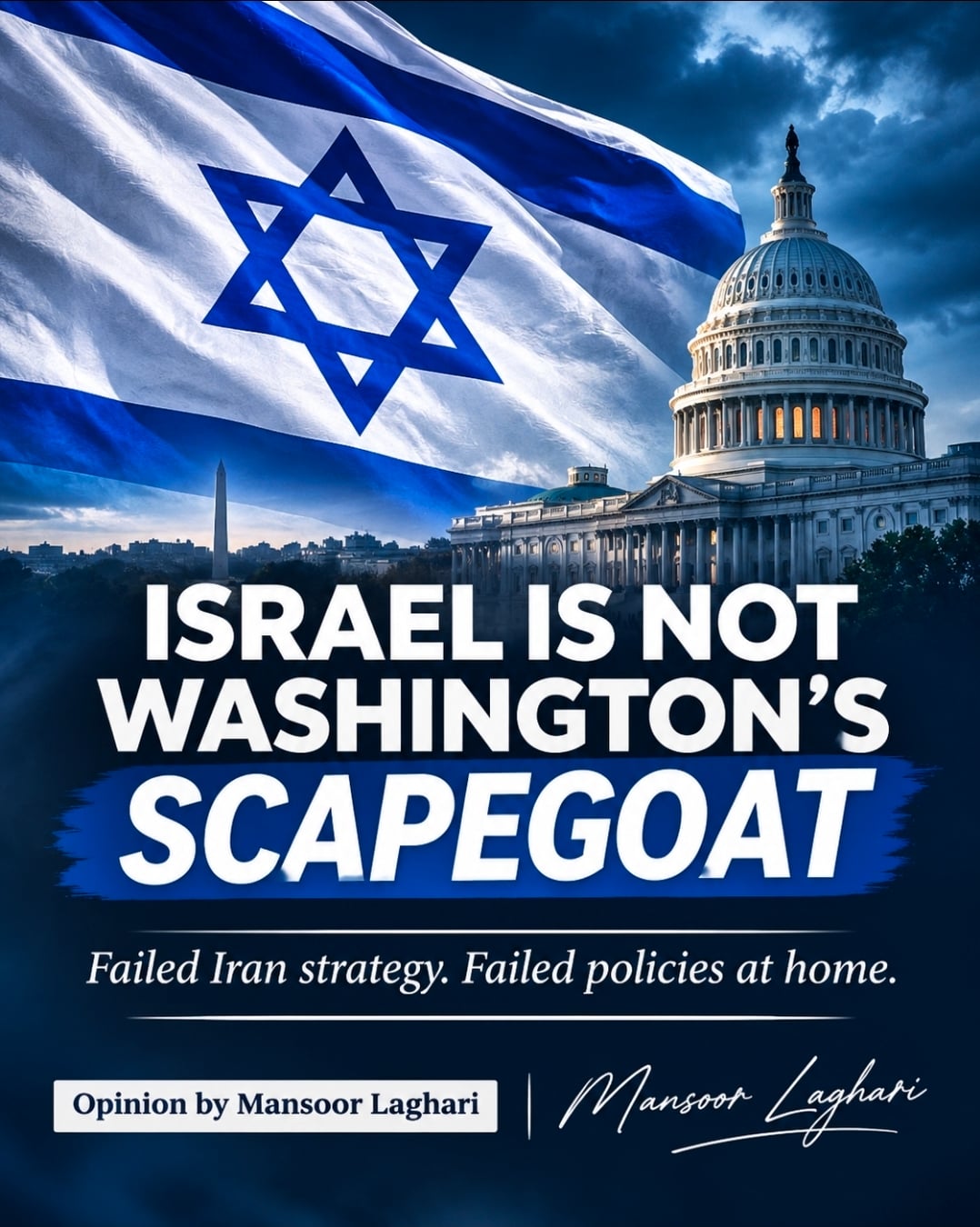
The Shameful Politics of JD Vance’s Midterm Blame Game
Trump’s Iran-war strategy and domestic failures handed political opportunities to anti-Israel socialists. Instead of confronting those mistakes, Washington is questioning its alliance with the Jewish state.
The Republican Party has suffered a devastating defeat in the 2026 midterm elections. Democrats have gained control of Congress, American voters have delivered a warning to the Trump administration, and the political landscape has shifted in ways that could have serious consequences for Israel.
But perhaps the most disturbing development is not the Republican defeat itself. It is the willingness of Vice President JD Vance to invoke America’s relationship with Israel while explaining why his party lost.
Let me make one thing absolutely clear.
Israel is not responsible for Washington’s economic failures. Israel is not responsible for the Trump administration’s immigration policies. And Israel must not become the scapegoat for an American government that failed to convert military operations against Iran into a lasting strategic settlement.
The United States is the most powerful country on Earth. Its president commands its armed forces, directs its foreign policy, and is accountable to American voters.
When decisions made in Washington produce disappointing results, American leaders must accept responsibility.
Blaming the Jewish state is not leadership. It is political cowardice.
Iran was a legitimate threat. Washington’s strategy deserves scrutiny.
The Islamic Republic of Iran is not an innocent victim of Middle Eastern instability. For decades, Tehran has financed and armed organizations responsible for terrorism, including Hamas and Hezbollah. Its leadership has repeatedly threatened Israel’s existence while intimidating its own population and undermining regional security.
Israel’s determination to defend itself against those threats is entirely legitimate.
No sovereign nation should be expected to accept permanent threats of destruction from an ideological adversary.
The United States also has compelling national-security interests in preventing Iran from acquiring nuclear weapons, protecting its allies, and ensuring freedom of navigation in the Persian Gulf.
But supporting those objectives does not mean endorsing every military decision made in their name.
The Trump administration joined Israel in launching military operations against Iran in February 2026. American and Israeli forces inflicted serious damage on Iranian military infrastructure.
Yet military destruction is not equivalent to strategic victory.
Months later, the conflict remains unresolved. A ceasefire has failed to produce a comprehensive peace agreement. Iran retains threatening military capabilities, negotiations remain stalled, and the economic consequences have reached American households.
These outcomes raise difficult questions.
Did Washington establish realistic political objectives before initiating the campaign? Was there a credible exit strategy? Did policymakers adequately anticipate the consequences for oil prices, regional stability, and American public opinion?
Those are questions for President Trump, Vice President Vance, and the officials responsible for American national-security decisions.
Israel should not be blamed because Washington failed to develop a convincing political endgame.
Israel confronted a hostile regime that has repeatedly threatened its citizens. The United States made its own sovereign decisions about how, when, and to what extent it would participate.
The distinction is fundamental.
JD Vance’s Israel argument is shameful
On November 4, Vance argued that the Iran war was a major reason Republicans lost the midterms. He also said some voters wanted Washington to change its relationship with Israel.
The first argument deserves serious consideration. The second requires far greater care.
American voters have every right to oppose a war, question its costs, and demand an accounting of the administration’s decisions.
But opposition to a particular military campaign is not necessarily opposition to Israel.
The vice president should know the difference.
Vance is not an outside critic of the Trump administration. He serves at its highest level.
If the war was strategically mishandled, he has a responsibility to explain the administration’s decisions. If its economic consequences were underestimated, those errors deserve acknowledgment.
And if the administration failed to communicate a coherent strategy to the American public, that failure belongs to Washington.
It is shameful to introduce Israel into the explanation for an electoral defeat without clearly separating American strategic mistakes from the legitimacy of the US–Israel alliance.
Such rhetoric risks reinforcing a deeply troubling political narrative: that America’s problems can be explained by its friendship with the Jewish state.
That is a dangerous oversimplification.
America does not support Israel merely as an act of charity. The relationship reflects overlapping security interests, technological cooperation, intelligence sharing, democratic traditions, and decades of strategic partnership.
Israel is a sovereign country with legitimate security interests. It is not an American political punching bag.
Americans voted over their economic frustrations
The midterm results reveal a much broader crisis of confidence in the Trump administration.
Americans were angry about inflation, grocery prices, housing costs, fuel expenses, and the general affordability of everyday life.
According to preliminary national exit polling, nearly nine in ten voters considered the cost of living a crucial or major factor in their decisions.
That is a far more substantial indicator of electoral dissatisfaction than any simplistic claim that the alliance with Israel caused Republican losses.
American families are concerned about paying their bills.
They are concerned about their children’s futures.
They are concerned about whether economic opportunities are improving or disappearing.
The Iran war contributed to those anxieties through its effects on energy markets and broader economic uncertainty. But tariffs, domestic economic decisions, and public perceptions of government performance were also important.
Immigration enforcement created additional political complications, particularly among communities concerned about the consequences of aggressive enforcement policies.
These were American policy debates shaped by American political decisions.
Israel did not establish America’s tariff structure. It did not determine the administration’s approach to inflation or immigration enforcement.
The American electorate judged the record of the American government.
That is how democracy works.
The DSA exploited the opening
There is another dimension to this election that supporters of Israel should examine carefully.
The Democratic Socialists of America gained important ground.
According to reporting in The Forward, at least five DSA members were projected to win seats in the House of Representatives, expanding the organization’s presence in Congress.
The DSA has adopted explicitly anti-Zionist positions, including a 2025 resolution opposing Zionism. Its national organization has also supported an arms embargo against Israel.
Those positions deserve to be understood for what they are: opposition not merely to particular Israeli government decisions, but to the political principle of Zionism itself.
For Jews who understand Zionism as the national self-determination movement of the Jewish people, that distinction is critically important.
DSA candidates also campaigned on affordability, healthcare, and economic inequality. Their victories cannot simply be attributed to anti-Israel sentiment, nor should every voter who supported them be assumed to share every position of the organization.
Nevertheless, the consequences for U.S.–Israel relations could be significant.
The administration’s unpopular decisions helped create a political environment in which candidates advocating major changes to American support for Israel gained influence.
Washington’s failures created an opening. The DSA took advantage of it. Israel may now face the political consequences.
That is the bitter irony of this election.
A military campaign launched in part to confront the Iranian threat has been followed by electoral gains for a political movement whose national organization opposes Zionism and seeks to restrict American military support for Israel.
The result should prompt strategic reflection, not finger-pointing.
Jewish self-determination is not negotiable
I write as an American Muslim, a United States Army veteran, a human rights activist, and an unapologetic Muslim Zionist.
I support Israel because I believe the Jewish people possess the same fundamental right to national self-determination that other peoples claim for themselves.
That conviction does not depend on which political party controls the White House.
It does not depend on whether Israel’s prime minister is popular or unpopular.
And it does not disappear because an American administration suffers an electoral defeat.
Jews are not strangers to the land of Israel. Their historical, religious, cultural, and national connections extend back thousands of years.
I have visited Israel. I have stood at the Western Wall, walked through places scarred by the October 7 atrocities, and witnessed the grief of communities whose lives were shattered by Hamas terrorism.
I have also experienced the extraordinary warmth of Israelis who welcomed me, a Muslim born in Pakistan, as a brother.
My convictions are not theoretical.
I know what it means to defend Jewish self-determination in environments where hatred of Israel has become a political and religious loyalty test.
I have been called a kafir, accused of betraying Islam, and threatened because I refuse to accept the idea that Muslims must hate Jews or oppose Israel.
I reject that demand completely.
I am Muslim. I am American. I am a Zionist. And I will not apologize for defending the Jewish people’s right to live securely in their ancestral homeland.
Supporting Israel does not require agreement with every Israeli government policy. Nor does opposing an Israeli government decision establish hostility toward Jews.
But a political movement’s opposition to Zionism deserves examination because it raises a deeper question about whether Jewish national self-determination is being treated differently from that of other peoples.
That question cannot be brushed aside.
Israel is an ally, not an electoral liability
American foreign policy should always be guided by a serious assessment of national interests.
But national interests cannot be reduced to the political frustrations of a single election cycle.
Israel remains a significant American partner in intelligence, defense technology, counterterrorism, cybersecurity, and regional security.
The two countries have important disagreements, as allies sometimes do. Their strategic interests are not identical.
Yet the relationship is much deeper than one president, one administration, or one military campaign.
Weakening that relationship because of anger over the Iran war would confuse criticism of military strategy with the value of a longstanding alliance.
There is no contradiction in demanding accountability for American war planning while supporting Israel’s security.
There is no contradiction in criticizing Prime Minister Benjamin Netanyahu while defending Israel’s right to exist.
And there is no contradiction in opposing the Iranian regime while questioning whether Washington chose the most effective strategy to confront it.
These are distinctions that serious policymakers must preserve.
The danger arises when electoral disappointment becomes an excuse to undermine an ally rather than examine the decisions that produced the disappointment.
Washington must own its mistakes
The 2026 midterms were a warning to the Trump administration.
Voters expressed dissatisfaction with economic conditions, the costs of war, and aspects of the government’s domestic record.
Those concerns deserve serious attention.
The administration should examine its Iran-war strategy, the economic consequences of the conflict, the effectiveness of its domestic policies, and the political divisions that emerged within its own coalition.
It should also recognize that anti-Israel political movements have gained opportunities to influence the next Congress.
But none of this establishes that Israel is responsible for the Republican Party’s defeat.
The administration chose its economic policies.
The administration chose its immigration policies.
The administration chose the extent of American participation in the Iran war.
And the American electorate judged those decisions.
The Jewish state should not be expected to carry the political burden of decisions made by the American government.
JD Vance may believe the Iran war cost Republicans the election. He is entitled to make that argument and present the evidence.
But invoking the U.S.–Israel relationship as part of an electoral blame narrative demands precision and responsibility.
The alliance should not become collateral damage in Washington’s internal political struggles.
America’s political leaders must answer for their own record.
The DSA’s gains should be assessed seriously. The Iranian regime’s continued threats should not be forgotten. And the strategic value of the U.S.–Israel relationship should not be casually dismissed because of one election.
Above all, Israel’s right to defend its citizens and the Jewish people’s right to self-determination must not become bargaining chips in an American political blame game.
Washington made the decisions. Washington must accept the consequences.
Israel is not America’s scapegoat. And Jewish self-determination is not the price of Republican defeat.