CEO of Time to Stand Up for Israel
Israel: Learning to Carry the Empty Chair
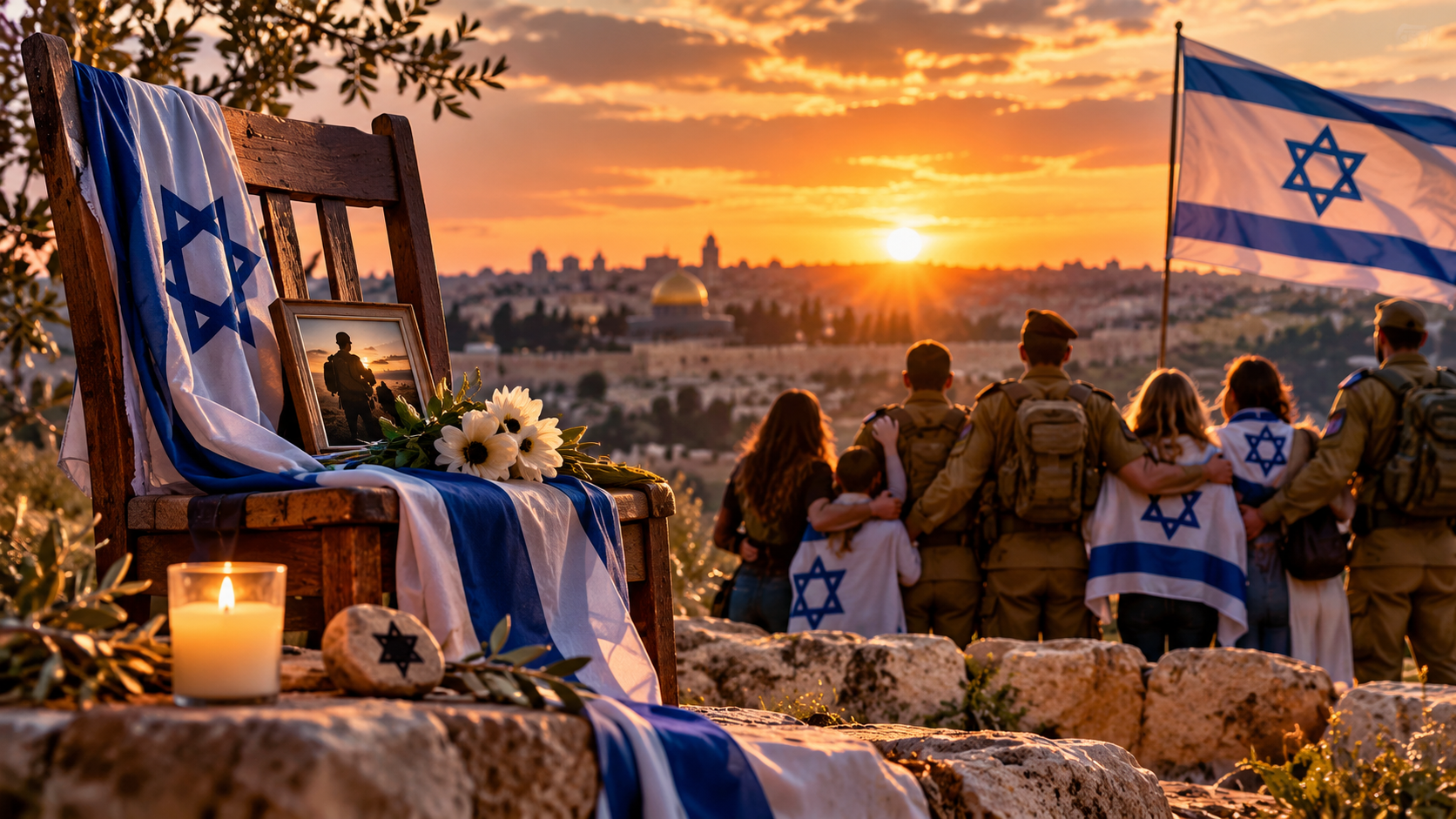
Photo Credits: Sabine Sterk ( AI)
There are many ways to describe loss, but I think one of the most painful is an empty chair. It is the chair at the family table that nobody sits in anymore. It is the place beside you in bed that remains untouched. It is the telephone number you still know by heart although you know nobody will answer. It is automatically wanting to tell someone something and then remembering that you cannot. Loss is not only about the moment somebody dies. It is about all the ordinary moments afterward in which that person should have been there. Israel has lived with those empty chairs throughout its history, but since October 7, 2023, there seem to be far too many of them. Behind every person murdered, every soldier who fell, every hostage who did not return alive, and every life lost during the years of war that followed, there is another circle of people learning to live with absence. Parents lost children. Children lost parents. People lost husbands, wives, partners, brothers, sisters, friends and colleagues. Entire communities were changed. Yet somehow, through a kind of strength I have always admired, Israel continues to choose life.
Perhaps that is one of the things outsiders misunderstand about Israelis. Israeli resilience does not mean Israelis do not suffer. It does not mean they simply shrug their shoulders and continue. Quite the opposite. Israel remembers intensely. People talk about those they have lost. They tell their stories. They carry photographs. They commemorate them. They cry for them. A country can celebrate a wedding and mourn a soldier on the same day. It can dance and still carry grief. That is not a contradiction. It is perhaps the essence of resilience. The Israeli mindset has never been about pretending that terrible things did not happen. It is about refusing to allow those terrible things to determine whether life itself is still worth living. There is something profoundly Jewish and profoundly Israeli in that determination. We remember, we mourn, and then somehow we plant another tree, build another home, start another company, welcome another child, celebrate another wedding and gather around another Shabbat table.
What has always touched me most about Israel is the sense of community that becomes especially visible when tragedy strikes. Israelis can argue endlessly with each other. Politics, religion, traffic, food, football, almost anything can become an argument. But when somebody needs help, those differences can suddenly become remarkably small. After October 7, ordinary people did extraordinary things. Families opened their homes. Volunteers transported supplies. Restaurants prepared meals. People collected clothing and equipment. Communities supported displaced families. Strangers drove across the country because someone they had never met needed something. People attended funerals of people they did not personally know because they did not want a family to stand alone. That is Israel too. Not simply the Israel presented through casualty figures, military briefings and political arguments, but the Israel of human beings who instinctively ask, “What can I do?”
For me, the memories of October 7 began before I understood what was coming. I wrote the following words because three years later, I still remember that strange feeling on the afternoon before the attack. Looking back, those hours feel almost like standing on the edge of a world that was about to disappear.
Carved Into My Heart
On the afternoon of October 6, 2023,
I felt something changing.
The hostile WhatsApp groups I followed
suddenly exploded with hatred.
Message after message.
Anger. Threats. Celebration of something
I could not yet see.
Something felt wrong.
When Shabbat entered,
I tried to reach someone in Israel.
No answer.
It was Shabbat.
And while Israel became quiet,
somewhere in the darkness
evil was preparing to break that silence.
The next morning, I woke up.
And the world I knew was no longer the same.
The images that reached me that morning
are carved into my heart forever.
Images I wish I had never seen.
Faces I will never forget.
Stories that still hurt three years later.
Today, my thoughts are with those
who lost their lives on October 7,
with the soldiers who fell protecting their country,
with the hostages who never came home,
and with everyone who was taken from this world
during the long years of war that followed.
But today, I think especially
of those who remained.
The mothers and fathers.
The husbands and wives.
The children.
The brothers and sisters.
The friends.
The people who somehow had to learn
how to wake up every morning
with an empty chair,
an unanswered phone,
a voice they can only hear in their memories,
and a place in their heart
that nobody else will ever fill.
To all of you,
I send my love, my energy, and my strength.
There are wounds that time cannot erase.
There are people we do not “move on” from.
We simply learn to carry them differently.
And perhaps, little by little,
you will become stronger.
Not because you have forgotten them.
But because you carry them with you.
In every memory.
In every story.
In every tear.
In every smile that eventually returns.
They lived.
They loved.
They mattered.
And they will not be forgotten.
May their memory forever be a blessing.
Am Yisrael Chai.
Three years later, I think those last words matter more than ever. “Am Yisrael Chai” is sometimes translated simply as “The people of Israel live,” but emotionally it says much more. It is not a denial of death. It is an answer to death. It says that after everything, we are still here. After terrorism, war, antisemitism, funerals, fear and unbearable personal loss, there will still be life. There will still be children running through Israeli streets. There will still be families gathering for Shabbat. There will still be music. There will still be innovation, arguments, laughter, love and people complaining about completely ordinary things. There will still be Israelis planning tomorrow. Sometimes simply making plans for tomorrow is an act of defiance.
This is why I become uncomfortable when Israeli strength is interpreted as an absence of pain. Behind the Israeli smile can be grief that outsiders never see. The soldier laughing with friends may be carrying memories he cannot explain. The mother returning to work may still cry when she enters an empty bedroom. The survivor celebrating a birthday may simultaneously be thinking about someone who should have been standing beside her. Strength does not replace grief. It grows around it. Eventually a person discovers that laughing again is not a betrayal of the dead. Falling in love again is not forgetting. Celebrating is not disrespectful. Living is not abandoning those who no longer can. Sometimes living fully is the greatest tribute we can give them.
That, to me, is the positive Israeli mindset at its most powerful. It is not naive optimism. Israelis know too much history for naive optimism. It is optimism with scars. It is the conscious decision that sorrow will have a place in our lives, but it will not be given ownership of them. Israel has buried far too many people, and every grave represents a universe of memories, relationships and unfinished plans. Yet the answer cannot be to stop living. The answer must be to live more consciously, to protect one another more fiercely, to value community more deeply and to understand that tomorrow is never guaranteed.
So on this anniversary, I do not only remember October 7. I remember October 8, and October 9, and every morning afterward when somebody who had lost almost everything somehow got out of bed. I remember the volunteers, the soldiers, the doctors, the families, the communities and the strangers who became family. I remember a country wounded but refusing to surrender its humanity. I think of all those empty chairs, and I hope that beside those chairs there will eventually be laughter again. Not because the people who once occupied them have been forgotten, but precisely because they have not.
Their names remain. Their stories remain. Their love remains. Their absence remains too. But Israel remains.
And after the tears, Israel will smile again. Not the smile of a nation that has forgotten, but the smile of a people who remember exactly who they lost and choose to carry them into the future.
May their memories forever be a blessing.
Am Yisrael Chai.
Related Topics