Leadership With Heart
Israel Must Act. G-d Determines the Outcome.
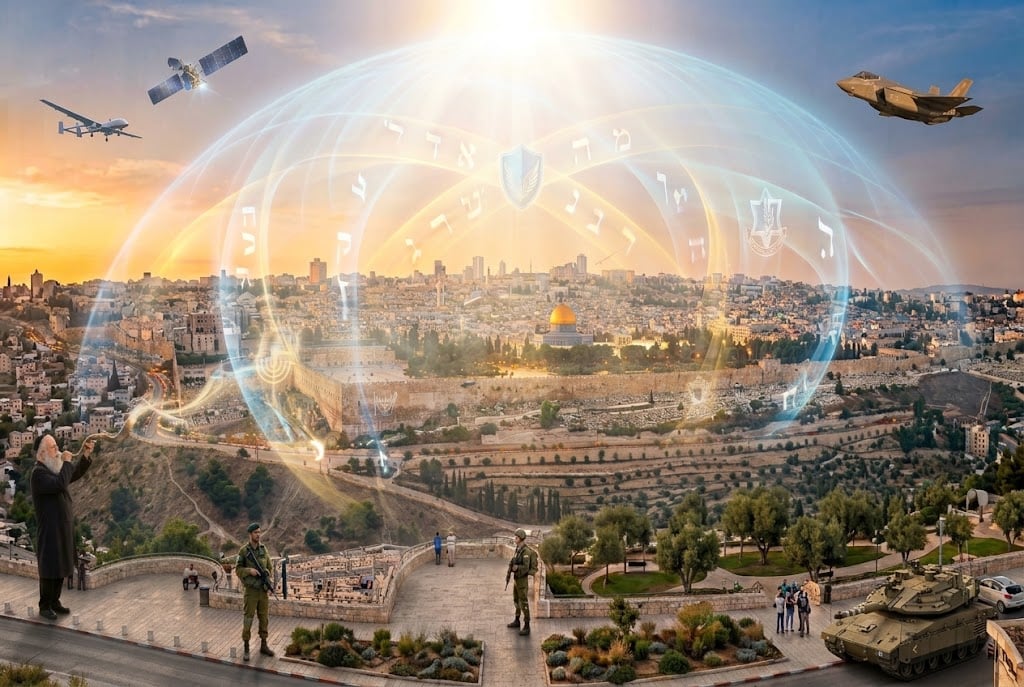
AI generated image
Even after all these years, Israel’s ability to meet danger with courage, intelligence, and resolve still inspire awe.
This week offered two striking examples. In Gaza, Israeli forces captured Mu’in al-Arabid, whom Israeli officials identify as a senior figure in Hamas’s internal-security apparatus—a man they say helped conceal hostages, protect senior Hamas operatives, and sustain the terrorist organization’s ability to operate. In southern Lebanon, the IDF reported that its forces had established operational control of the strategic Ali al-Taher Ridge, above and below ground, after clearing Hezbollah operatives from an underground network built over decades with Iranian support. The military says it is continuing to neutralize that infrastructure.jpost+1
These were not routine achievements. They required intelligence, meticulous planning, technological skill, courage, and the resolve of soldiers and commanders who shoulder responsibilities that few democracies place on their young people. They reflect a quality Israel has displayed repeatedly, often at unbearable cost: when danger closes in, Israelis adapt, invent, endure, and fight back.
But operational success is not strategic control.
Israel can capture terrorists, uncover tunnels, seize commanding terrain, disrupt weapons networks, and improve its intelligence picture. It cannot control the intentions of enemies committed to its destruction. It cannot foresee every danger, stop every attack, or know every consequence of every decision. No fence, weapon system, diplomatic assurance, intelligence estimate, or technological breakthrough can offer perfect security.
That is not an argument for fear. It is an argument for responsibility.
The most painful lesson of October 7 is not that Israel lacked talented people, sophisticated technology, or formidable military power. Israel had all of those things. The failure was, in part, a failure of judgment: a failure to keep testing long-held assumptions against a changing and dangerous reality. Warnings were discounted. Threats were minimized. Capabilities Israel possessed were not always translated into the alertness and readiness required when it mattered most.
A nation that lives in a dangerous neighborhood cannot allow past success to become a substitute for vigilance. It must test its assumptions, hear warnings that are inconvenient, and prepare not only for the threats it expects, but also for those it would rather believe are impossible.
This is difficult work. It is also holy work, because it is work undertaken to protect life.
Moses at the Jordan
This Rosh Hashanah, the tension between determined action and human limitation takes us back to Moses.
In Parashat Nitzavim, Moses tells the Jewish people that God’s commandment is neither remote nor impossible:
“It is not in heaven, that you should say: ‘Who shall go up for us to heaven, and bring it to us, that we may hear it and do it?’ Neither is it beyond the sea, that you should say: ‘Who shall go over the sea for us, and bring it to us, that we may hear it and do it?’ But the word is very near unto you, in your mouth, and in your heart, that you may do it. (Deuteronomy 30:12–14)
Moses speaks of return to God, covenantal renewal, and the choice of life. He does not tell the people that every task will be easy. He does not promise that faithfulness will spare them from hardship or uncertainty. He tells them something both more demanding and more hopeful: the next act of responsibility is not beyond their reach.
The Torah is not in Heaven. It is not beyond the sea. It is near—in our mouths, in our hearts, and in our hands.
Yet Moses himself stands at the Jordan River, looking toward the Land of Israel that he will not enter.
One can only imagine the ache of that moment. Moses confronted Pharaoh, led a frightened and often rebellious people through the wilderness, received the Torah at Sinai, pleaded for the people after their failures, and spent forty years carrying the burden of their survival and their future. He could see the Promised Land. He could prepare the people to enter it. But he could not cross the river with them.
He could teach. He could rebuke. He could bless. He could pray. He could prepare Joshua to lead.
But he could not dictate the final outcome of his life’s work.
The Jordan is not the “sea” Moses names in the verse. Still, it is a fitting counterpart: a visible boundary between what human beings can do and what God alone will decide.
Moses could fulfill his duty. He could not command the result.
That is not a contradiction. It is the point.
The Torah is near because responsibility is near. But the future is not ours to command.
The Work Within Reach
Rosh Hashanah asks each of us to look honestly at what we have done with the time, strength, opportunity, and responsibility entrusted to us.
The question is not whether we can solve every problem. We cannot.
The question is whether we are doing what we can with what God has placed within our reach.
For an individual, the work may be painfully close: an apology delayed too long; a relationship allowed to drift; a parent who needs more care; a neighbor who needs help; a charitable obligation we have avoided; a habit, grievance, or temptation that has begun to govern us more than we are willing to admit.
For a Jewish community, the work is no less immediate. It means strengthening synagogues, schools, and institutions. It means showing up for families shattered by terror and war, supporting those who are grieving, caring for the elderly and vulnerable, and ensuring that Jewish children inherit not only knowledge, but confidence, pride, and love for their people.
For Israel, responsibility means treating security not as a problem that can someday be declared solved, but as a permanent duty.
Israel must learn from failure. It must listen when warnings are inconvenient. It must challenge comfortable assumptions and make sure that Jewish lives are never left defenseless.
Israel should pursue every credible advantage: better intelligence, stronger borders, layered air and missile defense, resilient communications, effective counter-drone and cyber capabilities, and the technologies that will shape the next generation of defense. Artificial intelligence, autonomous systems, advanced sensors, cyber tools, and space-based capabilities will all matter in the years ahead.
But technology must never become an illusion of invulnerability.
Innovation can extend Israel’s reach. It cannot replace sound judgment. A smart sensor cannot substitute for an alert sentry. An algorithm cannot replace moral and military leadership. A sophisticated intelligence system cannot absolve leaders of the obligation to ask hard questions when something does not add up.
Israel should value its allies and pursue diplomacy where diplomacy can advance security and peace. But the Jewish state must retain the independent ability to defend its people.
That is not militarism. It is the hard lesson of Jewish history.
For too many centuries, Jews depended on the goodwill of rulers, neighbors, and nations that promised protection but failed when protection mattered most. Israel exists so that Jewish life will never again depend entirely on someone else’s willingness to defend it.
Jewish power, however, must never become an end in itself. Its purpose is to protect life, safeguard Jewish freedom, deter those who would destroy us, and enable Israel to bring its creativity, knowledge, and compassion to a wounded world.
Strength without conscience can become cruelty. Conscience without strength can become helplessness. Israel needs both.
When Silence Is Not an Option
Moses tells us that the Torah is near “in your mouth.”
Today, that means speaking when silence is easier.
Israel’s struggle is fought not only along its borders. It is fought wherever Jewish history is erased, Jewish peoplehood is denied, or Israel alone is held to a standard that no other democracy is expected to meet. It is fought on campuses, in newsrooms, in legislatures, in international bodies, and online.
No Israeli government is above criticism. Israel is a democracy, and debate, dissent, and accountability are not weaknesses. They are signs of a living society.
But criticism of an Israeli policy is not the same thing as denying the Jewish people the right to national self-determination. One belongs within democratic argument. The other denies Jews a right broadly accepted for other peoples.
Jews should not be asked to prove our humanity before we are permitted to defend ourselves. Israel should not be required to accept the murder of its citizens, the taking of its hostages, or rockets launched at its towns as the price of international approval.
Silence does not correct falsehood. It leaves falsehood standing.
We should answer lies with facts, intimidation with dignity, and hatred with moral clarity. We should reject antisemitism and the dehumanization of any people. Yet we should also say plainly that Jewish and Israeli lives matter; that the Jewish people have an enduring, indigenous, historical, religious, and national connection to the Land of Israel; and that Israel has both the right and the obligation to defend its citizens.
The Torah is also near “in your heart.”
That is where Jewish unity begins.
We are not a people without disagreement. We disagree intensely about religion, politics, identity, culture, military service, the courts, the peace process, settlements, Diaspora relations, and Israel’s future. Those disagreements are real, and they will remain.
But disagreement cannot become contempt. Debate cannot become abandonment.
Unity does not require uniformity. It requires mutual responsibility.
It means embracing former hostages and their families, honoring those murdered in captivity, and remaining present for all families still carrying the trauma of October 7 and its aftermath. It means supporting Israel’s soldiers and their families while also praying that Israeli power is used wisely and honorably. It means helping victims of terror rebuild their lives. It means protecting vulnerable Jewish communities in America, Europe, and elsewhere. It means refusing to let a Jewish child feel ashamed to wear a kippah, a Magen David, or an Israeli flag.
It also means caring for the sick, the bereaved, the elderly, and the isolated. It means strengthening the institutions that sustain Jewish life. It means tikkun olam not as a slogan, but as the practical obligation to bring healing where healing is possible.
A people that remembers its own vulnerability should be especially determined to relieve the vulnerability of others.
The Limits We Do Not Set
Moses could not cross the Jordan. But he did not stop leading.
He prepared Joshua. He strengthened the people. He made sure that the next generation was ready.
That is our task.
We may not control every threat. We may not reach every horizon. We may not live to see every part of the Jewish mission fulfilled. There are battles we will not finish, prayers whose answers we will not witness, and fears we cannot entirely quiet.
But we can act.
We can protect life. We can strengthen Israel. We can care for one another. We can speak the truth. We can support Jewish families, Jewish institutions, Jewish learning, Jewish security, and Jewish continuity. We can leave the Jewish people safer, stronger, wiser, and more united than we found them.
Rosh Hashanah teaches neither that we control the year ahead nor that our choices are meaningless.
We do not control fate. We do not command history. We do not know what the coming year will bring—to Israel, to the Jewish people, to our families, or to ourselves.
But teshuvah, tefillah, and tzedakah matter. They matter because they call us back from complacency and self-absorption. They call us to repair what we have broken, pray with humility, give with generosity, and carry responsibility with courage.
The year ahead remains in God’s hands. The duty before us does not.
So this Rosh Hashanah, we pray—not as an alternative to action, but as its necessary companion.
We pray for Israel’s strength, security, and moral clarity; for the safety of its soldiers and citizens; for healing for the wounded; for comfort for the bereaved; and for recovery, renewal, and enduring support for all those scarred by captivity, terror, war, and loss.
We pray for Jews throughout the Diaspora: for communities facing hostility on campuses, in workplaces, in schools, and in the public square. We pray that Jews may live openly and proudly, without fear or isolation.
And we pray that the ancient lies, collective scapegoating, and false accusations used to demonize Israel and the Jewish people will be exposed and rejected. May they be replaced by truth, moral clarity, and recognition of the Jewish people’s humanity, history, and rights.
May “Never Again” remain more than a memorial to the past.
Never again defenseless.
Never again silent in the face of hatred, lies, or threats to Jewish life.
Never again willing to leave Jewish communities unprotected.
The Torah is not in Heaven. It is not beyond the sea.
The next act of responsibility is near.
We are accountable for our actions. God determines what lies beyond them.
Shanah tovah u’metukah. Am Yisrael Chai.
Related Topics
Related Posts