
Leadership With Heart
Israel Must Win the Information War
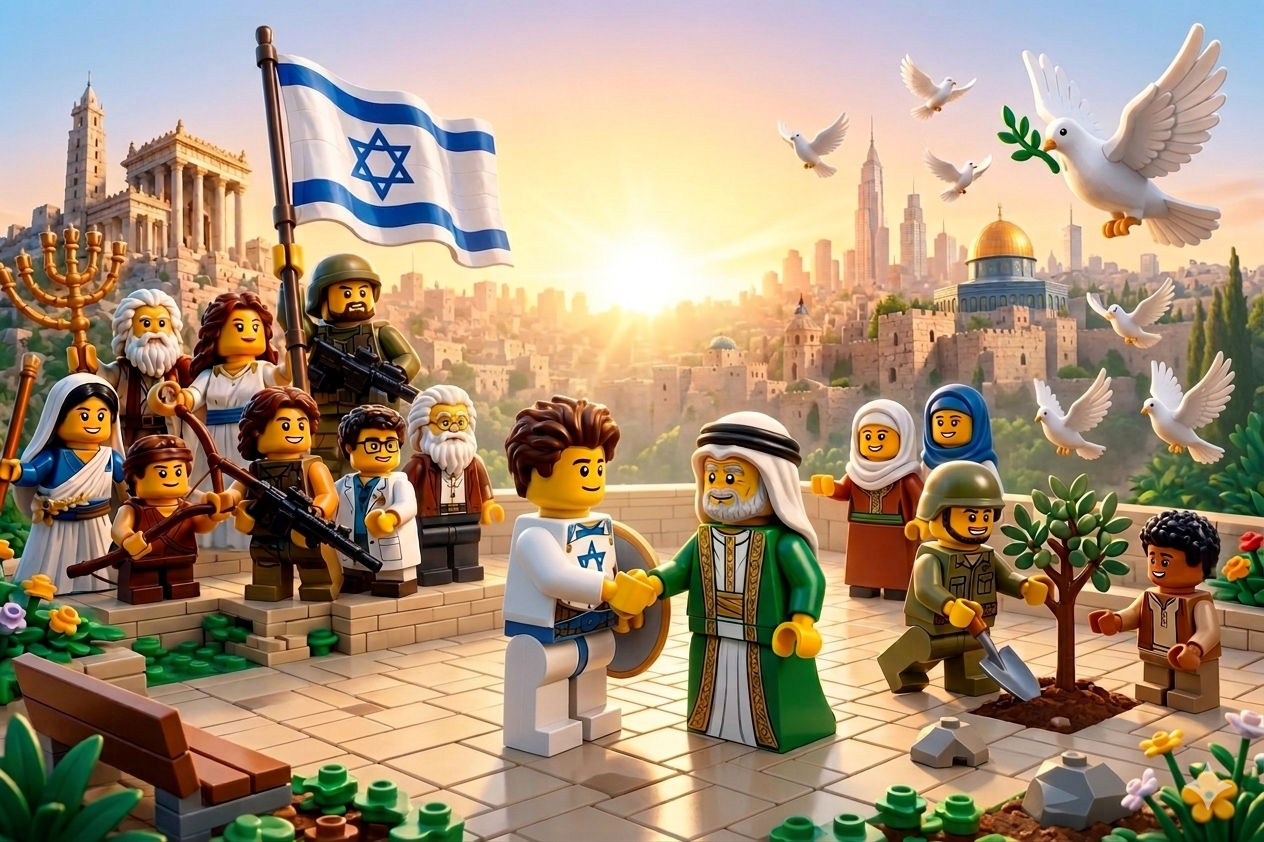
AI generated image
For more than three thousand years, the Jewish people have maintained an unbroken connection to the Land of Israel. Long before the emergence of the modern international system, Jewish life was rooted in Jerusalem, Hebron, Safed, Tiberias, and across the biblical heartland. Empires rose and fell, exiles came and went, yet Jewish identity remained anchored to the same land through memory, law, prayer, language, and continuous historical presence.
The modern State of Israel is therefore not a colonial anomaly or artificial construct. It is the restoration of an indigenous people to its ancestral homeland after centuries of dispersion, persecution, and statelessness. Its legitimacy rests both on historical continuity and on widely recognized principles of international law.
Yet in today’s global discourse, these foundational facts are increasingly obscured.
The Inversion of Moral Language
One of the most consequential developments in the information space is the inversion of moral terminology. Armed groups committed to Israel’s destruction are frequently reframed as “resistance movements,” while Israel’s defensive actions are portrayed as aggression.
In a striking inversion of truth, Iran and aligned terrorist proxies across the region have become highly effective in modern narrative warfare. They often present themselves as victims while portraying Israel — a country roughly the size of New Jersey — as a disproportionately powerful aggressor. This framing omits a fundamental geopolitical reality: Israel is the world’s only Jewish state, situated in a region far larger in both landmass and population, where multiple influential actors continue to openly reject its legitimacy.
Through sustained repetition, emotionally charged messaging, and increasingly sophisticated digital amplification, this narrative has gained traction in global discourse, particularly among audiences with limited exposure to the region’s historical and strategic context. The result is a systematic reframing of Jewish self-determination as colonialism, and of defensive security measures as moral wrongdoing.
The Ideological Nature of the Conflict
While often described in territorial terms, the conflict Israel faces has a deeper ideological core: whether a Jewish state has any legitimate right to exist in the region at all.
The experiences of hostages held by Hamas following the October 7 attacks underscore this reality. In his memoir Hostage, Eli Sharabi describes nearly 500 days in captivity, during which he endured not only physical deprivation but sustained ideological messaging asserting that Jews have no legitimate claim to any part of the land.
This reflects the documented ideology of Hamas, which explicitly rejects Israel’s right to exist, and is reinforced by broader networks that promote rejectionist narratives.
Israel has repeatedly demonstrated willingness to pursue negotiated peace and territorial compromise. However, major Palestinian leadership factions have, at various points, declined agreements premised on mutual recognition of two states for two peoples. Extremist organizations such as Hamas explicitly reject this framework altogether.
No durable peace can exist where the legitimacy of one party is denied in principle.
From Conventional Conflict to Information Warfare
Israel is now engaged in a dual battlefield: one physical, and one informational.
Alongside conventional security threats, there is a rapidly evolving digital front in which state and non-state actors use artificial intelligence, meme culture, and short-form viral content to shape global perceptions. Recent reporting has highlighted how Iranian-linked influence networks have experimented with AI-generated, pop-culture-style content — including simplified animated formats — designed to spread rapidly across social media platforms and influence younger audiences.
These campaigns are not incidental online phenomena. They are part of a broader strategic effort to influence perception by transforming complex geopolitical realities into emotionally accessible narratives that often bypass context and fact.
In such an environment, speed and emotional resonance frequently outweigh accuracy.
The Cost of Narrative Absence
For decades, many assumed that Israel’s legitimacy would be self-evident. After the Holocaust, repeated wars of survival, and sustained terrorism, it seemed unlikely that the existence of a Jewish state would again become a central subject of global contestation.
That assumption has proven incorrect.
In today’s fragmented media ecosystem, absence of clear narrative creates space for distortion. Where Israel’s story is not clearly articulated, it is often told by others — partially, selectively, or inaccurately. Over time, repetition of simplified narratives replaces historical and legal context with emotional shorthand.
This creates a strategic vulnerability: legitimacy that is not actively communicated is too often assumed to be open for debate.
At a certain point, however, Israel’s existence cannot be treated as an open question. It is a historical fact, a legal reality, and a national expression of an indigenous people in their ancestral homeland. While some actors continue to reject this, Israel itself does not exist on provisional terms.
The strategic implication is clear: the debate over whether Israel has a right to exist is not where Israel’s public discourse should remain anchored.
A Smarter, Clearer Hasbara
Israel’s public diplomacy must evolve from reactive messaging to coordinated, long-term strategic communication.
Effective hasbara is not about slogans or defensiveness. It is about clarity, consistency, and accessibility grounded in fact.
Several core truths must be communicated without ambiguity:
- The Jewish people are indigenous to the Land of Israel.
- Israel is the world’s only Jewish state, in a region of more than 50 Muslim-majority countries.
- Israel is a democratic state facing sustained security threats from organizations committed to its destruction.
- Groups such as Hamas and Hezbollah explicitly reject Israel’s existence, target civilians, and deny the Jewish historical connection to the land.
- Israel remains committed to peace through strength and will not yield to terrorism.
- Lasting peace requires rejecting ideologies that glorify violence in favor of coexistence and mutual acceptance.
At the same time, Israel must move beyond a purely reactive posture in global discourse. Continuously responding to accusations is not sufficient in an environment where narratives are formed rapidly, emotionally, and often before facts are even considered.
A more effective approach is proactive: consistently shaping understanding before distortion takes hold. That means articulating not only Israel’s legitimacy, but also its values, its security realities, and its consistent preference for peace and coexistence.
If adversarial actors are using AI-generated content, viral formats, and emotionally compelling media to shape perceptions, democratic societies must respond with equal sophistication — but anchored in truth.
This requires sustained investment in modern storytelling: digital media, educational content, documentary formats, and culturally resonant narratives capable of reaching global audiences where they actually consume information.
Israel’s story must be told not only accurately, but compellingly: as the story of an ancient people returning home, building a modern democracy, and defending itself against actors openly committed to its eradication.
Reclaiming Moral Clarity
A functioning international discourse depends on the ability to distinguish between those who seek coexistence and those who reject it.
Despite constant external pressure, Israel remains a society committed to democracy, innovation, pluralism, and the sanctity of life. It contributes disproportionately to global advancements in medicine, technology, agriculture, and humanitarian aid, guided in part by the enduring principle of tikkun olam — the responsibility to repair and improve the world.
Yet the conflict persists because recognition remains incomplete. Peace requires not only agreements on borders, but acceptance of legitimacy.
Historical context remains essential. Since the Khartoum Resolution — which articulated the “Three No’s” of no peace, no recognition, and no negotiations with Israel — the region has seen both diplomatic breakthroughs and persistent rejectionism. While normalization agreements in recent years demonstrate that change is possible, rejectionist ideologies continue to deny the permanence of Jewish sovereignty.
This tension remains one of the central obstacles to lasting peace.
Conclusion: Truth as Strategy
Israel does not seek perpetual conflict. Its citizens consistently aspire to security, stability, and peace.
But peace cannot be built on denial — of history, identity, or mutual legitimacy.
The struggle Israel faces today is not only military or diplomatic. It is narrative and civilizational. It is about whether truth can survive in an age of algorithmic distortion, ideological polarization, and rapidly evolving information warfare.
Reclaiming that truth requires more than defense. It requires clarity, confidence, and a sustained commitment to telling Israel’s story accurately, accessibly, and unapologetically to the world.
Related Topics
Related Posts