
Israel Needs a State, Not Another Savior
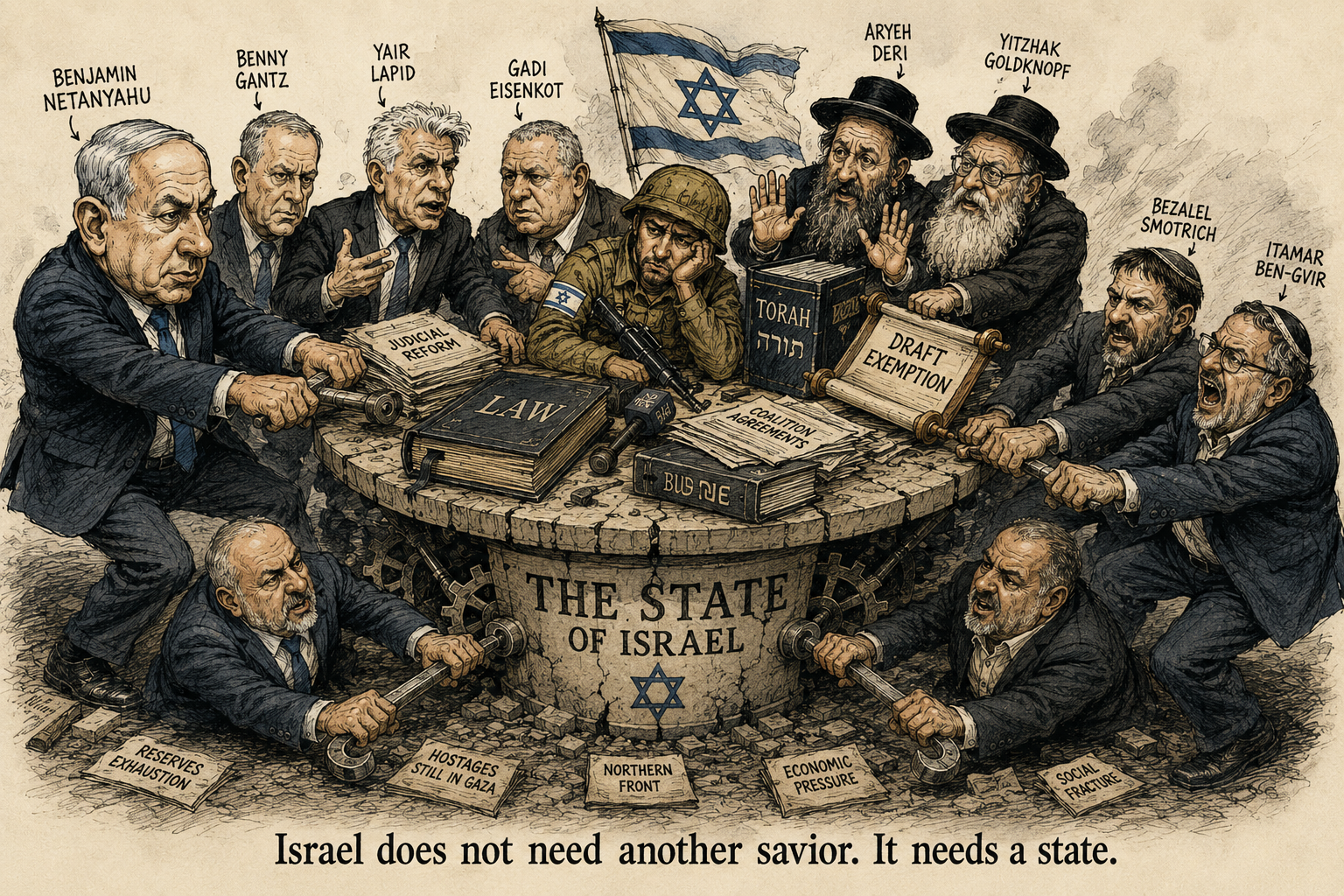
Netanyahu’s triangle of failure is now impossible to ignore. October 7 destroyed his security myth. Iran exposed the limits of his strategic sovereignty. The unfinished corruption trial corrodes his moral authority.
For decades, his central promise was simple and brutal: only I can keep Israel safe. That promise was the foundation of his power. October 7 shattered it. Israel survived, but the man who built his entire brand on security failed at the one thing for which he demanded absolute trust. This is not a detail. It is the collapse of the core contract between Netanyahu and the Israeli public.
The demand for a state commission of inquiry is therefore not procedural. It is the first test of whether Israel can still tell itself the truth. Without it, national grief becomes evasion: candles, ceremonies, “never again,” and no accountability. A government that says “now is not the time” is declaring that wartime grants it immunity from self-examination.
Iran delivered the second blow. Netanyahu positioned himself as the master strategist who alone could handle Tehran and Washington. Israel showed military reach and capability, yet the endgame was decided in Washington. The message was clear: Israel can strike, but the political conclusion is written elsewhere. For a leader whose image rested on exceptional control, this was strategic humiliation disguised as partnership.
The third side is ethical corrosion. A prime minister asking for unlimited trust in matters of life and death is simultaneously fighting the courts, prosecutors, and legal institutions investigating him. This creates an impossible split: the guardian of the state and the defendant against the state. No healthy democracy can long survive when its leader’s personal survival requires delegitimizing the institutions that sustain public trust.
This is bigger than one man. Netanyahu’s genius was turning every fracture — ethnic, religious, geographic, legal — into a political lever. He managed Israel instead of building it. But fractures eventually reach the army, the reserves, the borders, the budget, and the families burying their children. October 7 was the result.
A state is not a permanent emergency machine. It is not a television studio with borders, not a coalition bargain protected by soldiers, not a heroic biography projected onto national life. A state is the slow, difficult architecture that makes power answerable: institutions, duties, limits, budgets, inquiry, law, and a public capable of hearing bad news without immediately converting it into betrayal.
This is what Netanyahu’s long rule hollowed out. He did not abolish the state. He displaced it. He replaced institutional trust with personal indispensability, strategy with tactical survival, public responsibility with tribal mobilization. The tragedy is that this worked politically for years. The catastrophe is that reality eventually tests what propaganda only postpones.
That is why removing Netanyahu is not enough. His opponents must form something rarer: a state-bearing coalition. Not just an anti-Bibi bloc, but a government that restores the basic grammar of statehood: inquiry, accountability, equal burden, law, strategy, and seriousness.
Gadi Eisenkot represents this possibility. A military insider with personal loss, hawkish credentials, and Mizrahi roots, his critique is not against strength, but against strength without strategy and institutions. Israel does not lack force. It lacks a state capable of directing it.
This is also why the next Israeli majority cannot be built only from exhaustion. Exhaustion removes governments; it does not found states. A serious alternative must speak to security without paranoia, Jewish continuity without clerical exemption, sovereignty without messianic intoxication, and democracy without the childish illusion that courts, soldiers, teachers, prosecutors, and civil servants are obstacles to the nation rather than its living skeleton.
The Haredi draft crisis reveals the same sickness. A state at war cannot demand repeated sacrifice from some while granting permanent exemption to others. Torah cannot become a bureaucratic shield from sovereignty.
Ben-Gvir and Smotrich are not side effects. They are logical outcomes of a system that rewards rage and ideological capture over governance. Netanyahu arbitrated between them only to stay in power. That is not leadership. It is hostage politics.
The 2026 election is therefore not merely left versus right. It is a referendum on whether Israel can still produce a majority willing to carry the state rather than merely consume it.
Netanyahu remains a formidable survivor. But he has one argument he cannot erase: under his watch, Israel became less governable and, on the day it mattered most, catastrophically unsafe.
Power can keep a coalition alive. Only statehood can keep a people alive. Israel does not need another savior. It needs a state.
Yochanan Schimmelpfennig