


Israel needs America
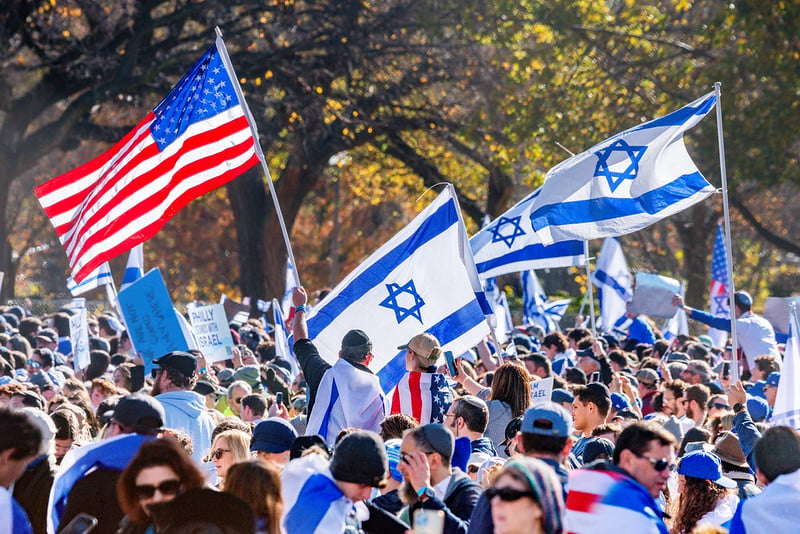
Israel’s popularity is at its lowest it has ever been in the United States. According to public opinion data from Pew Research Center and Gallup, roughly 60% of Americans now hold an unfavorable view of Israel. Among young Americans, the gap is even more striking. A staggering 80% of Democrats aged 18-49 have an unfavorable view of Israel, while57% of Republicans of the same age group also hold an unfavorable view of Israel.
As Israel’s image among Americans continues to erode, it will eventually have consequences on Washington’s policy towards Israel. Yet there seem to be little urgency among Israeli leaders. Some appear to believe that Israel can replace what the alliance with America offers by simply increasing defense spending.
Israel is undoubtably a powerful country. It has sophisticated armed forces, a strong military-industrial base and advanced intelligence capabilities. It has demonstrated that it can conduct complex military operations successfully.
But as impressive as those capabilities are, Israel still benefits enormously from American intelligence, access to some of the most advanced weapon systems, diplomatic protection and joint development projects in all fields from defense to civilian sectors. Those cannot be replaced by a mere defense budget increase.
Antisemitism is certainly a factor in Israel’s decline in popularity but not all of the decline can be attributed to it. It goes deeper than that. Some responsibility lies directly to Prime Minister Netanyahu’s policies.
Him turning this alliance into a partisan political issue might be proven to be one of his and Israel’s biggest strategic mistakes. His open alignment with President Trump and MAGA movement, as well as him criticizing President Obama’s Iran nuclear deal in Congress when it was already a done deal, alienated many Democrats and Independents.
His unwillingness to control his far right coalition partners combined with his refusal to sufficiently tackle settler violence in Judea and Samaria, has played a huge role in Israel’s negative perception among many Americans.
Yet the relationship with the United States is far too important to be given up that easily. Washington provides military financing, access to advanced American weapons systems, missile-defense cooperation, intelligence and, critically, diplomatic weight. The current ten-year U.S. memorandum provides $38 billions in military aid, running from 2019 to 2028.
Diplomatically the alliance is as valuable. The United States are a permanent member of the UN Security Council and possesses veto power. Americans have historically provided Israel with important diplomatic protection. In November 2024 and June 2025, for example, the United States vetoed Security Council resolutions concerning the Gaza war that had received support from other Council members.
Israel should work around the clock to change the course of this partnership. This is a strategic imperative.
The bipartisan foundation matters.
For decades, one of the most valuable features of U.S.-Israeli relations was its ability to survive different administrations. That bipartisan foundation is especially important because Israel cannot depend on which party controls the White House or the Congress in a particular election cycle. A relationship that depends extensively in one president, one party or one coalition is inherently vulnerable.
The Israel’s objective should be to build a relationship that is broad enough so neither side views partnership with Israel as inconsistent with American values or American interests.
That requires recognizing that American support is not generated only from the White House. It depends from Pentagon, Congress, American businesses, universities, Jewish and non-Jewish communities, and above all American voters.
Israeli leaders should therefore work closely with congress, governors from different parties or states and most importantly, increase their engagement with the American public. They should distance themselves from extremists like Ben Gvir or Smotrich and make clear that settler violence is not acceptable.
Israel should distinguish disagreement from confrontation
The United States and Israel will inevitably disagree. They will disagree on settlements, military operations, Palestinian policy, Iran and appropriate use of American weapons. Such disagreements are normal between sovereign allies.
The strategic question is how to manage these differences.
Israel can maintain its right to make sovereign decisions while simultaneously recognizing that Washington has its own interests, legal constrains and domestic political pressures. This means more consultations before major decisions that could create substantial diplomatic and political costs to America.
It also means treating American concerns as something to negotiate and not something to dismiss. An ally does not have to surrender its sovereignty to take another’s ally’s interests seriously.
Military independence is valuable but not the same as strategic independence
Israel should continue to invest heavily in its defense and should seek to reduce its dependance on American aid where possible. A greater self-reliance means reduced vulnerability, but there is a danger in assuming that replacing American financial support with greater domestic spending will reproduce everything the partnership with America provides.
Weapons are only one component of military power. Access to American technology, supply chain, intelligence, joint operations and logistic capacity can not be replaced by simply increasing defense budget.
The objective should be to increase independent defense capacities while simultaneously preserving the relationship with America that enhances Israel’s existing capabilities. Both should go hand to hand.
Diplomacy is also a form of national security
Traditionally, deterrence has been at the center of Israel’s national security. And that should continue to be the case. In an anarchic international system, States need hard power to defend themselves. But diplomacy can also function as a national security asset and Israel should not overlook the importance of American diplomatic support.
The U.S. veto has blocked hostile resolutions at UN Security Council and U.S. mediation helped broker Abraham Accords in 2020. Before that United States facilitated helped in Israel’s normalization with Egypt and Washington remains crucial in Israel’s effort to normalize with Saudi Arabia. One of Saudi Arabia’s demands for normalization with Israel are the U.S. security guarantees. Without it, establishing reciprocal formal recognition will be very difficult.
A worsening U.S.-Israeli relationship could reduce Washington’s willingness to shield Israel at the United Nations Security Council. That could expose Israel to international sanctions and other forms of economic pressure.
Such measures could affect trade, investments, banking system, access to international market. Giving Israel’s deep integration into the global economy that sustain economic pressure could severely disrupt its economy and reduce its prosperity.
Israel would survive even a severe deterioration of relationships with Washington and Europe. It possesses a formidable military, highly developed economy and advanced technology. But the question is not whether Israel can survive without American support. It most certainly could.
The real question is what kind of strategic environment will Israel operate in.
It will operate in an environment where Israel faces greater diplomatic isolation and loses access to certain technologies and logistical capabilities which will affect its freedom of action in the Middle East.
That is why Israeli leaders should not take diplomacy lightly and the crucial role America plays in it.
Israel does not have to chose between independence and partnership with America. It needs both. Independence does not mean isolation. Israeli military power gives room to act, the alliance with United States gives room for maneuver.
So the objective should be for Israel to be strong enough to stand strong on its own while also recognizing the strategic value of having Washington on its side.