
CEO of Time to Stand Up for Israel
Israel Needs Unity More Than Ever
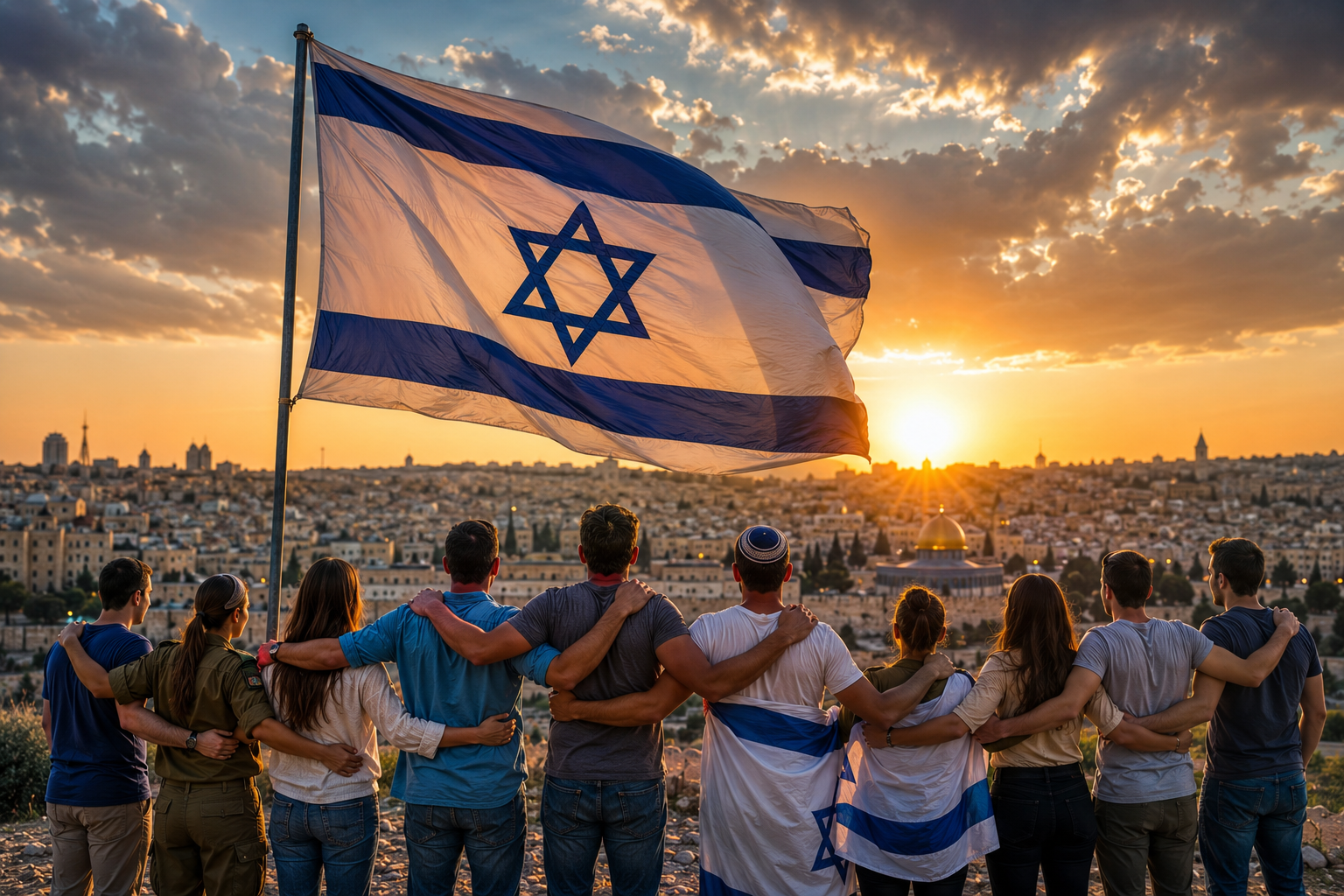
Photo Credits: Sabine Sterk (AI)
I have loved Israel for as long as I can remember. Not because I believe it is a perfect country, but because it is an extraordinary one. One of the qualities I admire most is that Israel remains a vibrant democracy in one of the most unstable regions in the world. It is a nation where people debate passionately, where governments can be challenged, where citizens can protest, and where every vote matters.
As the founder of the Dutch foundation Time To Stand Up For Israel, I have always made a conscious decision to stay away from Israel’s internal politics. I live in the Netherlands. I cannot vote in Israeli elections, and I do not believe it is my place to tell Israelis which political party they should support. My role has always been to support Israel as a nation, to defend its legitimacy, to counter misinformation, and to stand against antisemitism. Governments come and go. Israel remains.
Yet watching from the sidelines has become increasingly difficult.
Over the past several years, I have become deeply concerned by the growing divisions within Israeli society. Political disagreements are entirely normal in any democracy. They are even healthy. But what I have witnessed in Israel often goes far beyond disagreement. Endless demonstrations, growing hostility between political camps, public attacks on institutions, and an atmosphere in which fellow Israelis increasingly view each other as enemies rather than partners have created an image of a nation struggling with itself.
That worries me far more than any election result ever could.
Some recent events have only reinforced that concern. National Security Minister Itamar Ben Gvir understandably expressed anger over activists involved in flotillas attempting to challenge Israel. Many Israelis shared that frustration. However, some public actions surrounding those events created unnecessary international controversy and risked distracting from Israel’s legitimate security concerns. When political symbolism overshadows strategic communication, Israel often pays the price internationally.
Another worrying development has been the growing public friction between Israel’s political leadership and the military establishment. Defense Minister Israel Katz’s announcement that he intended to replace Major General Avi Bluth because of disagreements over policy in Judea and Samaria has highlighted tensions that are now visible to the entire world. Whether one agrees or disagrees with either side is almost secondary. The public perception of conflict between elected leaders and senior military commanders sends an unfortunate message at a time when Israel needs confidence and stability.
Prime Minister Benjamin Netanyahu remains another source of deep division. Like him or dislike him, one fact cannot be ignored. He won the previous election according to the democratic rules of the State of Israel. Respecting democratic outcomes is essential for every democracy to survive. At the same time, public debate should focus on elected leaders themselves and their policies, not on unelected family members or personalities surrounding them. Democracies function best when criticism remains focused on governance rather than becoming personal.
What concerns me most is not whether one political bloc wins or loses. It is the growing impression that Israel is drifting toward internal confrontation. That is something the country simply cannot afford.
On October 27, 2026, Israelis will once again go to the polls to elect all 120 members of the twenty sixth Knesset. Every citizen will vote for a political party rather than an individual candidate. Seats will then be distributed proportionally among parties that pass the electoral threshold of 3.25 percent. Any party failing to reach that threshold will receive no seats, making every vote especially significant.
Forming the next government will require a coalition controlling at least 61 seats. While that number appears straightforward, Israeli politics rarely is. Current expectations suggest that perhaps ten or more parties could enter the Knesset, making coalition negotiations every bit as important as the election itself.
The campaign will inevitably revolve around Benjamin Netanyahu, but this election is about far more than one individual. Israelis will be deciding how their country should move forward after the trauma of October 7, the wars that followed, the continuing security threats, the fate of the hostages, judicial reform, military service, economic challenges, and the relationship between Israel’s many religious and secular communities.
The next government will inherit enormous responsibilities regardless of who leads it.
Polls may identify the largest party, but in Israel that alone guarantees nothing. The true challenge begins after the votes have been counted. Coalition building has always been the defining feature of Israeli politics. Smaller parties can become decisive, alliances can shift rapidly, and a handful of seats may ultimately determine who becomes prime minister.
This complexity is one of the strengths of Israeli democracy, but it also requires maturity from political leaders and voters alike.
Israel’s enemies are watching every development closely. Hamas, Hezbollah, Iran, and those around the world who seek to delegitimize Israel carefully monitor every sign of domestic division. Every televised confrontation, every political crisis, and every public feud is used as propaganda to argue that Israel is weak.
Nothing could serve Israel’s adversaries better than an Israel consumed by internal conflict.
Democracy does not require everyone to agree. It requires everyone to accept that fellow citizens who vote differently are not enemies. Protest is legitimate. Criticism is legitimate. Campaigning for political change is legitimate. Hatred between Israelis is not.
No politician is greater than the State of Israel.
No party is more important than the future of the Jewish state.
The election on October 27 will shape the next government, but it should also become an opportunity to rebuild trust, strengthen institutions, and remind the world that despite fierce debates, Israel remains one nation.
As someone who has loved Israel since childhood, who has lived in both Syria and Israel, who has dedicated years to defending Israel internationally, and who asks nothing more than to see the country thrive, I have only one hope.
When the ballots have been counted, when the speeches have ended, and when the coalition negotiations are complete, Israelis should remember that they share something far greater than political differences.
They share one homeland.
Israel does not need another period of internal division.
Israel needs unity
Related Topics
Related Posts