A Moroccan Journalist
Israel: Orchestrated by Ashkenazim, Built by Moroccans
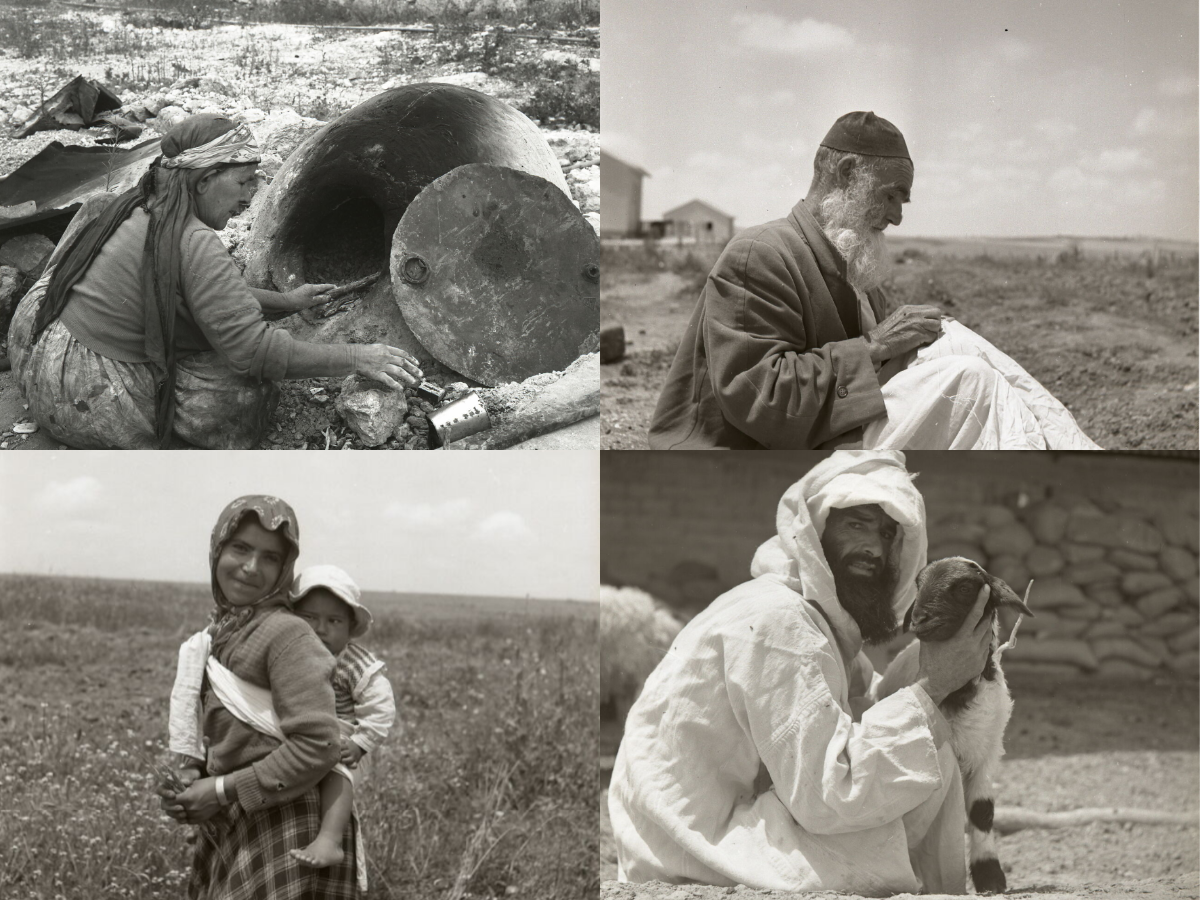
Moroccan immigrants in Israeli moshavim and kibbutzim, photographed in 1958 by Boris Karmi. (National Library of Israel)
At first glance, you might think these pictures were taken in the Atlas Mountains, or in one of Morocco’s remote villages, or simply somewhere else in the country. The surprise, however, is that they all come from Israeli moshavim and kibbutzim, photographed in 1958 by Boris Karmi, capturing the lives of newly arrived Moroccan immigrants.
Zionism or, perhaps better put, the Zionist project as practiced by its architects, has never seen Jews as the same. Some were always closer to the imagined “ideal,” European, secular, educated, while others were framed as raw material to be re-molded. Much of the discourse today focuses on Ethiopian Jews, who endured forced sterilizations, segregated blood banks, and systemic marginalization. And one must not forget that the Falasha or Beta Israel community, many of whom are still refused aliyah today, is a fact that demonstrates how the hierarchy within Zionism continues to operate.
Others recall the Yemeni Jewish children who disappeared in state hospitals under suspicious circumstances. Still others point to the Iraqi Jews, stripped of property and dignity, only to be placed in Israel’s periphery and told to be grateful. Georgian Jews, Bukhari Jews, and Jews from the broader Middle East also entered this story of hierarchy, often finding themselves marked as outsiders despite sharing the same religious identity. Each story is different, but the common thread is striking: not all Jews were received as equals.
From the standpoint that I am Moroccan, I want to focus on the Moroccan Jews, or let us say the broader Mizrahi story through a Moroccan lens. This is not nostalgia, and it is not grievance for grievance’s sake. It is a social history, lived, embodied, often quiet, of how a state was orchestrated by one elite and built, day after day, by another.
King Mohammed V sought to limit Jewish emigration through what was called the “Judeo-Muslim entente.” Most remained skeptical as Morocco aligned with Arab states opposing Israel. Restrictions tightened from 1958 to 1961 despite international pressure. The tragic sinking of the ship Egoz, also called Pisces, on January 10, 1961, which claimed the lives of over forty Moroccan Jewish émigrés, became a turning point. This disaster prompted King Hassan II to consent to a clandestine agreement, known as Operation Yachin, that, along with payments through HIAS, allowed up to 97,000 Moroccan Jews to emigrate to Israel between 1961 and 1964.
The Arab-Israeli wars between 1967 and 1973, and Israel’s illegal occupation of Palestinian and other Arab territories, sparked anti-Jewish sentiment in Morocco. This sentiment was not entirely new, as earlier violence had erupted in the wake of Israel’s declaration of independence in 1948, most notably the riots in Oujda and Jerada in which dozens of Moroccan Jews were killed. The Moroccan government, however, acted to protect the Jewish community. Still, the conflicts accelerated emigration as Jews feared for their long-term security, with the population dropping from 60,000 in 1967 to 18,000 by 1976. By the 1970s, Morocco’s Jewish population had declined to less than 10 percent of its original size.
Zionism itself did not originate in Arab countries. It was born in European societies where Jews faced pogroms, legal restrictions, systemic anti-Semitism, and later the catastrophe of the Holocaust. These experiences prompted the idea of creating a Jewish homeland as a refuge from persecution. In Arab countries, however, Jews were not initially thinking of leaving. In Morocco, for example, Jewish communities were deeply rooted, integrated into social and economic life, and far more religiously observant than their European counterparts, often more concerned with piety and community than with nationalist ideologies. Zionist organizations nevertheless sought to extract these Jews through unofficial channels.
In Morocco, allegations surfaced that these organizations paid the government to allow Jewish emigration. The smuggling was not done out of love for Moroccan Jews but rather for numbers. Ashkenazi-led movements understood that a state could not be built with European Jews alone, especially given their smaller demographic pool. They therefore sought to bring as many Jews as possible, even if considered by them to be of “lower quality,” to serve as a labor force. Moroccan Jews were brought to Israel not with promises of equality but as workers for the fields, construction sites, and service economy. In this sense, their role resembled the way wealthy Gulf states import South Asian workers today: the Gulf elites maintain control while Indians and Pakistanis perform the hard labor.
Let us pose a simple, uncomfortable question. If the early state’s rhetoric said “ingathering of exiles,” why did the institutions behave as if there were first-class exiles and second-class exiles? The answer is not reducible to villains and saints, history rarely is, but to structures: immigration pipelines designed by people who imagined the Jewish future in their image; housing and schooling policies that routed different Jews into different futures; a cultural hierarchy, what one might call Ashkenormativity, that taught some accents to feel “neutral” and others “thick.”
The migration itself was framed as rescue. But rescue into what? Into ma‘abarot, transit camps, that hardened into development towns. Into vocational tracks rather than elite academic streams. Into the periphery of Dimona, Yeruham, Kiryat Shmona, and Sderot where people did the heavy lifting of frontier life while the symbolic center set the terms of belonging. The social map was spatial, center versus periphery, but it was also moral: who counted as cultured, who counted as modern, who counted as still needing to be made Israeli. Immigration of Moroccan Jews to Israel encountered many difficulties. The new immigrants who were housed in these camps brought different ways of life and thought with them, which were misunderstood by the many immigrants originating from Europe.
Most notable was the complaint of the Moroccan hot temper, which clashed with the neighbors’ slower temper. This was the origin of the derogatory nickname “Maroko sakin,” meaning Moroccans with knives, by which Moroccan immigrants were pejoratively labeled, a stigma that stuck to them for decades. The cultural gap and overt and covert discrimination caused unrest across Israel, and already in the early years, the population dispersal policy created tensions with settlement coordinators who tried to halt the abandonment of settlements on the borders of Israel.
The transition of Moroccans from villages on the frontier to the city and their rejection of agricultural life in kibbutzim and moshavim was assumed to show refusal to participate in “productive enterprises” and the Judaization of the land. The truth is more complex: it revealed an active strategy of survival in the face of separation and socialization policies the state imposed in the 1950s.
The integration of Moroccan Jews into Israeli society was marked by severe cultural dislocation and systemic discrimination. Coming from traditional mellahs, they encountered a secular, European-oriented society dominated by Ashkenazi Jews, who often viewed them as “dirty” and “illiterate.” Relegated to menial jobs despite their previous mercantile roles, they faced housing discrimination. Some, disillusioned by their treatment, even returned to Morocco in the early 1950s.
Statistics show that of the approximately 40,000 Moroccans who emigrated to Israel from 1949 to 1954, about 6 percent, or 2,466 individuals, returned to Morocco. The immigration office in Marseille, which handled prospective North African immigrants, described them contemptuously in 1950 as “abject human beings” who would need to be kneaded to shape them into Israeli citizens. Complaints circulated about the influx of “orientals,” “human refuse,” and “backward people.” The contempt was systemic and unapologetic.
Wadi Salib in 1959 said the quiet part out loud. A neighborhood with many Moroccan Jews erupted not out of thin air, but out of a thousand daily slights and a hundred institutional choices. The protest was led by David Ben-Arush, who became a symbol of resistance against ongoing discrimination. A decade later, Musrara’s young people coined a name, “Black Panthers,” that refused to accept the idea that Jewish sameness erased Jewish difference. This was not a footnote to national history, it was national history. The protest was about housing and jobs, yes, but also about recognition: who gets to be the subject of Israeliness and who remains its object.
In response to this marginalization, Moroccan Jews played a pivotal role in establishing the Israeli Black Panthers, a movement that challenged socio-ethnic stratification and Ashkenazi dominance, drawing inspiration from global civil rights campaigns. The Panthers were not merely a protest group, they were a mirror held up to Israeli society, exposing how the promise of Jewish unity had fractured into a hierarchy of Jews and “other” Jews. Their goal was to promote their social status and they fought passionately to earn their place in Israeli society.
Work tells the story most plainly. “Built by Moroccans” is not a metaphor. It is construction sites and textile floors. It is the service economy. It is kitchens, uniforms, and guard posts. And when the military becomes a ladder, which rungs are open? The cockpit and certain intelligence corridors stayed disproportionately closed for decades, while infantry brigades and border units were disproportionately filled by Mizrahi soldiers. The symbolism was almost too neat. Some Israelis learned to fly the state; others learned to carry it on their backs.
Language policed the borders of respectability. “Edot haMizrah,” the communities of the East, was a catch-all that homogenized Iraqi and Moroccan and Yemeni and Tunisian as if history had not made these identities richly different. Slang did the rest. “Marokai” became a stereotype, quick-tempered, knife-wielding, over-fertile, doing the work that all stereotypes do: explaining inequality as temperament rather than as policy. And the English borrowed another label, “Black Panthers,” that was at once a badge of defiance and a reminder that even in a Jewish state, some Jews were “blacks” to other Jews.
Is this the whole story? Of course not. Moroccan Jews also remade the center in their image. Piyyut moved from the side room to the main hall. The Andalusian orchestra is now a national treasure. Couscous is not ethnic cuisine, it is dinner. Liturgical cadence, Arabic and Judeo-Arabic turns of phrase, the warmth of Mimouna, these refused to stay folklore. Politics, too, shows agency. From David Levy’s ascent in Likud to the rise of Shas as a vehicle for Sephardi dignity to defense and finance portfolios held by leaders of Moroccan descent, there is power here, not just pain. The Mahapach of 1977 was not merely left versus right, it was periphery versus center, a demand to renegotiate the social contract. Their demographic power became undeniable. Many of the first and second generation of immigrants from Islamic countries, often called the “second Israel,” believed this change in regime would finally give them a voice that had been denied under Mapai’s reign.
Still, the contract was never just about ballots. It was about classrooms. Who remembers being tracked, quietly but firmly, into vocational schools while others prepared for university? It was about clinics. Who remembers the ringworm radiation treatments of the 1950s, justified as modern medicine, experienced as something else entirely? It was about family archives. Who remembers dossiers that lost children and bureaucracies that lost patience? Even where the facts are debated, the feeling is not. Many Moroccans learned early that the queue to full equality had a separate line.
Let us try an example that is not dramatic, because drama can distract. Imagine two twelve-year-olds in the 1960s, one from a Tel Aviv center-city school, one from a development town in the Negev. The tests are the same, the teachers’ expectations are not. The first boy’s accent reads native, his parents’ Hebrew is mid-century European. The second boy’s accent reads other, his parents’ Hebrew is inflected with Fez or Casablanca. Track placement becomes destiny. In thirty years, who is designing the industrial policy and who is implementing it? Who is running the hospital and who is cleaning it? Exceptions exist, many of them, but a structure is known not by its exceptions, rather by the rules it normalizes.
Culture studies gives us a few terms worth keeping, ethnocracy, Ashkenormativity, peripheralization. But the point is simpler. The early state’s nation-building was also class-making and race-making. It created a ladder and then positioned different Jewish communities on different rungs while claiming the ladder did not exist. When Moroccan voices said otherwise, they were told to be grateful. After all, had they not been saved? Gratitude is a beautiful private virtue. Weaponized as public policy, it becomes a muzzle.
And yet, Moroccan Jews also did what migrants and provincials and others have always done. They built parallel institutions. They won hearts through culture. They created leverage through politics. The result is today’s Israel, where a Friday night table in Ashdod or Beersheba can feel like a referendum on the canon. Umm Kulthum meets Naomi Shemer. Piyyut meets rock. Amnon Levy interviews a grandmother whose Hebrew is a third language and whose wisdom is first. The mainstream did not merely absorb the margins, the margins pushed the mainstream to expand.
But is recognition the same as repair? Not necessarily. When Mizrahi music wins Eurovision aesthetics but Mizrahi neighborhoods still carry higher poverty rates, has the hierarchy truly shifted, or has it learned to sing along? When Moroccan heritage is celebrated in festivals but the periphery schools remain under-funded, what exactly has changed? This is where policy must follow culture. Investment in schools where accents differ. Pathways into elite IDF and tech units not as miracle stories but as routine. Public memory that puts Wadi Salib and Musrara alongside 1948 and 1967 in the national storyline. This is the work of a state that admits what it did and chooses differently.
Some will say, are we not past this? After all, the Knesset, like the pop charts, no longer looks like a single Europe. True, and welcome. But representation is not the same as redistribution, and pride is not the same as parity. The sentence I began with remains: Zionism, at least as administered by its early state builders, did not see all Jews the same. The more honest sentence for our time is this: Israel’s elites still reproduce themselves unless pushed not by a one-time protest but by a long, stubborn, Moroccan patience that refuses to be silent and refuses to be bitter.
What would a new social contract sound like? It would begin in the schools, with teachers trained to hear every accent as a resource, not a deficit. It would move through the army, with transparent selection and mentoring into the units that shape the economy long after discharge. It would re-map the periphery, development towns as innovation hubs, not sacrifice zones. And it would rewrite the syllabus, Wadi Salib, the Panthers, the poetry of Rabbi David Buzaglo, the sermons and the songs, so that every child learns that the country’s cultural north star shines from the south and the east too.
I am Moroccan, and I will end as Moroccans end, by speaking of what people make with their hands. The country’s roads and homes, its kitchens and bases, its music and prayers, so much of it was indeed built by Moroccans. Orchestrated by Ashkenazim, built by Moroccans is not a slogan meant to divide. It is a diagnosis to heal. If we can speak it without defensiveness, if we can let the sentence breathe, perhaps the next sentence can be truer: orchestrated by many, built by all. Until then, we owe the truth to the grandparents who were told to be grateful and the grandchildren who ask, quietly but insistently, grateful to whom, and on whose terms?
Related Topics