
Israel Playing Four-Dimensional Chess
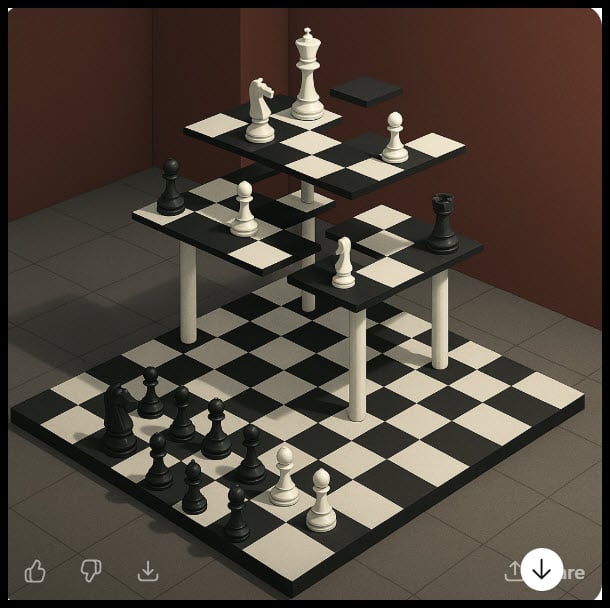
Four-Dimensional Chess: The Reality Israel Cannot Escape
In the brutal arena of global geopolitics, most nations engage in two-dimensional chess. Their decisions—military, diplomatic, or humanitarian—are judged within predictable rules: protect your citizens, defeat your enemies, and secure your borders. But Israel, in its war against Hamas, is forced to play four-dimensional chess, navigating layers of complexity and contradiction that no other modern nation is expected to manage.
The current conflict, ignited by Hamas’s October 7th sneak attack that brutally slaughtered over 1,200 Israeli civilians and abducted more than 200 others, would have—by any traditional standard—justified a full-scale and unrelenting military response. Any other nation attacked so savagely would be expected to destroy the aggressor’s military infrastructure and neutralize its command. Yet when Israel does so, it is immediately accused of using disproportionate force and failing to care for the enemy’s civilian population—a civilian population Hamas itself uses as a shield and a propaganda weapon.
This is not just hypocrisy; it is a distortion of moral logic. No other country is expected to ensure the humanitarian well-being of the very population behind which its enemies hide. No other country is asked to measure every counterattack with a moral calculator while the other side deliberately embeds rocket launchers in hospitals and tunnels under schools.
Israel’s challenge is therefore not a conventional one. It must not only defend itself militarily (Dimension 1) and navigate the global diplomatic landscape (Dimension 2), but also manage international public perception (Dimension 3) and the moral narrative (Dimension 4) in real time.
Dimension 1: Military Defense in a Rigged Arena
Israel’s armed forces are bound not only by the laws of war but by self-imposed moral and ethical standards that far exceed those of most other modern militaries. Precision targeting, roof-knocking warnings, evacuation corridors—these are designed to minimize civilian casualties even when Hamas uses civilians as human shields. Yet, while Israel minimizes harm, Hamas maximizes it—on both sides. The military task would be difficult in any context, but in Gaza, Israel faces an enemy that manipulates its own people’s suffering for strategic gain.
Dimension 2: Diplomatic Strategy in a Biased World
While Israel navigates shifting alliances and pressure from the United States and other powers, it also contends with entrenched diplomatic hostility. Many in the international community ignore the root cause of the conflict—Hamas’s genocidal charter and its unrelenting attacks on Israeli civilians—and instead issue reflexive condemnations of Israel’s right to self-defense. At the United Nations, resolutions flow freely against Israel while Hamas’s war crimes are met with silence. No other country is denied the presumption of legitimacy that Israel constantly must defend.
Dimension 3: Public Perception in a War of Optics
In the digital age, battles are won and lost not just on the ground, but on screens. Hamas knows this well. They stage grief and destruction for the global press while silencing dissent in Gaza. Every Israeli strike—no matter how justified—becomes viral content. Meanwhile, Israeli restraint, precision, and innovation in warfare rarely make headlines.
To counter this, Israel must professionalize its public diplomacy. It must invest in strategic communications, multilingual rapid-response media teams, visual documentation of Hamas war crimes, and targeted campaigns that expose the hypocrisy of Israel’s critics. Its story must be told by Israelis, survivors, humanitarian workers, and international observers who refuse to accept the inversion of victim and aggressor.
Dimension 4: Moral Positioning in an Asymmetric Ethical Battlefield
Here lies the most paradoxical battlefield. Israel is held to moral expectations that no other nation faces. When it acts with restraint, it is still condemned. When it acts with resolve, it is demonized. The international community appears to demand that Israel sacrifice its own people’s security to preserve a fiction of moral equivalence. This is an impossible standard—but one Israel must still address.
And here’s the cruelest irony of all: Israel must visibly and systematically provide food, water, and humanitarian aid to the civilian population of Gaza—the very population Hamas claims to protect, but cynically uses as a media weapon. No matter how twisted this seems, it is now a core component of winning the moral narrative.
Let that sink in: A country under unprovoked attack is being told that part of defending itself includes keeping its enemy’s civilian population alive, fed, and documented in real time for the cameras. Even when those civilians may be harboring militants. Even when supplies are stolen by Hamas and repurposed for its own fighters. Even when Israel’s own hostages are still trapped in tunnels beneath the very ground it must supply.
And yet—this, too, is a dimension in the war Israel cannot ignore.
To succeed, Israel must not only deliver aid but show the world it is doing so. It must operate field hospitals, facilitate humanitarian corridors, and even drop food packages from the sky—accompanied by cameras and journalists, because in this warped moral theater, perception is reality. The goal is not to earn applause. The goal is to deny Hamas the oxygen of propaganda. Israel’s visible humanity is a weapon in this war as real as any drone or tank.
Playing to Win Across All Dimensions
If Israel is to survive and thrive, it must embrace the game it never asked to play. It must become expert at navigating the multi-layered battlefield:
- Military effectiveness must remain uncompromising and precise.
- Diplomatic engagement must be persistent, strategic, and, when necessary, unapologetically assertive.
- Public narrative warfare must be professionalized, relentless, and proactive—especially online, where distortion thrives.
- Moral leadership must be lived out visibly, not just in values but in tangible actions.
Israel does not have the luxury of simple equations. Its enemies exploit complexity. Its friends expect perfection. Its critics deny its legitimacy. And yet, it must play—and win—on all fronts.
This is not fair. But it is real. And reality is the only board that matters. Four-dimensional chess isn’t a metaphor—it’s Israel’s lived experience. The only response is to master the game. And win.