

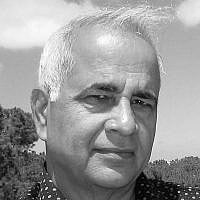
Israel Prize Awarded to Prof. Reshef Tenne – Honouring a Genius
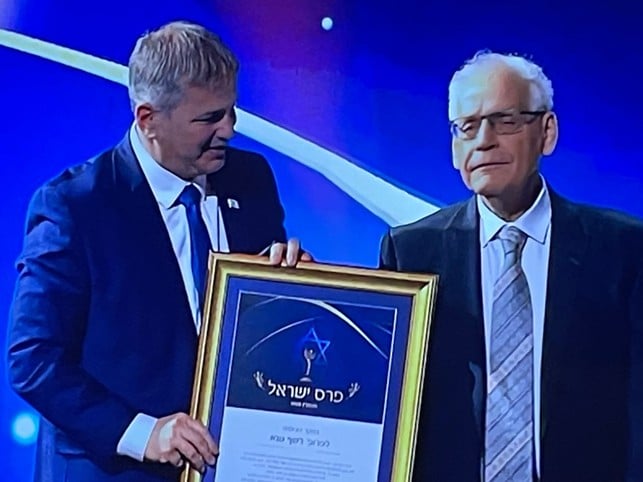
During the celebrations of Yom HaAtzmaut, Israel’s Independence Day, on April 22, 2026 at Jerusalem, a short traditional state ceremony was held to award The Israel Prizes for 2026. First awarded in 1953, The Israel Prize is the highest cultural honour of Israel, awarded annually in the presence of the President, the Prime Minister, the Speaker of the Knesset (Israel’s legislature), the President of the Supreme Court of Israel and the Mayor of the city of Jerusalem, to individuals whose contributions in the areas of culture, education, medicine, science, and society have had a lasting impact on Israel. Among the awardees this year was Prof. Reshef Tenne from Molecular Chemistry and Materials Science Department at the Weizmann Institute of Science, who received the Israel Prize in the field of Chemistry Research and Chemical Engineering.
Prof. Reshef Tenne is known across the world of S&T for his breakthrough in transforming tungsten disulfide (WS2) and molybdenum disulfide (MoS2) into Inorganic Fullerenes and Nanotubes, specifically into closed soccer-ball-like cages called fullerenes and cylindrical shapes called nanotubes. In 1992, he discovered that these two-dimensional layered inorganic (non-carbon) materials spontaneously reshape themselves into closed three-dimensional nanostructures at very high temperatures [1]. These shapes—with controlled size, composition, and mechanical properties—have exceptional strength, chemical stability, and lubricating properties as well as unique optoelectronic properties.
The genius of Reshef is that he has initiated the field of 2D nanomaterial engineering, which has enormous scope and potential for applications across a range of areas from energy to medical devices, improved industrial machinery, optoelectronics, catalysis and beyond. Sustained efforts by Reshef over the years established that nanoparticles made of tungsten disulfide function as nanoscale ball bearings and have since become a material used for industrial machine lubrication. In addition, he demonstrated that the nanotubes he discovered could reinforce polymers and thus have significant potential for a wide range of applications in medical technologies and the aerospace industry.
Reshef was born in Kibbutz Usha in the Zvulun Valley in northern Israel in 1944. A kibbutz is a unique, collective community in Israel, traditionally based on socialist and egalitarian principles where members share property, income, and responsibilities. Currently, about 250 Kibbutzes exist in Israel, with a population averaging 500 each, with communal responsibility and compassion. The author has discussed the concept in some detail in a previous article [2].
Reshef earned his BS, MS and PhD degrees during 1966-1976 at Hebrew University, Jerusalem, following it with a postdoctoral stint at the Battelle Institute (1976-79). He joined Weizmann Institute in 1979, a milestone in his research career, because he has ever since worked with a singular zeal to maintain the tempo of his research in developing new materials having potential for industrial applications. Currently, at age 81, Prof. Tenne continues to be among Israel’s most visible scientists, having made unique contributions to materials science and to physical and inorganic chemistry.

I have known Prof. Reshef Tenne for over 15 years now, and interacted with him closely, during my four visits to Israel, during which I spent about 20 days each time at Weizmann Institute. Reshef is very popular among active researchers working on Nanoscience and Nanotechnology in India. He is a close friend of Prof. C.N.R. Rao, the topmost Indian scientist – a chemist himself. Three alumni of Reshef’s lab occupy academic positions in India. Reshef has visited India several times, to deliver talks on his work on Inorganic Nanotubes and Fullerene-like structures and their applications. In 2010, at my instance, he spoke at Bhabha Atomic Research Centre in Mumbai to a large audience of over 600 scientists, sharing with them the excitement of non-carbon nanostructures.
Reshef has a penchant to seek answers to basic questions in materials science, even tough ones, which might look a wasteful exercise to many researchers, but not to him. In 1991, for instance, while working successfully on the use of photoelectrical etching to produce high efficiency PEC cells for solar energy conversion, he was already looking keenly to answer the question: why does carbon form fullerenes, as shown by Kroto and co-workers in 1985 [3] or nanotubes, as shown by Iijima in 1991 [4], but the same not seen for inorganic materials. The result was a focus on MoS2 where the bonding state of bulk and rim atoms were different from graphite. That brought forward the Kroto-Iijima-Tenne mechanism, also known as the dangling bond edge-closure mechanism applicable to inorganic materials to form their nanotubes from 2D layered compounds. Reshef demonstrated that tiny spheres of WS2 and MoS2 could serve as lubricants with an exceptionally low coefficient of friction. Today, three companies market innovative lubrication technologies based on this idea.
Sustained research contributions by Prof. Tenne have yielded substantial benefits for industry in Israel. Reshef has converted inorganic new nanomaterials from the stage of curiosity to scaling their production up to tons stage for eventual real-world applications in frontlines areas such as aerospace, medicine, energy and environmental, and even tailoring the properties of these nanomaterials to suit their ultimate applications.
There are exciting details about Reshef’s work that one would like to describe, for instance, about the non-carbon nano materials developed by Reshef; or, their scaling up for applications in frontline areas of benefit to humanity; or, his persistent efforts to unravel new pathbreaking science, such as, recent synthesis of new nanotubes from the large family of “misfit” compounds, like PbS-NbS2, LaSe-TaSe2. But I believe the story of Reshef as an ‘Institution’ will not be complete, unless we also touch upon Reshef being a source of inspiration to numerous budding scientists, all his life. For that I prefer to highlight three things unique in a life lived uniquely by him. These are:
(A). Reshef underwent paramilitary training after enlisting in the Paratroopers Brigade in 1963. He served as a paratrooper in IDF during war-times in 1963-1985. His training, as a paratrooper, keeps him ever-ready in the lab to take calculated risks in his research as it is unfolding, and plunge at right time for the big rewarding discoveries;
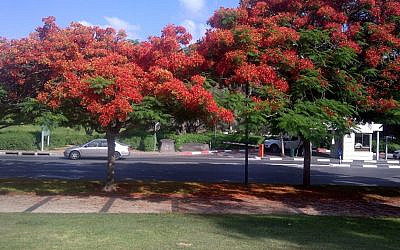
(B). The ambience of WIS, as provided by dedicated scientists, old and new alike, in its labs, as well as by Nature via its bountiful, serene environment that WIS campus provides. One can feel invigorated just by taking a walk on its sidewalks, more so in the vicinity of the Weizmann House. It is very rewarding for Reshef when he takes his 6 am morning walk inside the campus, and often gets bright new ideas, ready to debate them after a few hours with his group members in the lab. In October 2015, he and his family shifted to a flat in a multistorey building, just on the periphery of the WIS campus, that provides a view of Nature, full 360 degrees around. Thus, he not only enjoys full freedom of academic work that WIS gives to all its scientists, but also freedom to live literally among “his” people, while being surrounded by his own family.
(C). He is a mentor 24/7, and has a habit to take his students and post docs along with him in the scientific journey undertaken by him which continues in his 82nd year! The young scientists bloom in his labs, and in the process contribute pridefully to fulfil his dreams, providing inner happiness to him, in return. Throughout his career, Prof. Tenne has trained dozens of researchers, eight of them from India, and has served in key leadership positions within the chemical sciences. No wonder, he relishes the successes of his past students/colleagues and takes great pleasure to see his alumni thriving, and cheers them to move ahead with the enthusiasm of a young scientist in his 30s, or so.
His former student, Prof. Gitti Frey, is a professor at the Technion and currently the Dean of the Faculty of Materials Science and Engineering. Prof. Maya Bar-Sadan, another student of Reshef is currently the Chair of the Department of Chemistry at Ben Gurion University of the Negev, and is simultaneously the vice rector of Ben-Gurion University.
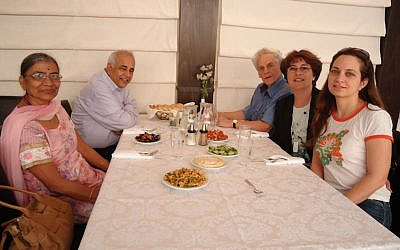
Reshef married Leah Jonas in 1972. The couple had three children, a girl Dana and boys Ron and Tal. Unfortunately, Leah expired in 2003. That led to his second marriage in 2009 to Alla Zak, a former doctoral student in his group, who is currently the Dean of the Faculty of Sciences and Head of the Nanomaterials Laboratory at Holon Institute of Technology, and Scientific Advisor in the Dept. of Molecular Chemistry and Materials Science at the Weizmann Institute.
While celebrating the Israel Prize won by Reshef, one can state that over the course of his career, he has received numerous prizes and honours for scientific and academic excellence, among them was the 2023 Von Hippel Award, the Materials Research Society’s highest honour, the EMET Prize (2020), the Rothschild Prize (2016) and the Landau Prize of Mifal Hapais (Israel Lottery) in Nanotechnology (2006). He was elected to the Israel Academy of Sciences and Humanities in 2011.
Israel Prize is awarded to Israeli citizens only, but an exception was made in 1991 while awarding it to Zubin Mehta. Mehta, an Indian citizen, had served as the conductor of the Israel Philharmonic Orchestra for 50 years before retiring in 2019. Another exception was made this year while awarding 2026 Israel Prize to President Donald Trump for “special contributions to the Jewish people”.
References
[1]. Tenne, R.; Margulis, L.; Genut, M.; Hodes, G. (1992), Polyhedral and cylindrical structures of tungsten disulphide, Nature. 360 (6403): 444–446.
[2]. Negba – a kibbutz with a war memorial, Jatinder Yakhmi, The Blogs, Times of Israel, April 3, 2022, https://blogs.timesofisrael.com/negba-a-kibbutz-with-a-war-memorial/
[3]. Kroto, H., Heath, J., O’Brien, S., Curl, R., and Smalley, R., C60: Buckminsterfullerene, Nature 318, 162–163 (1985).
[4]. Iijima, Sumio, “Helical microtubules of graphitic carbon”, Nature, 354 (6348): 56–58 (1991).