
Israel should give Syria a chance
For more than 50 years, Syria was the jewel in the crown of Iran’s malign, regional agenda of aggression and expansionism. After spending more than a decade investing huge sums of money, weapons, and tens of thousands of fighters into backing and propping up the regime of Bashar al-Assad, Iran lost its most prized asset in the space of 10 days in late 2024. In the preceding days, Iran and Hezbollah lost multiple casualties on the front lines. As the regime fell, Iran and all of its proxy partners hurriedly withdrew all of their forces to neighboring Lebanon, to Iraq and to Iran itself.
The Syria that stands today is one that faces huge structural, social, communal, security and economic challenges. These are not just the result of nearly 14 years of civil conflict, but also the cost of more than half a century of corrupt, inept, sectarian and oppressive Assad family rule. While Syria’s transitional government is led by remnants of a reformed jihadist movement, in the past year, we have witnessed the formation of a transitional government in which technocratic ministers from Syria’s diaspora in the US, Europe and the Gulf dominate 80% of the ministries.
In less than a year, this Syrian transitional government has received official visits in Damascus from more governments around the world than the Assads received in 53 years. Moreover, having previously faced the world’s biggest and most intricate sanctions regime since 1979, Syria has been granted sanctions relief at record-breaking speed. At no time in world history has a post-conflict country come close to matching the speed and scope of this rush to Damascus.
The cause for this surge in engagement is the historic opportunity that the change in Syria represents. For too long, the phrase “what happens in Syria never stays in Syria” was associated with security threats, but the promise of turning that equation on its head and generating positive ripple effects emanating from Syria is a cause that has united the world – from the United States to Russia, China, and everywhere in between. This trend has two rare exceptions, however. In an unfortunate twist of irony, only two governments worldwide have taken a posture of opposing Syria’s transition: Israel and Iran.
Iran’s drive to oppose a post-Assad Syria is unsurprising: it seeks to rescue what it has lost. In partnership with Hezbollah, Iran has persistently sought to destabilize the new Syria through support to an insurgency, much of which has its roots within remnants of Iran’s long-standing Syrian partner, the Fourth Division. But in doing so, Iran has come up against a Syrian transitional government that has determinedly confronted what remained of Iran’s military and militia networks.
In fact, in a consistent campaign that has spanned the country, Syrian government forces have seized an enormous amount of weaponry from Iranian-linked actors – much of it prepared for smuggling to Hezbollah in Lebanon. According to publicly documented incidents recorded by Syria Weekly, in the past 10 months, Syria has seized more than 4,000 weapons systems tied to Iranian-linked activity:
- 910 mortars
- 721 landmines
- 614 rifles
- 496 Grad rockets
- 461 tank or artillery shells
- 285 rocket-propelled grenades
- 280 anti-tank guided missiles
- 148 anti-tank rockets
- 99 heavy machine guns
- 11 man-portable air defense systems (MANPADS)
- 4 automatic grenade launchers
Had these weapons successfully crossed into Lebanon, Hezbollah would be in a far better place than it is today.
While most of these seizures were the result of leads generated by Syria’s General Intelligence and Interior Ministry, some came via information provided by the United States. In fact, the US-Syria security relationship has developed rapidly in recent months.
In May 2025, an American intelligence package was provided to Damascus regarding a vast network of tunnels, compounds and arms caches all tied to the IRGC around al-Bukamal in eastern Syria. Days later, Syrian Interior Ministry forces raided and seized every structure and detained every operative in what was described to me by a US official as a “game-changing operation.” Since then, US and Syrian forces have conducted at least six targeted raids on ISIS (one of which killed the most senior ISIS leader in Syria) and several more on Iran-linked targets. The US did not invite Syria to join the global coalition against ISIS out of courtesy – it did so after months of successful cooperation that bore results previously unimaginable while Assad was in place.
This is what makes Israel’s hostile posture towards the new Syria so puzzling – and frustrating. There is no doubting the problematic history of Syria’s new leadership, but that same leadership has held out a peaceful olive branch to its Israeli neighbor since its very first days in Damascus. And its decisive actions against Iran and other sources of regional instability speak for themselves. Two hundred square kilometers of Syrian territory were invaded and occupied by Israeli forces in December 2024, and since then, Syria has faced nearly 1,000 Israeli airstrikes and more than 600 ground incursions. Throughout all of that, the most aggressive Syrian response has been to file symbolic complaints at the UN Security Council.
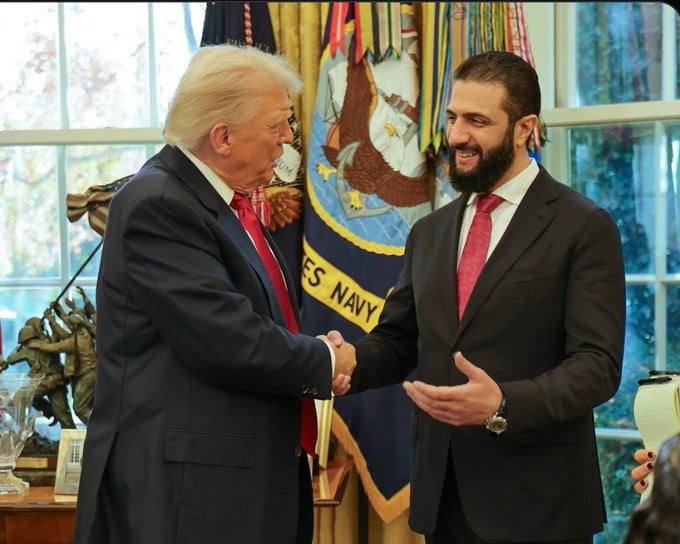
It is time that Israel joins with the rest of the world in doing what President Donald Trump has repeatedly called for: giving Syria a chance. The scale of Syria’s internal economic, political and social challenges is vast, but with the support of the US, Europe, Russia and China, significant progress has been made in a short time. If the world has any chance of reaping the rewards of a stable Syria, Israel must cease its military actions and re-engage in US-mediated talks. Syria and Israel have been at loggerheads for too long, but moving towards peace must begin with security agreements first. For the first time, Syria is signaling a desire to apply the 1974 ceasefire agreement between the two countries as the basis for a new Israel-Syria relationship. With a US role in guaranteeing mutual security, there is no reason why a “trust and verify” relationship cannot be achieved.
To throw away this opportunity would be a historic mistake.