Israel, The Name That Outlived Ruin
When we look at a name, we usually stop at its meaning and go no further, rarely asking where it came from. I prefer the opposite, tracing a name back to its root, because a name often hides more than the story it carries on its surface. I’ve been turning the name Yisrael over for a long time now. Following its trail has taken me somewhere I never expected.
Who Jacob wrestled with that night is a question Jewish tradition left open for centuries, never quite closing it. The text names no one, calling him only a man. In the seventy-seventh chapter of Bereishit Rabbah, Rabbi Chama bar Chanina identifies him as Esau’s guardian angel. But over time, that angel came to carry something far larger than Esau alone.
Even before anyone gets named, the text itself is woven through with a pun. The river Jacob wrestled beside is called Jabbok, and the verb wrestled is vayeavek in Hebrew, both drawn from the same root, as though the river’s own name already carried what would happen on its bank. Jacob’s own name sits close to that same sound too, the same consonants arranged in a different order. The text ties a man, a river, and a verb, three separate words, into a single knot of sound.
The Torah tells this same night once more, in a very different place, in the twelfth chapter of Hosea, and there the story picks up a detail Genesis never mentions. Hosea calls Jacob’s opponent an angel outright, and adds that Jacob didn’t only wrestle that night, he wept, he pleaded. Genesis told a struggle. Hosea adds a tear to the same night.
In the second century, in the very years Betar was razed by Rome and the Bar Kochba revolt was crushed in blood, Rabbi Akiva became the first to identify Esau directly with Rome. He read the verse the voice is the voice of Jacob, but the hands are the hands of Esau as a prophecy of what Rome’s hands would do to the Jewish people. That identification spread and swelled across the centuries, covering pagan Rome first, then Christianizing Rome, then by the medieval period all of Christian Europe, everything gathered under the single name Edom. This is, of course, a historically situated reading, not a judgment on Christianity or Islam as they exist today, but a trace left by the language of medieval exile itself. According to the historian Malachi Haim Hacohen, medieval Sephardi Jews described their own exile as living under Edom and Ishmael, taking Ishmael as the ancestor of the Arabs, reading the vision of the Four Empires in the Book of Daniel as a promise of liberation from both Christian and Muslim rule at once. This was a statement about the political reality of that era, about the dependency of living as a minority, not a claim about the essence of either faith. The nameless man Jacob wrestled with in the dark became, over the centuries, the shared name for every empire this people would come up against.
What stopped me most was the shape this identification took inside Kabbalah. Worth a note of caution here too, this reading is a cosmological framework, not a judgment on any real people or faith, it describes something that unfolds before creation itself. The thirty-sixth chapter of Genesis counts off, one by one, the kings who reigned in Edom while Israel still had none, the same pattern repeating eight times over, one becomes king, dies, is succeeded by another, who dies in turn. In that recurring phrase, reigned and died, the Arizal read the foundation stone of all Lurianic Kabbalah, the teaching of Shevirat HaKelim. Each king of Edom stood for a vessel that burst under a light it couldn’t hold, one of the collapsing rungs of Tohu, that first order built only to be destroyed, an event set at the very origin of creation, with no bearing on historical Edom or any people that came after. Only the last king survived, the one named alongside a wife, because balance arrived with him and the world of Tikun began.
Some teachers place these two stories, the shattering of Edom’s kings and Jacob’s wrestling, inside the very same night. The Talmud itself tells it this way, that Jacob crossed back over the river to retrieve small vessels he’d left behind. The mystical reading takes those vessels to be the fallen, shattered vessels themselves, and the angel Jacob grapples with in the dark to be the spiritual overseer of every king of Edom still to come, of all that future breaking. That night, quite literally, Jacob was searching for his own broken vessels. The wrestling itself was a struggle against the shattering.
The name itself was born out of that same struggle. Yisra, from the root sarah, means both to struggle and to prevail. El means God. But the five letters themselves carry something else too, according to the thirteenth-century compilation Yalkut Shimoni, and to a note in the Arizal’s own Likutei Torah. The five letters that spell Yisrael, yud, shin, reish, aleph, lamed, can be read as the initials of seven names, the three patriarchs and the four matriarchs. Yud carries Yitzchak and Yaakov. Shin carries Sarah. Reish carries Rivka and Rachel. Aleph carries Avraham. Lamed carries Leah. Five letters hold seven names, without leaving a single one out. The name Jacob received that night ties him not only to what was coming, but to the whole of his own lineage.
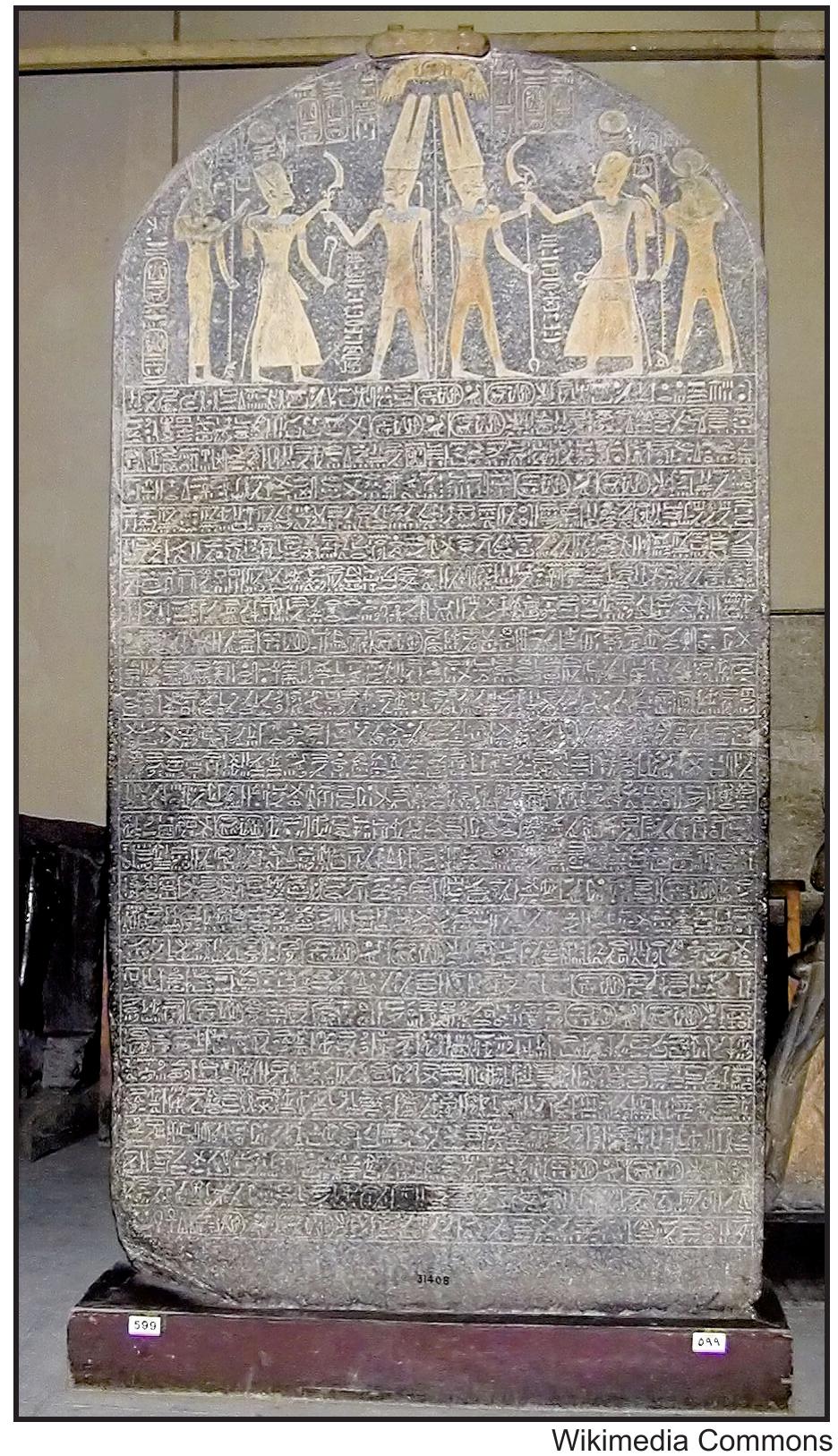
Yet the earliest written trace of this name isn’t found in the Torah, nor in the Zohar, but somewhere far more distant. In 1896, Flinders Petrie found a granite stele in a mortuary temple at Thebes, belonging to Pharaoh Merneptah, dated to around 1208 BCE. The stele praises a campaign in Canaan, Ashkelon is taken, it says, Gezer is seized, and in one line it reads, Israel is laid waste, its seed is no more. This is the earliest known trace of the name Yisrael in writing, and it surfaces inside a boast of destruction, much as the name itself was born out of a breaking.
Egyptian scribes, when they wrote, attached a small symbol to every proper name, marking what kind of thing that name referred to. Ashkelon and Gezer were each given the sign for a city. Israel was given something else entirely, three seated figures, the determinative for a people or a community. It may have had no land yet, but its name was already bound to a people, some thirty-two centuries ago.
There’s an even older trace, though it remains contested. In 1913, the Egyptologist Ludwig Borchardt bought a small granite pedestal fragment from an antiquities dealer, and it sat in the storerooms of Berlin’s museum for nearly a century before anyone noticed it. In 2001, Manfred Görg proposed that the third of its three name rings, broken and incomplete as it is, could be read as Israel, the first two already spelling Ashkelon and Canaan. Some scholars accept the reading, others remain cautious over small differences in the letters. If it holds, the fragment reaches back roughly two centuries earlier than the Merneptah Stele, pushing the name’s trail all the way to around 1400 BCE.
I can’t help thinking about how this same distinction resurfaced three thousand years later, in a place no one would have guessed. On May 12, 1948, the cabinet of a state not yet founded voted on a name. Judea stood as the strongest candidate, but historic Judea was a small area around Jerusalem, too narrow for the borders the partition plan had drawn. It was the name of a place and the place was too small. Israel had never been only a place to begin with. The vote passed seven to three.
No one in that room knew what an Egyptian scribe, or the Arizal, had once carried inside that same name. But the name seems to have been doing the same work for three thousand years, remaining the name of a people trying to gather something that broke. Its first written trace was a boast of ruin. Its mystical reading was a shattered vessel. And today, still, knowingly or not, we go on gathering the pieces.