


A Correspondent in Tel Aviv
Israel, Turkey and Cyprus’s Only Strategic Choice
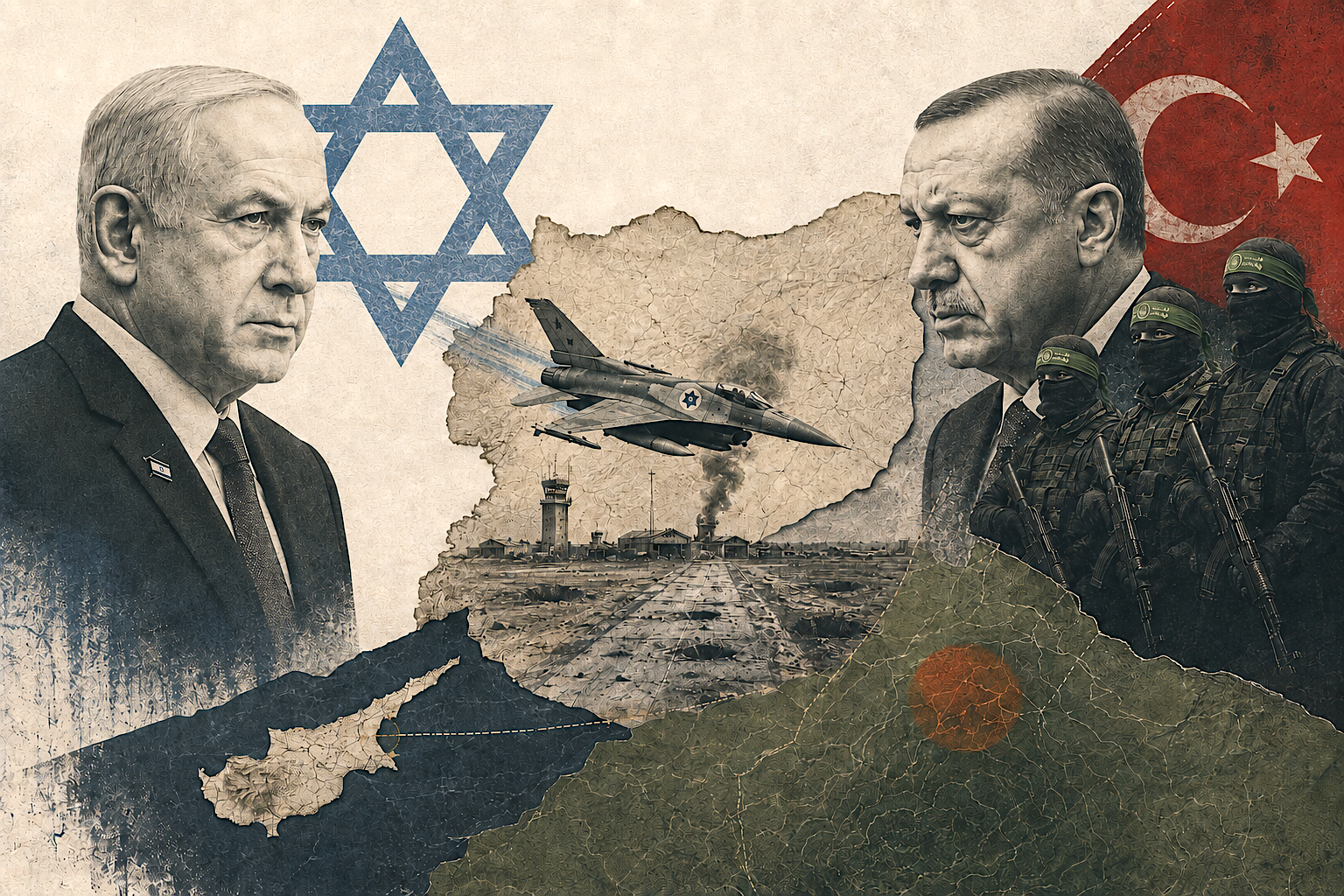
The revived speculation that Israel and Turkey could go to war in Cyprus—and that the IDF might subsequently “liberate” the occupied north—is not merely baseless and absurd. It is dangerous.
No defense treaty obliges Israel to fight on Cyprus’s behalf.
Turkey does not seek a spectacular war with Israel. It methodically expands its strategic depth, creates faits accomplis, then presents them as nonnegotiable reality.
This Turkish approach was first tested not in Syria or Libya, but in Cyprus, albeit somewhat differently: invasion, occupation, settlement, militarization, economic subordination of the occupied north, and the conversion of an illegal order into a supposed “new normal.”
Turkey now applies the same strategy on a larger scale.
In Syria, it trains and arms the new forces, seeks military access and turns influence into permanent presence.
The confrontation over Abu al-Duhur airbase highlighted once again the real contest over who will shape postwar Syria.
Tom Barrack, the U.S. ambassador in Ankara and envoy to Syria, may plausibly argue that PM Benjamin Netanyahu used the affair to strike the base for electoral gain.
Yet the essential fact remains: Turkey is doing precisely what it stands accused of doing. Ankara denied that Turkish officers had even visited the base; Syria confirmed that they had. That alone is revealing.
Tom Barrack, meanwhile, primarily represents the vast private interests that secured his appointment—unless we are to believe an 80-year-old real-estate billionaire suddenly discovered a vocation for diplomacy.
Hence the Israeli Prime Ministers’ jab that the ambassador’s views were not Donald Trump’s.
OK. Whatever “Trump’s views” means.
In Libya, Ankara used its military presence to impose maritime faits accomplis. In the Eastern Mediterranean, it is constricting the room for maneuver available to Cyprus, Greece and Israel.
Cyprus’s geopolitical alignment is therefore not a matter of affection or ideology. It is survival. The European Union can offer political, economic and diplomatic support. It has neither a unified army nor an automatic plan to defend the Republic of Cyprus.
As the Russian threat grows—much to the perverse delight of the leftist admirers of Putin, Erdoğan and the wider Islamofascist rot— Europe’s ability to help Cyprus shrinks inevitably.
The Cyprus-Greece-Israel alignment does not guarantee that anyone will fight for someone else. It provides, however, especially for Cyprus, something equally important: intelligence, technology, air defense, interoperability, joint exercises, energy links, and diplomatic depth.
Deterrence is not preparing for war. It is raising the price of aggression for the adversary. Something the island never had before.
That gives value to a country, however small. This architecture also includes Cyprus’ military cooperation with France, strong relations with the United States, and expansion toward India and the United Arab Emirates.
Cyprus and India’s longstanding relationship has been rapidly strengthened, while the India–Middle East–Europe Economic Corridor could reshape the regional landscape.
The additional benefits of cooperation with Israel are tangible: investment and roughly 600,000 Israeli tourists annually, for a start.
Yet a loud minority of obsessives and antisemites on both the far left and far right on the island seek to sever these ties—exactly as Erdoğan would wish.
They cannot grasp what an isolated Cyprus would mean amid upheaval, facing a hostile axis that seeks control of the entire island.
They also ignore that cooperation between Greek-American and American Jewish organizations helped deliver the EastMed Act, opened the way to lifting the U.S. arms embargo, and produced other gains for Cyprus that Turkey rails against.
Why? Because they raise the cost of what Ankara once did unopposed.
Jeopardizing the strategic relationship with the region’s only democracy because of conspiracy theories, pro-Russian propaganda, apologetics for Palestinian and other Islamist terrorism, and Erdoğan’s narratives—all swallowed whole out of intellectual laziness or ideological obsession—would amount to national suicide.
Cyprus and Israel—the region’s only two non-Muslim democracies—do not fit into the “new order” that Erdoğan, Qatar, and the region’s mullahs are seeking to impose. In the worldview of these fanatics, Greek Cypriots and Jews have no place in their ancestral homelands.
The real choice is not “Israel or…” It is deterrence or strategic entrapment—until fate eventually catches up with Cyprus.
Peace that depends entirely on Turkey’s goodwill is not peace.
It never was. It never will be.
It is merely surrender postponed.