
Middle East Analyst
Israel-US War to Topple Iranian Regime Was Lost in Gaza
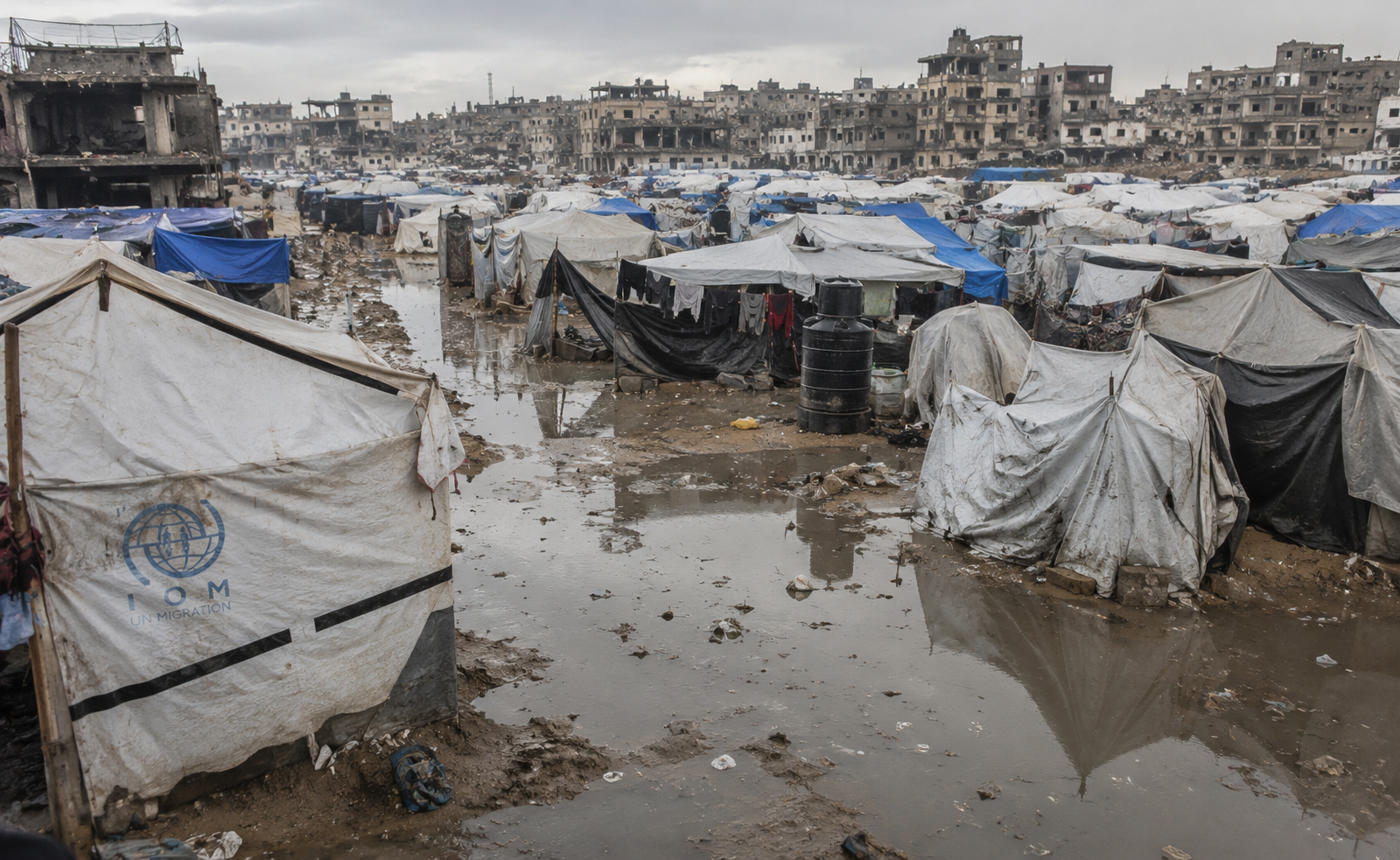
By author (AI)
The plan to topple Iran’s regime from the outside was always implausible because it depended on two prerequisites that did not exist: broad, sustained popular backing inside Iran and credible, reliable external support. The decisive reason both failed was a structural deficit of trust — trust in the United States and Israel as sponsors, and trust by those countries toward the populations they expected to mobilize. No event illustrates that deficit more clearly, or more consequentially, than the functional collapse of the Gaza Board of Peace.
Popular Backing as the Decisive Variable
Externally driven regime change requires more than elite dissent or episodic protests. It requires a clear, sustained willingness by a large portion of the population to accept existential risk. Ordinary people calculate survival, social order, and the reliability of outside patrons before they risk everything. When the promise of protection, sanctuary, or a viable post-regime plan is not believable, mass mobilization does not follow. Counting on rhetoric or short-lived demonstrations to substitute for that calculus was not a strategy — it was wishful thinking.
The question, then, is what destroyed the believability of American and Israeli support across the region. The answer runs directly through Gaza.
The Board of Peace: Promise, Failure, and What It Signaled
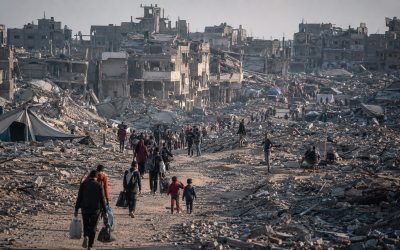
When Israel and Hamas reached a ceasefire in October 2025, the reconstruction of Gaza was priced at over $70 billion by the World Bank, UN, and European Union. The scale of destruction was almost incomprehensible: roughly 85 percent of buildings and infrastructure damaged or destroyed, some 70 million tonnes of rubble to be cleared, an economy that a UN trade report described as suffering the most severe crisis ever recorded. Against that backdrop, a credible, well-funded international mechanism for reconstruction would have represented something rare in this region — a demonstration that international promises could actually be kept.
The Gaza Board of Peace, authorized by UN Security Council Resolution 2803 in November 2025, was positioned as exactly that mechanism. When President Trump formally unveiled it at Davos in January 2026, he declared himself honored to be its chairman and called it potentially “one of the most consequential bodies ever created.” The ambition was real. The follow-through was not.
From the outset, the Board was structurally compromised. European nations that had broadly supported the underlying peace framework refused to join the Board itself. The United Kingdom, France, Germany, Italy, Spain, Norway, Sweden, Slovenia, and Belgium all declined, citing a mandate that had expanded far beyond its original UN authorization and, critically, a governance structure that concentrated unchecked power in the chairman. Germany cited constitutional incompatibility; Greece’s prime minister said the Board’s reach “goes way beyond” its Security Council mandate; Slovenia warned it could “dangerously undermine the international order.” The ceremony in Davos proceeded without America’s closest allies on stage — a symbolic fracture that was impossible to paper over.
The funding collapse made the structural problems concrete. At the Washington conference, $17 billion was pledged — a fraction of the $70 billion needed — from the United States, the UAE, Qatar, Saudi Arabia, Kuwait, and Morocco, among others. By April 2026, Reuters reported that less than $1 billion of that had actually been transferred. Only three countries — the United States, UAE, and Morocco — had contributed anything at all. The Board, which had publicly denied facing funding constraints, was forced to issue an urgent appeal to member states to accelerate disbursements. Meanwhile, Gazan civilians remained in deplorable conditions: living in rubble, without functioning housing, water systems, or a viable economy. The $26 billion in emergency relief needed in just the first 18 months remained almost entirely theoretical.
What explained the donor reluctance? Experts tracking aid to Palestinians pointed to the same underlying reality that drove European governments away: the Board’s structure lacked the transparency and accountability that serious donors require. Arab governments were unwilling to funnel billions through a body that was, in effect, a vehicle for unchecked American unilateral control. One international aid expert told Al Jazeera that the publicized pledges were closer to a “talk show” than real financial commitments. The Board also faced an impossible circularity — donors would not release funds until security improved, but security could not improve without funds to build governance and policing capacity.
Meanwhile, on the ground, Israel continued expanding its military footprint in defiance of the ceasefire terms. By May 2026, Israel controlled approximately 60 percent of Gaza’s territory, having progressively moved the so-called “Yellow Line” deeper into Palestinian areas far beyond what the October framework envisioned. More than two million Palestinians were confined to an ever-shrinking area. Hamas, rather than being displaced, had reconsolidated its governance and security presence across the roughly 40 percent of the strip outside Israeli control. Phase two of the peace plan — Israeli withdrawal, Hamas disarmament, and the transfer of authority to the US-backed National Committee for the Administration of Gaza — had stalled entirely.
Then came February 28, 2026. The United States and Israel launched Operation Epic Fury, coordinated strikes targeting Iran’s nuclear facilities, military infrastructure, and leadership. Whatever remained of the Board of Peace as a functioning symbol of international commitment to Gaza was immediately consumed by the larger conflict. The Gaza mirage did not slowly fade — it was extinguished.
What This Means for Iran Strategy
The connection to Iran is not metaphorical. Iranians weighing the risks of opposing their regime — at the cost of their freedom, their families, their lives — look at the same external patrons asking for their trust. What they see is a Gaza Board of Peace whose chair announced permanent control without accountability, whose European democratic partners refused to join, whose billions in pledges materialized as less than one, and whose founding purpose was already an afterthought when the bombs started falling on Tehran.
This is the Kurdish lesson repeated at greater scale, and it is worth being specific about what that lesson actually was. The Syrian Kurds — principally through the Syrian Democratic Forces and their Kurdish YPG core — served as the essential ground infantry for the American campaign to destroy the Islamic State. They did the bleeding that the United States was unwilling to do itself. They took the casualties in Kobani, in Raqqa, in the grinding street-by-street campaign that finally broke ISIS’s territorial caliphate. Washington provided air power, intelligence, logistics, and political cover. The partnership was real and the Kurdish sacrifices were enormous.
Then, in October 2019, President Trump ordered a withdrawal from northeastern Syria, effectively clearing the way for a Turkish military offensive against the same Kurdish forces the United States had just fought alongside. The betrayal was not subtle or ambiguous. It was announced on a Sunday and by Monday Turkish-backed forces were advancing. The message delivered to every potential local partner watching — in the region and beyond — was unambiguous: the United States will use you, and when you are no longer useful, it will move on. Communities that have been burned that way learn to protect themselves first. Expecting them, or anyone watching them, to extend trust again without concrete proof of a different commitment is not strategy — it is fantasy.
The Kurdish betrayal, Gaza’s rubble, an unresolved occupation in the West Bank, a Syria still scattered, an Iraq whose society was shattered and never fully reassembled, an Afghanistan abandoned to the Taliban after twenty years — the through-line is consistent enough that it is no longer a perception problem or a communications failure. It is a conclusion drawn from evidence. It must be stated plainly: in the aftermath of Gaza, it is unlikely that a majority of people in any Muslim country believes that the United States or Israel is genuinely concerned with their welfare. That is not fringe sentiment or radical propaganda. It is the rational inference of populations who have watched the pattern repeat across decades and across borders. Asking those populations to stake their lives on the good intentions of external sponsors, without any demonstrated basis for that trust, was the foundational error from which everything else in this plan followed.
What a Credible Strategy Would Require
If the goal is ever to catalyze meaningful internal pressure on a repressive regime, the preconditions are not primarily military. They are relational. Credibility is earned slowly through consistent, demonstrable policies that prioritize the safety and dignity of regional populations — not through institutions designed for optics, pledges designed for press conferences, or military campaigns launched while reconstruction promises lie unfulfilled.
The plan failed its most basic test: it asked people to risk everything for sponsors who had not yet demonstrated they were worth trusting. Without rebuilding that trust through actions rather than announcements, even the most sophisticated operational plans will remain what this one was — strategic fantasy.
All figures sourced from World Bank/UN/EU joint assessments (October 2025, May 2026), Reuters, Al Jazeera, Times of Israel, House of Commons Library briefings, and INSS (February 2026).
Related Topics
Related Posts