
Israel was blamed while the October 7 massacre was still underway
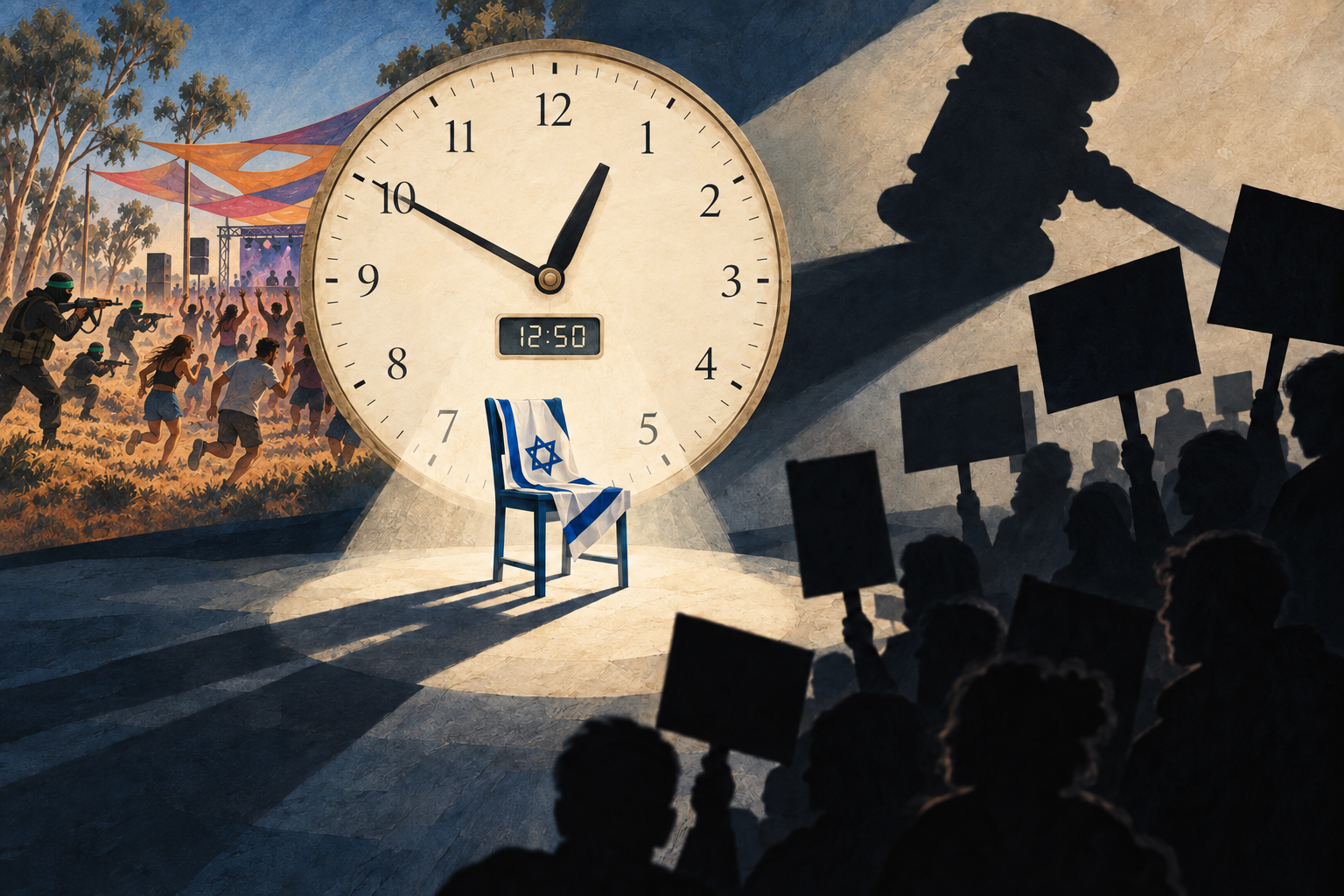
At 12:50 p.m. on October 7, 2023, with the Hamas attack still underway in Israel, an organizer called London’s Metropolitan Police to notify officers that a major pro-Palestinian demonstration would take place the following Saturday. The scale of the massacre was not yet known, and a side had already been chosen.
Five minutes later, at 12:55 p.m., the Community Security Trust, which monitors antisemitism in Britain, recorded the first antisemitic incident linked to the attack: a car displaying a Palestinian flag drove past a synagogue in Hertfordshire as Jews celebrated Simchat Torah. By the end of that Saturday, 31 antisemitic incidents had been recorded across the country, compared with a previous average of five a day.
There is a problem with the chronology of one of the most common explanations for what followed October 7: that Israel’s military response in Gaza caused the wave of anger against Israel and, at its most extreme, the global surge in antisemitism. Israel began airstrikes that same day. But the prolonged campaign, the large-scale ground offensive and the devastation later invoked to explain that backlash still lay ahead. Those later developments cannot explain a judgment already being rendered while the massacre was underway.
That same Saturday, while Israel was still counting its dead, a statement signed by 34 Harvard student groups was already holding the “Israeli regime entirely responsible for all unfolding violence.” About 1,200 people were killed that day and 251 taken hostage. The next day, hundreds gathered in Times Square, where chants included “Resistance is justified” and “Globalize the intifada.” Some demonstrators reportedly chanted “700,” an apparent reference to the Israeli death toll being reported at the time. In Britain, the Community Security Trust recorded 416 antisemitic incidents in the first week after the attack, more than in any subsequent week, including after Israel began its large-scale ground offensive on October 27.
None of this means that solidarity with Palestinians is inherently antisemitic. Conflating the two would be a serious mistake. But solidarity with Palestinians is also not the same as justifying what had just happened.
The rush to judgment continued. On October 17 came another test: an explosion in the area of Al-Ahli Hospital in Gaza. Authorities in Hamas-controlled Gaza blamed Israel and announced that about 500 people had been killed. News organizations around the world reported the claim before it could be verified. A summit between President Joe Biden and Arab leaders was canceled. In the days that followed, independent assessments and intelligence agencies concluded that the evidence pointed to a rocket fired from Gaza, although who fired it has never been conclusively established. The New York Times later acknowledged in an editors’ note that its early coverage had relied too heavily on Hamas claims that could not be independently verified. The headline traveled around the world. The correction to the picture did not.
There is another part of this story, and it is harder to dismiss. Documents recovered in Gaza show that more than a year before the attack, Yahya Sinwar was already contemplating scenarios involving a large-scale assault and an extreme Israeli response. “We knew there was going to be a violent reaction,” Basem Naim, a member of Hamas’s political leadership, later told The Washington Post. Khalil al-Hayya was more explicit. The goal, he said, was to “change the entire equation.” “What could change the equation was a great act, and without a doubt, it was known that the reaction to this great act would be big.”
How could it have been otherwise? What country, after roughly 1,200 of its people were killed and 251 abducted in a single day, would not respond militarily against the group responsible? The point became harder to ignore when Ghazi Hamad, another member of Hamas’s political leadership, said October 7 was only “the first time”: there would be a second, a third and a fourth. Hamas did not merely expect Israel to react. Documents from before the attack and statements by its leaders afterward indicate that they went into October 7 knowing that a response on a massive scale was a foreseeable consequence.
And that brings us back to the chronology. The mobilization against Israel began too early to be explained by the scale its military response would eventually assume. Israel was being blamed while it was still counting its dead. Antisemitic incidents were already soaring well before Israel launched its large-scale ground offensive in Gaza.
None of this proves that Hamas orchestrated the demonstrations abroad. There is not enough evidence to make that claim. The explanation may be more unsettling precisely because it requires no conspiracy at all. The ideological infrastructure already existed, from familiar slogans and campus networks to a narrative that cast Israel as a colonial power and an apartheid state. Within that framework, the roles had already been assigned: Israel was the oppressor and the Palestinians the oppressed. Whatever happened next would be understood through that lens, even when what happened first was the massacre of Israelis. October 7 did not have to create a narrative. It found one waiting for it.
What came afterward, the destruction in Gaza, thousands of deaths and a long war, clearly fueled and prolonged the reaction. That must be acknowledged. But what happened afterward cannot explain what came before.
To understand the war of narratives, go back to 12:50 p.m. that Saturday. The massacre was still underway, and the condemnation had already begun. Israel was still counting its dead and trying to drive Hamas gunmen from its territory, yet the judgment had already been rendered. The war had barely begun, but the narrative already had its winner.