
Former Jewish Prison Chaplain / Co-Founder: L’chaim
Israeli and Worldwide Jewish Organizations Condemn Ben Gvir’s Death Penalty Bill
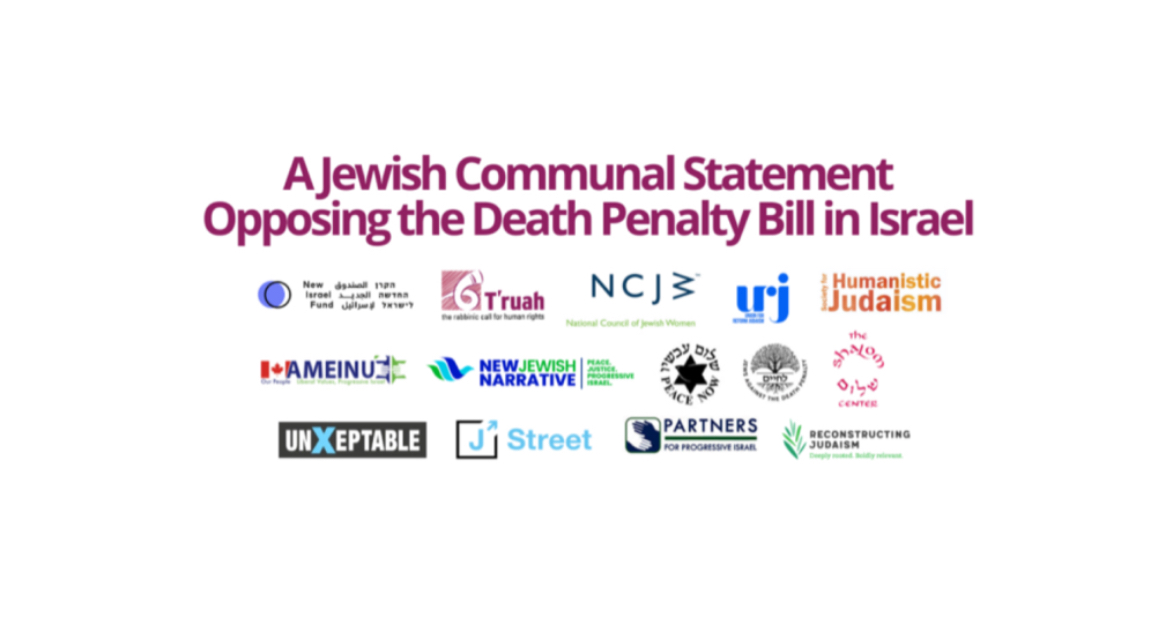
Image: Some of the organizations that have signed onto the recent Jewish Communal Statement Opposing the Death Penalty Bill in Israel. Source: https://truah.org/press/a-jewish-communal-statement-opposing-the-death-penalty-bill-in-israel/ No copyright.
The Jewish Communal Statement Opposing the Death Penalty Bill in Israel, which went public last week, reveals the immense scope of reputable Israeli and Jewish groups that are standing firmly against this legislation. The unambiguous statement builds upon the documented massive scale of rabbinic voices who already stand against the death penalty, as well as online petition in Israel that already has well over five thousand signatures. The statement begins by declaring: “We write out of deep concern regarding the death penalty bill currently advancing in the Knesset.” (For clarity, the text of the statement will appear in red in this essay.) This deliberate opening underscores the significance of this moment in Israel’s life. The existential danger that this bill poses to Israel makes it one of the most consequential pieces of legislation ever to come before the Knesset. Given the tremendously broad consensus of Jews – well into the millions – that the signatories of this document represent, it behooves death penalty proponents in the Knesset to examine and understand the various clauses of this vital declaration.
Signatories Reflect Broad Consensus
Before doing so, it is helpful to discern the vast scope of the many organizations that, as of this writing, have already signed this document, in addition to the 4300 members of “L’chaim! Jews Against the Death Penalty.” Signatory Hashomer Hatzair USA has roughly 7,000 members outside of Israel. J Street reports having approximately 200,000 supporters and a Rabbinic and Cantorial Cabinet with over 1,000 members. The organization also includes over 1,100 national lay leaders and a 200-member Advisory Council of prominent Americans. The National Council of Jewish Women is a grassroots organization with over 250,000 members, advocates, and supporters across the United States and Israel, as of 2026.
The list continues with Reconstructing Judaism, the central organization for the Reconstructionist movement, representing approximately 40,000 to 50,000 members across nearly 100 affiliated congregations and havurahs. The Society for Humanistic Judaism (SHJ) has over 10,000 members across roughly 30 affiliated congregations in the United States and Canada, based on estimates. While this reflects the core organization in North America, some estimates suggest a broader, more international reach, with some reports indicating up to 40,000 members globally. T’ruah: The Rabbinic Call for Human Rights organizes, trains, and supports more than 2,300 rabbis and cantors across 47 states and 5 Canadian provinces who are chaverim (members) of T’ruah. Last but certainly not least, the Union for Reform Judaism (URJ) includes a vast network of roughly 825 to 900+ congregations across North America, serving an estimated 1.5 million to 2.2 million people. It is considered the largest Jewish denomination in North America, with approximately 880,000 registered adults in its constituency. It is with these millions in mind that the members of the Knesset should consider the words of this communal declaration.
Making Israel a Pariah State
The statement makes its first point by referring to the enormity of the change that this bill proposes within Israeli society and in the eyes of the world.“For decades,” it states, “Israel has maintained a policy of de facto abolition of capital punishment, reflecting a broad recognition, shared across Jewish tradition and democratic societies, that the power of the state to take life demands the greatest restraint. This proposed legislation would mark a significant departure from that longstanding norm by authorizing executions and embedding capital punishment in Israeli law.” The broad consensus to which the statement refers is the fact that more than 70% of the world’s countries have abolished capital punishment in law or practice. The U.S. is an outlier among its close allies in its continued use of the death penalty, and this bill would lower Israel to its lamentable status. Indeed, Ben Gvir’s proposed death penalty bill would, if enacted, place Israel on par with Iran as a top global executioner. Israeli politicians and citizens would do well to realize this likelihood as they consider voting for this law.
Blatant Racism
The Jewish communal statement then turns to the issues of racism. “As currently proposed,” it continues, “the bill creates a discriminatory hierarchy within the law. It mandates the death penalty only in cases involving Palestinian suspects in the West Bank, preserves judicial discretion in comparable cases involving Israelis, and excludes altogether cases in which Israeli settlers kill Palestinian residents. This bill is racist and discriminatory by design and indefensible in principle.”
Applying different standards to Jewish and non-Jewish terrorists is, of course, inherently racist. This undeniable fact regarding Israel’s bill is reminiscent of the current reality of the death penalty’s racist implementation in the United States. There, racial bias against defendants of color and in favor of white victims has a demonstrable, statistically significant effect on which defendants the “justice” system charges with the death penalty, sentences to death, and ultimately executes. Those convicted of murdering white victims are much more likely to be given the death sentence. Capital punishment has long come under scrutiny for being racially biased. Earlier in the twentieth century, when states applied it for the crime of rape, 89 percent of the executions involved black defendants, most for the rape of a white woman. In the modern era, when executions have been carried out exclusively for murder, 75 percent of the cases involve the murder of white victims, even though about half of all homicide victims in America are black. Almost all of the sophisticated studies exploring this area over many years have uncovered a bias in this regard. These studies typically control for other variables in the cases studied, such as the number of victims or the brutality of the crime, and still found that defendants were more likely to be sentenced to death if they killed a white person. A similar trend will no doubt develop in Israel in cases involving Jewish versus non-Jewish victims.
Abrogation of Jewish Values
After invoking this racist reality of the bill, the statement continues by drawing from Jewish law and values: “Jewish tradition places the highest possible value on human life. Our sages erected extraordinary barriers around the use of the death penalty, teaching that a court that executes even once in seventy years is considered destructive. This moral caution reflects a foundational Jewish commitment to the sanctity of life. Laws that mandate irreversible punishment while eliminating discretion and safeguards risk undermining the Jewish and democratic principle that all human beings deserve equal protection and dignity under the law.” Let there be no doubt: the safeguards that traditional Jewish law established rendered capital punishment essentially impossible to carry out. For murders to be eligible for death, two eyewitnesses needed to have caught them in the act and warned them ahead of time that their action would result in the death penalty. Many of the most powerful and brilliant rabbinic voices reflect this impossible standard. Consider the words of some of the loftiest figures among them: Rabbi Eliezer ben Azariah, Rabbi Tarfon, and Rabbi Akiva, as found in the Talmud:
“A Sanhedrin [Rabbinic court] that affects an execution once in seven years is branded a destructive tribunal. Rabbi Eliezer ben Azariah says: once in 70 years. Rabbi Tarfon and Rabbi Akiva say: Were we members of a Sanhedrin, no person would ever be put to death.[Thereupon] Rabban Simeon ben Gamaliel remarked, they would also multiply shedders of blood in Israel!” (Mishnah, Makkot 7a)
Indeed, there were dissenters. — like Rabban Simeon ben Gamaliel above — who were pro-death, citing similar deterrence factors and other now antiquated notions of “justice.” Posterity can forgive them for their views, which reflected the understanding of their times, including in the realm of deterrence.
Jewish tradition also forbids the execution of someone where there is any level of doubt about guilt or fairness. It is for this very reason that rabbinic tradition placed prodigious safeguards to ensure that no innocent person would face execution. Arguably, the most famous comment comes from one of the most renowned Jewish sages: the Rambam, Rabbi Moses ben Maimon (1135-1204). Maimonides, as he is often called, was a Sephardic Jewish physician and philosopher who became one of the most prolific and influential Torah scholars of the Middle Ages. As he famously wrote of capital punishment in Sefer HaMitzvot, Prohibition 290: “It is better to acquit a thousand guilty persons than to put a single innocent one to death.” And yet: Israel has already done just that with its 1948 execution of innocent Israeli Defense Force officer Meir Tobianski, whom the Jewish State hanged and posthumously exonerated. Maimonides’s charge for the protection of the innocent must inform the decision now before the Knesset: one innocent death is one too many.
Inciting Martyrs and Inviting Murders
The communal statement continues: “Israel faces real and ongoing security challenges, but history and experience show that the death penalty does not deter violence and instead risks deepening cycles of harm.” It is for precisely this reason that the current debate in the Israeli Knesset regarding the proposed death penalty bill for convicted terrorists is one of the most consequential human rights discussions before that esteemed legislative body in the twenty-first century. Its outcome impacts not only the State of Israel, but Jews everywhere.
If the Knesset enacts the bill – if the unconscionable stain of executions succeeds in darkening the moral fabric of Israeli society – antisemitic extremists would assuredly blame all Jews for their state’s sponsored murder program, neatly fitting it into their warped view of Israel – and, by extension, Judaism – as a so-called “Death Cult.” Specifically, the spectre of executions has the potential to do tremendous harm to Israel’s already precarious international standing as it seeks to distance itself from enemy nations like Iran. Israel claims to be opposed to the Iranian regime in terms of moral integrity, human rights adherence, and as a beacon of democracy in the Middle East. Executions in Israel would only align it with Iran in the minds of the world’s civilized nations, who would further equate both societies for their respective forms of religious fanaticism that seem to be dictating foundational law.
Just as this bill jeopardizes the safety and security of Jews across the globe, it also threatens to permanently mar what remains of Israel’s moral standing in the civilized world. In the highly volatile political climate that now imperils the rule of law in Israel, this issue further normalizes the invocation of state violence. It widens the gap between modern-day Israel and the central Jewish value of the inviolability of life.
This vital debate hinges on Justice Minister and death penalty proponent Itamar Ben-Gvir’s repeated claim that the fear of execution would deter would-be terrorists. In the wake of the recent fatal ramming and stabbing of two Israeli citizens in Beit She’an, Ben-Gvir falsely claimed that passing his execution law would help to deter others from committing such deadly acts of terror. Ben-Gvir’s statements reflect a widespread fallacy that scholars have debunked time and again. Despite this fact, Ben-Gvir’s abominable, politically-motivated comments calling death penalty opponents “Hamas supporters” – just like his monstrous noose-shaped lapel pin – seem to have deluded many Israelis and Jews. They refuse to realize that when it comes to the penalty of death, copious scholarship has demonstrated that deterrence is an abject fallacy
On the contrary, there is ample reason to conclude that the prospect of martyrdom through execution would only increase the likelihood of future acts of terror across Israel by further inciting martyrs and inviting murders. A renowned comment regarding the well-established relationship between the death penalty and a desire for martyrdom comes from 19th-century writer Eliphas Levi. Levi demonstrated a keen understanding of the dynamics at play when he wrote: “Every head that falls upon the scaffold may be honored and praised as the head of a martyr.”
Applying Levi’s wisdom to modern-day Israel, it becomes clear that a mandatory death sentence for Palestinians who murder Jews will almost certainly increase the number of terrorist attacks. Radical Islamist terrorists – like those who perpetrated mass murder on October 7th, 2023 – celebrate martyrdom to receive the supposed rewards awaiting them in paradise. They want to die for their cause. Their preference is for martyrdom in the act of killing, but if they can kill and then be placed on a pedestal for their peers to laud them as heroes facing the death penalty for their cause, then all the better. Such an eventuality would allow them to become celebrities in a world that hates Israel for how it treats non-Jewish citizens. If Israel institutes the death penalty, these scenarios could happen. Why would Israel want to encourage potential terrorists? On this purely practical level, this proposed legislation is insane. A far harsher punishment is incarceration. Let perpetrators consider what they have done and why they endure the constrictions of a maximum-security prison every day. As a former Jewish prison chaplain, I can personally attest to this harsh reality.
Proponents of the death penalty have argued that executing terrorists will prevent future hostage-taking for prisoner swaps. Israel can avoid this simply by changing the law to forbid including those directly involved in murder in any future prisoner exchanges, with no exceptions. This initiative would solve the problem without creating more dead martyrs around whose memory other terrorists would most assuredly rally.
The Inviolability of Life
Next, the statement focuses on the sanctity of life. “As members of a global Jewish community committed to Israel’s future,” it concludes, “we urge Israeli leaders to halt this legislation and to reaffirm values that have long guided Jewish life: the sanctity of human life and the dignity of every person.” If enacted, the death penalty bill currently before the Israeli Knesset would constitute a violation of arguably the most fundamental of all human rights: the right to life itself. The Universal Declaration of Human Rights (UDHR), a foundational document of the United Nations, adopted in 1948, clearly established this human right. It is therefore logical that the United Nations Human Rights chief, Volker Türk, denounced Israel for its proposed legislation to execute Palestinians. Türk reminded Israel that “when it comes to the death penalty, the United Nations is very clear, and opposes it under all circumstances.”
Any nation that engages in the blatant human rights violation that is capital punishment inherently fails the litmus test for a civilized society. The latest iteration of Israel’s proposed death penalty bill for convicted terrorists is no exception. On the contrary, it only provides further evidence of how quickly any procedural safeguards and notions of humanitarian practices evaporate once a civilization opens itself to the veritable danse macabre of state-sponsored killing. Attorney Robert Dunham, Director of the Death Penalty Policy Project and former Executive Director of the Death Penalty Information Center, encapsulated it best when he wrote that the current bill “is a walking human rights violation.”
Many Paths to Abolition
There are multiple reasons why individuals and organizations come to see the light of death penalty abolition. Beyond the arguments centering on religion, racism, false deterrence, and inviolability of life that the Jewish communal statement cites, L’chaim! Jews Against the Death Penalty has repeatedly outlined many other reasons for standing against capital punishment now, and always. These include the fact that executions always constitute torture, risk executing the innocent, and – from Adolf Hitler to Donald Trump to Ben-Gvir – have been used as a political tool, particularly during election campaigns. L’chaim has also illustrated how many execution methods are direct Nazi legacies, including firing squad, gassing, and lethal injection. Famed death penalty abolitionist Elie Wiesel best articulated L’chaim’s stance when he said of capital punishment – in the shadow of the Holocaust – that “death should never be the answer in a civilized society.” Members of the Knesset – and all death penalty proponents – should heed Wiesel’s message and the millions of voices of reason that the signatories of this communal statement represent. They should recognize that executions are never the answer – and that Israel’s proposed death penalty bill should not be the answer now.
Cantor Michael J. Zoosman, MSM
Co-Founder: “L’chaim: Jews Against the Death Penalty”
Advisory Board Member: Death Penalty Action
Related Topics
Related Posts