
Time for Positive Change...
Israel’s Arab Vote: More Than a Kingmaker
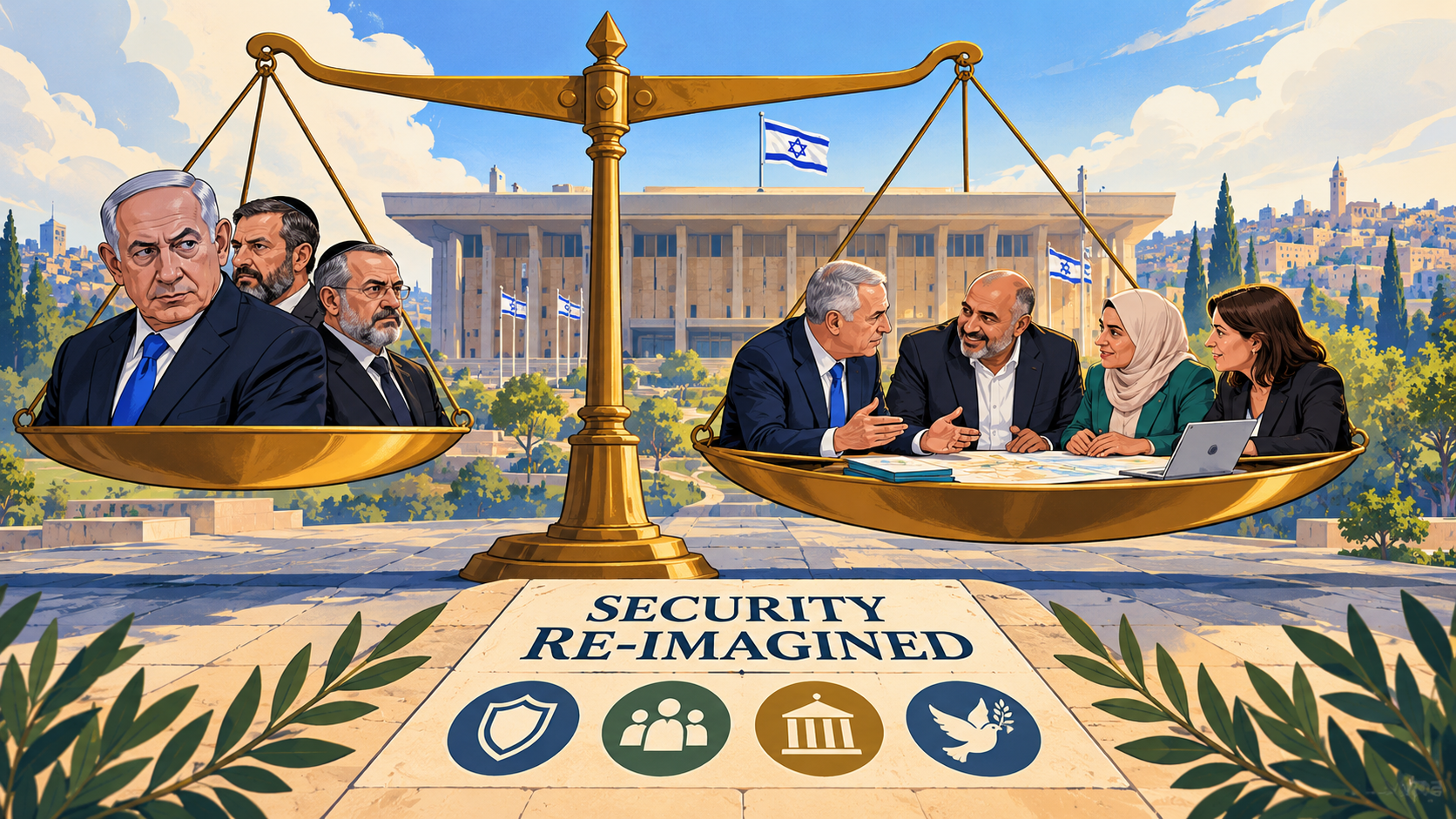
Diversity with Facilitated Deliberation Reduces Division and Improves Security
A path to stronger security through Jewish and Arab cooperation
Israel’s election has brought an important question into focus. Arab citizens, around one-fifth of Israel’s population, have voted in numbers that could give their representatives a decisive role in the next government. Yet the debate often treats these votes only as a way to make or break a prime minister. That misses a larger opportunity: Jewish and Arab political cooperation could itself contribute to Israel’s national security.
At the time of writing on 28 October, the count remains incomplete. An early partial count placed Benjamin Netanyahu’s bloc at 56 seats, Gadi Eisenkot’s at 48, and the Arab parties at 16. These numbers may change. What is already clear is that the Arab vote cannot simply be dismissed as irrelevant to government formation.
The power to recommend, support or oppose
Israel’s president consults the elected parliamentary groups before choosing a Knesset member to attempt to form a government. Ra’am and the Joint List can recommend Eisenkot, decline to recommend Netanyahu, or explain that they intend to oppose a Netanyahu government. A recommendation is not a coalition agreement. It does not bind a party to vote for every policy or even to support the government’s formation.
This distinction matters because Eisenkot has set conditions for parties entering his coalition: acceptance of Israel as a Jewish and democratic state, the values of the Declaration of Independence, universal military or civilian service, and recognition of Hamas as a terrorist organisation. In some statements he has also required support for Hamas’s destruction. He has said Ra’am does not currently meet those conditions and has rejected seeking its outside backing.
Ra’am could nevertheless recommend Eisenkot independently. He cannot dictate how another party votes. Accepting an unsolicited recommendation would not, by itself, amount to admitting Ra’am to his coalition. But there is a real political boundary here. If he negotiated a continuing agreement to rely on Ra’am’s votes, that would raise a separate question about his public commitments. It should not be disguised as something else.
A minority government is legally possible if it wins the Knesset’s confidence vote, even without 61 coalition members. Its survival would still depend on votes, abstentions, budgets and confidence arrangements. An Arab party could support selected measures without becoming a ministerial partner. Likewise, right-wing opposition members could support security legislation they judged necessary. Not every Knesset vote needs to follow the government versus opposition divide.
An overlooked national security asset
The more important issue is what meaningful cooperation could achieve. Israel faces grave external threats. Strong armed forces, intelligence and deterrence remain essential. But national security also depends on trust in public institutions, effective policing, economic opportunity, and the ability of communities to work together during crises.
Organised crime and illegal firearms in Arab towns are not merely an Arab community problem. They undermine public safety, local government, investment and confidence in the state. A credible Jewish and Arab governing partnership could help combine strong law enforcement with community trust, independent oversight and better local services. People are more likely to cooperate with police when they believe they will receive fair protection.
Ra’am’s inclusion of Yoav Segalovitz, a Jewish former senior police officer, near the top of its 2026 list makes this possibility unusually concrete. It does not prove that cooperation will succeed. It does show that policing and shared citizenship can provide practical common ground across a deep political divide.
The possible longer-term cycle is important. Fairer services and more effective policing can build trust. Trust can encourage reporting of crimes and cooperation with institutions. Improved safety can then strengthen confidence that democratic participation delivers results. The reverse is also possible: promises without delivery can deepen alienation. Outcomes, not slogans, must be measured.
A signal beyond Israel’s borders
A government that works constructively with Arab citizens could send a significant message across the region. It would demonstrate that Jewish national identity and meaningful Arab political participation need not be mutually exclusive. That may support relationships with Arab states and create a practical example of cooperation in a region marked by fear and mistrust.
It could also strengthen Israel’s response to international criticism of its democratic character. Yet this must be substantive, not a public relations exercise. Arab ministers or parliamentary partners would not by themselves settle disputes over inequality within Israel, or the distinct legal and political questions concerning Palestinians in the West Bank. Credibility would depend on actual improvements in equal treatment, safety and opportunity.
Diversity works better when professionally facilitated
The Bennett and Lapid government of 2021 to 2022 offers a cautionary example. It brought together parties from the right, centre, left and Ra’am. It collapsed after narrow parliamentary margins, defections from Bennett’s own party, and disputes over West Bank regulations. The government also struggled to manage disagreements that its partners knew would arise and the opposition capitalized on this.
Israeli governments have always had to reconcile parties with different values, voters and priorities. Yet coalition bargaining is often treated as a substitute for careful collective reasoning. Professional facilitators could provide another tool. Their task would not be to tell elected leaders what to decide, but to help them examine evidence, identify shared objectives, clarify differences and formulate workable options.
Imagine a proposal to strengthen police powers against organised crime. One party wants faster enforcement. Another fears unfair treatment of Arab communities. A facilitated discussion could produce a common goal with conditions: stronger investigations, independent scrutiny, safeguards against discrimination and a scheduled review of results. Parties might support the package while recording reservations about particular provisions.
The same method could be used in coalition negotiations, cabinet working groups and selected Knesset committees. Participants could agree in advance which matters require a common position, which allow a free vote, and how urgent security decisions will be handled. Facilitators would need independence, suitable security clearances where necessary, and no authority to override ministers or parliamentarians.
While not a magic solution, diversity offers another opportunity to improve deliberation. In a world becoming more polarized and divided, this is a subtle yet hugely significant step not only in improving democratic decision-making, but also in the protective security architecture.
Security through shared responsibility
There are serious objections to depending on Ra’am. Coalition partners may disagree about military operations, national service, Palestinian statehood or Israel’s national character. Such disagreements could threaten stability. Eisenkot’s stated conditions deserve to be taken seriously, as do the concerns of Arab citizens who do not want political participation to require surrendering their identity or views.
But those differences do not make every form of cooperation impossible. A parliamentary recommendation, issue-by-issue support, a negotiated coalition agreement and full cabinet membership are distinct choices. Each carries different obligations and risks. Clear rules, public accountability and honest recognition of disagreement matter more than pretending everyone thinks alike.
Israel’s Arab vote is therefore more than a potential kingmaker or king destroyer. It is a test of whether democratic participation can become shared responsibility, and whether that responsibility can improve security for all citizens. The opportunity is not to replace military strength with dialogue. It is to add stronger internal trust, better government and practical Jewish and Arab cooperation to Israel’s wider security capabilities.
A strong democracy does not require its citizens or leaders to agree on everything. It needs institutions capable of turning informed disagreement into sound decisions while preserving the right to dissent. That is a national security issue as much as a democratic one.
Click here for a 7-minute video explainer of the above article
Sources and further reading
The Times of Israel: The Times of Israel: Partial election count, 28 October 2026
The Times of Israel: Arab parties and election turnout
The Times of Israel: Eisenkot’s coalition conditions
The Times of Israel: Interview with Gadi Eisenkot
Israel Democracy Institute: How governments are formed
Related Topics
Related Posts