The views expressed herein are solely mine.
Israel’s Benghazi Option: Realism Over Diplomacy
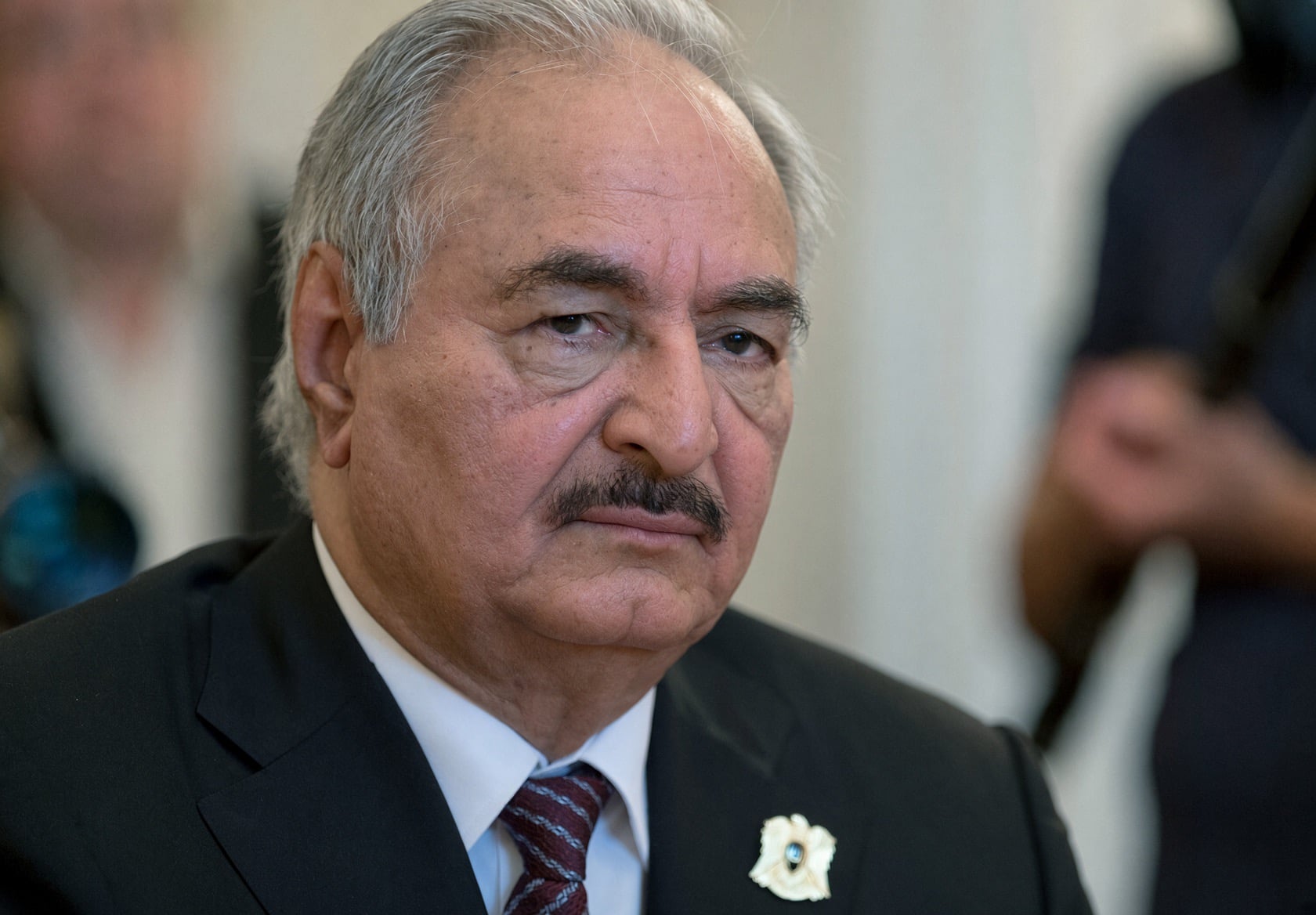
Libyan militia commander Gen. Khalifa Haftar in Moscow, Russia, August 14, 2017. (AP Photo/Ivan Sekretarev, File).
Egyptian subversion greeted King Hassan II’s February 1961 ascension, as Gamal Abdel Nasser’s assassins actively targeted the new monarch. In response, Mossad intelligence exposed the plot and alerted General Mohamed Oufkir, allowing Moroccan troops to dismantle the hostile Casablanca cell. This existential lifeline forced a raw, transactional alignment: Rabat repaid Jerusalem with sweeping strategic access, granting Israel a permanent station and security-training rights in exchange for 100 tanks for the Algerian front.
This strategic transactionalism expanded dramatically in September 1965, when Hassan cleared a Casablanca hotel floor for “the Birds,” a joint Shin Bet–Mossad team led by Israeli intelligence legends Rafi Eitan and Peter Malkin. The Arab League summit convened in that very building from September 13 to 18, blissfully compromised. Through covert wiretaps, Israeli intelligence caught Nasser snarling at King Hussein, exposing an Arab order of battle utterly unfit for war. Director Meir Amit rightly ranked this unprecedented haul among Israeli espionage’s crowning glories, while General Shlomo Gazit later confirmed these tapes guaranteed the General Staff’s 1967 victory.
At the same time, regime survival anchored the transaction’s other half. When dissident Mehdi Ben Barka sought Israeli assistance to overthrow the monarchy, he triggered a swift Mossad counter-alignment with Hassan. Israeli operational tracking relentlessly monitored Ben Barka until French officers intercepted him outside the Brasserie Lipp on October 29, 1965. Ultimately, Moroccan operatives liquidated the dissident, while Mossad provided the surveillance, safe houses, and body-disposal expertise code-named “Baba Batra.”
Today, Field Marshal Khalifa Haftar commands Hassan’s historic leverage from far superior strategic ground. The Libyan National Army occupies the vital Oil Crescent, commanding Sidra, Ras Lanuf, Brega, Zueitina, and Hariga. Past tactical port shutdowns choked 800,000 barrels a day, bleeding roughly $55 million daily in January 2020. More recently, the eastern infrastructure at Sarir and Messla pumped nearly 180,000 barrels daily of premium crude in September 2025. Furthermore, Arkenu’s parallel commercial networks exported 42.1 million barrels between January 2024 and December 2025, diverting $3 billion and shattering the National Oil Corporation’s monopoly. In short, Benghazi controls the actual operational valves, leaving Tripoli with nothing but a hollow United Nations diplomatic seat.
Accordingly, Jerusalem’s strategic planners require immediate access to these Libyan valves to secure the Jewish state’s energy supply. Domestic crude production yields a meager 25,000 barrels a day against a sweeping daily consumption of 220,000 barrels. In practice, Central Asian suppliers in Azerbaijan and Kazakhstan currently bridge this deficit via the highly vulnerable Eilat–Ashkelon pipeline. Compounding this vulnerability, Iranian missile strikes shuttered Haifa’s 197,000-barrel-a-day refinery in June 2025, forcing clean-product imports up to 74,000 barrels daily. Retail fuel prices for self-service 95-octane subsequently hit a record $2.69 per liter on October 1, 2026. To offset this threat, a crude-for-security pact must leverage an excise-schedule rebate to neutralize the heavy domestic taxes absorbing most of that cost.
Meanwhile, revisionist powers in Ankara and Moscow already exploit this strategic coastline to the detriment of Western interests. Turkey’s November 2019 maritime memorandum with Tripoli actively undercuts Israeli, Greek, and Cypriot Mediterranean claims. Simultaneously, Russia’s Africa Corps systematically upgrades six critical airfields, including Al-Khadim—one hundred kilometers east of Benghazi—Jufra, and Brak al-Shati. Russian tactical deployment at Brak al-Shati rose from 300 personnel in December 2024 to roughly 450 by August 2026. Kremlin forces across Haftar’s broader zone now total an estimated 2,000 troops. Yet, Field Marshal Haftar relies on Moscow simply because Netanyahu’s kleptocracy has offered nothing.
This proposed counter-strategy must deploy three immediate policy instruments to reverse the expanding Turkish-Russian footprint. To do so, under the Sarir Rebate, a joint Mossad–Shin Bet close-protection cell must be stationed within Haftar’s household, replicating the 1961 Rabat archetype in direct exchange for crude. In tandem, the Europe Asia Pipeline Company should lift 50,000 barrels a day of eastern crude—cutting a quarter of Israel’s import deficit—into Ashkelon via Emirati channels. The Finance Ministry would then rebate gasoline excise on this stream, deflating the record $2.69-per-liter pump price. Crucially, the agreement’s classified annex would cap Africa Corps growth at Al-Khadim and Jufra while supplying counter-drone lasers, coastal electronic-intelligence batteries, and armored cars.
Next, the Sidra Floor initiative must lease a tactical sensor deck between Tobruk and Ras Lanuf without establishing a permanent, politically sensitive military base. A rotational operational crew must deploy coastal radar, acoustic arrays, and counter-drone lasers, fusing this data with Greek and Cypriot intelligence feeds. This forward coastal presence would directly undercut Ankara’s illegal 2019 maritime claims, while granting the Israeli Navy a precise fix on Russian transports bound for the Sahel. Hassan’s 1965 hotel floor established the definitive precedent: maximizing strategic access without a public alliance.
Finally, the Hariga Loop initiative would reactivate a single processing train at Ras Lanuf and integrate operations with Benghazi’s new aviation infrastructure. Libyan state refineries control a 666,000-barrel-a-day nameplate capacity but processed a meager 153,000 barrels daily throughout 2025. The Ras Lanuf facility boasts a 220,000-barrel daily threshold yet has remained idle for most years since 2013. To bridge this gap, Israeli process-control teams would engineer the restart of this first train, enabling Bazan to refine a matching tranche of Sirte crude and return diesel and jet fuel to Hariga. Concurrently, Israeli industrial contractors would install air-traffic, perimeter, and fuel-farm systems at the $1.3 billion airport complex. This modern hub accommodates 15 million passengers, Airbus A380 operations, and a 3.8-kilometer runway. A discreet Tobruk liaison office would manage the portfolio through an established Abu Dhabi channel that already routes eastern Libyan aircraft toward Jerusalem. Formal diplomatic recognition can easily wait; technical dependence predated Morocco’s eventual Abraham Accords entry by fifty-five years.
Benghazi commands the crude oil, the strategic runways, and the sovereign ruler’s constant exposure to assassination. Israeli statecraft successfully priced that exact bargain in a Casablanca hotel in 1965. Going forward, Jerusalem’s planners must aggressively price this next Mediterranean lifecycle in Sirte crude.
Related Topics
Related Posts