Former Jewish Prison Chaplain / Co-Founder: L’chaim
Israel’s Death Penalty Would Violate the Human Right -and Jewish Value- of Life
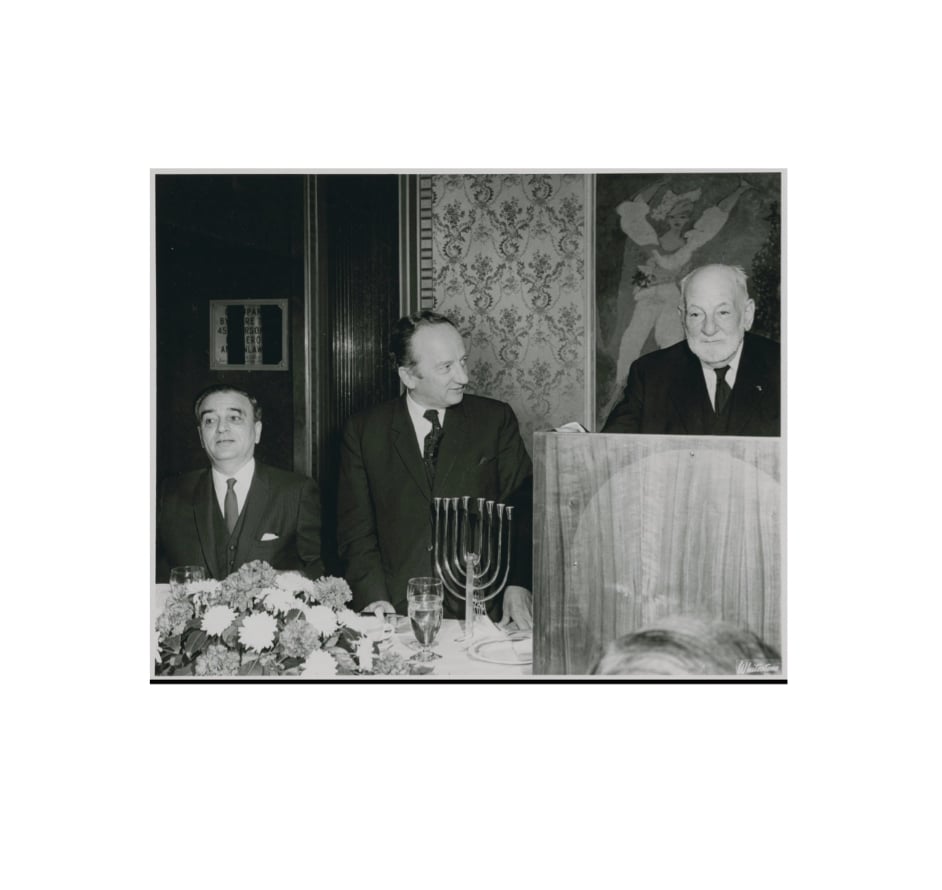
Monsieur René Cassin (1887-1976), pictured on the far-right, speaks at a Hanukkah gathering. Cassin was a French jurist and activist, a Sephardic Jew and a staunch supporter of Israel, who helped draft the right to life, as outlined in Article 3 of the Universal Declaration of Human Rights, adopted by the UN in 1948. No copyright. Source: https://open.substack.com/pub/davidaaronovitch/p/israelis-versus-the-jim-crow-zionists
If enacted, the death penalty bill currently before the Israeli Knesset would constitute a violation of arguably the most fundamental of all human rights: the right to life itself. The Universal Declaration of Human Rights (UDHR), a foundational document of the United Nations, adopted in 1948, clearly established this human right. It is therefore logical that the United Nations Human Rights chief, Volker Türk, denounced Israel for its proposed legislation to execute Palestinians. Türk reminded Israel that “when it comes to the death penalty, the United Nations is very clear, and opposes it under all circumstances.” Prime Minister Benjamin Netanyahu, National Justice Minister Itamar Ben-Gvir, and fellow proponents of Israel’s death penalty bill dismiss this human rights violation charge, often retreating to the erroneous claim that the accusation is further evidence of anti-Israel bias at the United Nations. Ben-Gvir even accuses individuals who invoke such human rights violations of being “Hamas supporters.” For death penalty advocates like Ben-Gvir, it seems that anyone who would invoke the human right to life – including Rabbis Jill Jacobs of T’ruah: The Rabbinic Call for Human Rights, Avi Dabush of Rabbis for Human Rights, and Rabbi Yitz Greenberg, among countless others – would qualify as supporters of terror.
Beyond parroting the disproven fallacy of deterrence and ignoring the fact that the death penalty bill would only incite and invite more would-be shaheeds (martyrs), Ben-Gvir’s flawed reasoning ignores the fact that one of the primary drafters of the UN’s Universal Declaration of Human Rights was René Cassin (1887-1976), a Sephardic Jew and staunch Israel supporter. Cassin was a French jurist and activist who had been sentenced to death and whose work drew heavily on his Jewish values and the Jewish experience of persecution and genocide, particularly the Holocaust, as a moral foundation for universal human rights. Cassin became one of the architects of what is now well-established as the human right to life that undergirds death penalty opposition worldwide. There can be no doubt that the views of the thousands of members of L’chaim! Jews Against the Death Penalty fully aligns with Cassin’s abolitionist perspective. It behooves the Jewish world – and Israeli politicians like Ben-Gvir and Netanyahu in particular – to learn Cassin’s Jewish story in helping to create the universal provision of the right to life – and the inherent inadmissibility of the death penalty for civilized humanity.
Monsieur René Cassin (1887-1976): The Sephardic Jew who helped draft the human right to life
Monsieur René Cassin was born in Bayonne on 5 October 1887 to a Portuguese Jewish family. He grew up in Nice, where he attended the Lycée Masséna, and graduated with a bachelor’s degree at 17. At the University of Provence, young Cassin studied political economics, constitutional history, and Roman law. He was awarded distinctions in law, a university degree with distinction, and the first prize in the competitive examinations in the faculty of law. Cassin was an invited speaker at various international peace conferences, and in 1914, in Paris, he was awarded his doctorate in juridical science, economics, and politics.
After completing his studies, Cassin served as a soldier in the First World War, during which he was seriously wounded. Upon his return from the front, he helped to found the Union fédérale, a leftist pacifist organization for veterans. Cassin also headed numerous non-governmental organizations and established the French Federation of Disabled War Veterans in 1918, serving as its president until 1940 and then as its honorary president. In 1920, Cassin was appointed professor of law at Lille and in 1929 at Paris, where he continued to teach until 1960.
On the international level, Cassin taught at the Academy of International Law in The Hague and the Graduate Institute of International Studies in Geneva, among other places. He also became a French delegate to the League of Nations from 1924 to 1938, where Cassin pressed for progress on disarmament and the development of institutions to aid the resolution of international conflicts. Cassin himself subsequently became a founder, member, and president of the European Court of Human Rights, which has been instrumental in limiting and ultimately helping to abolish the death penalty across its member states.
Cassin’s Jewish Values
Before the 1930s, Cassin’s Jewish identity was a private matter of secondary importance to him. The rise of Nazism, the Vichy regime’s anti-Semitism, and the Holocaust were the critical catalysts that forged his public Jewish identity and activism. In essence, while his early life was secular, the cataclysm of the Shoah fundamentally shaped his Jewish consciousness and channeled his legal and diplomatic efforts into the universal struggle for human rights, grounded in the Jewish historical experience and a commitment to justice for all.
On 24 June 1940, during the Second World War, Cassin heeded General Charles de Gaulle’s radio appeal and joined him in London, where he used his legal expertise to help de Gaulle’s Free France Forces. As a result of this allegiance, the Nazi-collaborationist Vichy government stripped Cassin of his French citizenship and sentenced him to death in 1942. This personal experience of confronting the arbitrary use of state power likely only reinforced Cassin’s opposition to capital punishment. De Gaulle appointed Cassin president of the Alliance Israélite Universelle (AIU) in 1943, an international Jewish educational organization that he led for the rest of his life. In this role, he became a Jewish statesman, using his position to fight anti-Semitism, safeguard Jewish rights, and promote education as a path to emancipation for Jews in North Africa and the Middle East.
The destruction of European Jewry and the war led Cassin to embrace his Jewish identity with defiance and pride and to commit to the Jewish cause as a core part of his commitment to universal rights. He stated that only since the persecution of 1933 had he stood in solidarity with the persecuted, and he dedicated his later life to ensuring that such horrors would never be repeated. He therefore helped found the Consultative Council of Jewish Organizations (CCJO) to promote human rights at the UN from a Jewish perspective. Cassin also became a strong supporter of the establishment and defense of the State of Israel, seeing it as an issue of human rights for Jewish refugees, though he remained rooted in France himself.
Cassin’s Central Role in Creating the Universal Declaration of Human Rights (UDHR)
Following the war, Cassin’s Jewish identity directly influenced his work on the UN Commission on Human Rights, to which he was seconded. With this group, Cassin went on to become a principal co-drafter of – and driving force behind – the Universal Declaration of Human Rights (UDHR). The UDHR does not have a single author; over two years, a diverse committee drafted it. Eleanor Roosevelt headed that committee, and key contributions came from Canadian John Peters Humphrey (principal author of the first draft) and Cassin, alongside members from China, Lebanon, Australia, Chile, the USSR, and the UK. Together, they formed an 18-member Commission on Human Rights to represent various cultures and legal systems, incorporating diverse perspectives to establish fundamental rights.
Cassin significantly shaped the final text of the USHR by adding the Preamble, structuring the document, and clarifying its universal principles. While Canadian John Humphrey wrote the initial draft, Cassin’s legal expertise refined it into the final, coherent, universally applicable declaration that the United Nations adopted in 1948. Cassin drew influence from the French Declaration of the Rights of Man and of the Citizen and the Code Napoléon. Crucially, he emphasized that the Declaration must apply to all people and territories, regardless of political systems, a core principle he championed. Cassin believed that general human rights for all people were necessary for the safety of any minority, including Jews. Such UDHR principles as the belief that humans were created in the Divine image align with fundamental Jewish values and tradition.
Regarding the legal framework for the text, Cassin integrated the concept of universal rights, ensuring the declaration covered civil, political, economic, and social rights, a vision stemming from his experiences. Finally, as Vice-Chair of the commission that created the document, he was instrumental in guiding the complex drafting process and ensuring the document reflected a broad consensus. In essence, Cassin transformed a basic draft into the definitive, structured legal text, solidifying the UDHR’s foundational principles for humanity. For this key role in drafting the Universal Declaration of Human Rights, Cassin was awarded the Nobel Peace Prize in 1968.
The resulting foundational document that Cassim helped craft outlines 30 articles of fundamental human rights. It serves to raise awareness and call for collective action against oppression and inequality, especially in times of conflict or crisis. Article 3 of the declaration offers a core tenet and guiding principle for twenty-first-century humanity vis-à-vis capital punishment. It asserts that “Everyone has the right to life, liberty and the security of person.” Relatedly, Article 5 of the UDHR concludes that “No one shall be subjected to torture or to cruel, inhuman or degrading treatment or punishment.” Of course, the death penalty is anathema to both of these core articles. Cassin and his fellow drafters absolutely intended for these articles to preclude capital punishment in every case.
Cassin’s Legacy: Aligning Judaism with Human Rights
It is impossible to overstate the impact of Cassin and the Universal Declaration of Human Rights. The human rights manifesto that Cassin was central in drafting became a common standard after World War II. It has become a veritable “road map” to uphold human dignity. The UDHR remains a central guide for UN efforts to establish binding international human rights laws and treaties that build upon its principles, making it central to the UN’s mission. Global calendars have rightfully enshrined 10 December, the day the United Nations adopted the UDHR, as Human Rights Day.
The number of Jewish organizations that uplift human rights is too long to list in its entirety. Jewish human rights organizations encompass global humanitarian aid (JDC, AJWS), advocacy for Jewish communities and Israel (CIJA, B’nai B’rith), monitoring human rights in Israel/Palestine (B’Tselem, IJV), combating antisemitism (B’nai B’rith), and promoting general human rights (AJC, B’nai B’rith), reflecting diverse approaches from mainstream advocacy to critical stances on Israeli policy, all rooted in Jewish values. At least one such organization – the UK human rights charity “René Cassin” aptly carries Cassin’s name as it continues to work to “promote and protect universal rights drawing on Jewish experience and Jewish values” and takes a strong stand against capital punishment. Of particular note, Rabbis for Human Rights is an Israeli human rights organization founded in 1978. It includes over 170 members and describes itself as “the rabbinic voice of conscience in Israel, giving voice to the Jewish tradition of human rights.” In the diaspora and Israel, T’ruah: The Rabbinic Call for Human Rights, often referred to as T’ruah, is a nonprofit organization of approximately 2000 rabbis and cantors who act on the Jewish imperative to respect and protect the human rights of all people in North America, Israel, and the Palestinian Territories.
Image: The official logo for the organization “René Cassin: The Jewish Voice for Human Rights”
Over 70% of nations have abolished the death penalty in law or practice. Those nations have understood the Third Article of the Universal Declaration that “everyone has the right to life, liberty and the security of person.” It is time for Israel to join civilized nations on this crucial issue. Supporters of Israel’s death penalty bill, like Ben Gvir, now would do well to learn from some of the innumerable historical and modern voices of reason who have joined the ranks of civilized humanity in realizing why it indeed matters how a society treats the least among them. As they consider the death penalty bill before them that would strike through the heart of the Jewish value and human right of life, may they consider Cassin’s prophetic words of warning: “There will never be peace on this planet as long as human rights are being violated in any part of the world.”
Cantor Michael J. Zoosman, MSM, BCC
Co-Founder: L’chaim! Jews Against the Death Penalty
Advisory Committee Member: Death Penalty Action
 .
.
Related Topics
Related Posts