Israel’s Education System Needs a Reset
Student learning. Credit. Yankrukov Pexels
The PISA 2025 results are a wake-up call. Israel has just recorded its lowest-ever PISA results – and we cannot simply carry on as before.
The results are in. And we need to pay attention. Fast.
The latest OECD PISA 2025 results paint a deeply troubling picture of education in Israel. More than 760,000 students across 91 countries and economies took part in the assessment, which measures what 15-year-olds know and can do in science, mathematics and reading. (OECD)
And Israel’s results should concern every parent, educator and policymaker in the country.
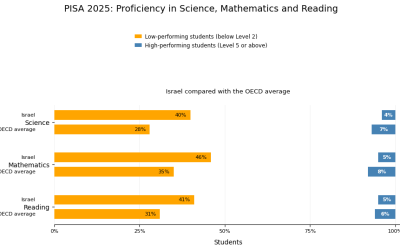
According to the OECD, Israel’s 2025 results are the lowest ever observed in PISA in all three subjects: mathematics, reading and science. Israel first participated in PISA in 2002.
Israel scored below the OECD average in all three subjects. The OECD says the 2025 results are significantly below Israel’s results in 2022, 2018, 2015 and 2012.
 This is not a minor fluctuation. This is not a bad year. This is a warning.
And we need to stop explaining it away.
Firstly, this is not about blaming teachers. Israel has many excellent teachers, outstanding educators and wonderful schools. But a national education system cannot be judged by its exceptions. A good education system has to work consistently for every child. It cannot be enough to point to excellent schools, exceptional teachers or children who are thriving and declare that the system is therefore working.
The question is whether the system as a whole is delivering the education our children need. The latest results suggest that it is not.
So we need to ask a much more fundamental question: Who is our education system actually designed for?
The answer should be obvious. It should be designed around the child.
Not around the bureaucracy. Not around the budget. Not around political convenience. Not around institutional interests. And not around protecting structures simply because they have existed for years.
Yet too often, decisions appear to be made according to what the system can accommodate rather than what children actually need.
That has to change. Israel needs to review its system so that the child comes first.
At the municipal level in particular, we need to change the questions from . “How much will this cost?” or even: “How much money will this after-school programme bring in?” to “What does this child need – and how can we provide it?” Of course money matters. Resources are limited. But the budget should serve the educational goal, not determine it.
But this is not all. We need to confront some uncomfortable realities.
The PISA results should force us to examine the entire system honestly – not defensively, not politically. Honestly.
1. Teacher training and classroom management need serious examination
We need to be honest about the quality and consistency of teacher skills, preparation, professional development and classroom management.
Having a teaching qualification does not automatically mean that someone has every skill required to manage a modern classroom and effectively teach every child in it.
The OECD’s 2025 data itself raises questions about the classroom environment in Israel. Around 30% of Israeli students said they could not work well in most or all science lessons, compared with 19% across the OECD, while 35% reported that noise and disorder disrupted most or every science lesson. (OECD)
Here, we need to ask: Are we giving teachers the training, support and tools they need? And if we are not, what are we going to do about it?
2. No institution should be powerful enough to block necessary reform
Teachers deserve representation. But no organisation should become so powerful that necessary educational reform becomes impossible. In my view, the teachers’ union has become too powerful and too resistant to change. Its influence cannot be allowed to stand in the way of meaningful educational reform, and in my humble opinion, the head of the teacher’s union, Yaffa Ben-David, should step down and make way for new leadership and a new approach.
This is not about weakening teachers. It is about ensuring that the interests of children come before the interests of any institution.
3. Parents should have a voice, but professional expertise must lead
Parents absolutely should be heard. They know their children better than anyone. But that does not mean educational policy should be determined by whoever has the loudest voice or the strongest lobbying power. Curriculum, pedagogy and educational policy need to be based on professional expertise, evidence and the best interests of children.
4. Technology and AI should enhance thinking, not replace it
This is becoming one of the biggest educational questions of our time. Technology can be enormously valuable. AI can be an extraordinary tool.
But more technology does not automatically mean better education.
Israel needs to ask some very serious questions about how technology is being used in our classrooms. And we should be learning from countries that have already spent years experimenting with digital education.
We do not need to be first to make every mistake.
Look at Sweden.
The Swedish government has explicitly shifted toward “more textbooks and fewer screens.” It has invested heavily in physical textbooks, moved away from compulsory digital learning tools for young children, changed the approach to digital national tests in primary schools, and is moving toward mobile-free schools. Sweden’s government says digital learning aids should be introduced when they support rather than hinder learning.
Look at Denmark.
Danish education authorities have recommended mobile-free schools, restricting access to irrelevant websites, putting tablets and computers away when they are not being used for teaching, and creating a better balance between digital and analogue learning. These recommendations followed PISA-related findings that 72% of Danish students reported using digital tools in every or almost every lesson in a typical week, compared with 16% across OECD countries.
The lesson is not that technology is bad. The lesson is that technology needs to serve education – not the other way around.
And the OECD’s latest work on generative AI makes the same distinction: AI can support learning when it is used with sound pedagogical guidance, but simply outsourcing tasks to AI can improve the appearance of performance without producing genuine learning gains.
Israel needs to learn from those who have already been down this road. We should not blindly repeat an experiment that other countries have already been running for years without learning from what they have discovered. Technology is a tool. It is not a substitute for teachers, reading, writing, mathematics, problem-solving or independent thought.
And AI makes this even more urgent. If we allow technology to do the thinking for our children, we risk weakening the very skills education is supposed to develop.
The question should not be: “How much technology can we put into the classroom?” It should be: “Does this technology actually help this child learn?” If the answer is no, we should have the courage to take it out.
5. Schools need accountability for outcomes – not simply procedures
We also need to rethink what we mean by accountability, because following procedures is not the same thing as educating children.
We should care about outcomes such as; Can our children read and understand complex material? Can they solve problems? Can they think independently? Can they reason? Can they apply what they have learned to unfamiliar situations? And most importantly – are they actually learning?
COVID could and should have been Israel’s great educational reset. The COVID pandemic presented the education system with an extraordinary opportunity. The traditional model was disrupted. Schools closed. We had a unique opportunity to ask what is working and what isn’t? What should we stop and what should we change? Instead, once the crisis passed, much of the system returned to doing things as it had before. That opportunity was missed.
Now we have another wake up call.
We need an independent review of the entire system. This cannot be solved with another slogan. Or another committee. Or more money being thrown at an increasingly inefficient system and underskilled teachers.
We need experienced, independent education professionals to examine the system honestly and objectively, setting all politics aside, from top to bottom. People who are prepared to ask difficult questions, including what can Israel learn from education systems that are achieving better outcomes?
Israel does not need to copy another country. But we should have the humility to learn from evidence and from the experience of countries that have already tested different approaches.
Israel needs to commission an independent national review of education. Not another exercise in defending the existing system. A serious examination of what is working, what is failing and what needs fundamental change.
And those responsible must accept accountability. A system cannot improve if nobody is ultimately responsible for its performance.
The time for defending the status quo is over. New leadership and new thinking are desperately necessary.
The PISA 2025 results are the warning. The question now is whether we have the courage to act on it.
Because, ultimately, this is about our children. They deserve better.
Israel’s education system needs a reset.
And we need to start now.
Related Topics
Related Posts