
Writing on Jewish life, relationships, trauma, and resilience
Israel’s Global Image Crisis is Also a Relationship Crisis

Illustrative: AI image created by the author.
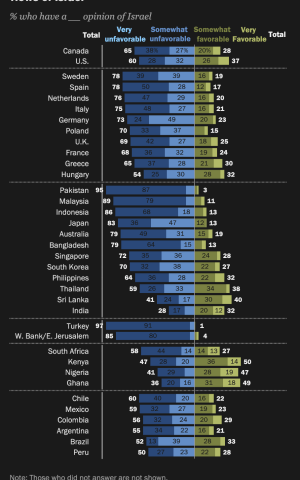
A new Pew Research Center survey should stop us in our tracks. Across 36 countries, a median of 67% of adults now hold an unfavorable view of Israel, while just 25% hold a favorable view. Pew also reports that majorities in most surveyed countries have little or no confidence in Prime Minister Benjamin Netanyahu. The survey was conducted from February 8 to May 13, 2026.
For Israelis and Jews around the world, those numbers are painful. For Israel’s friends, they are alarming. For Israel’s enemies, they are useful.
That last point matters.
Because part of Hamas’s strategy on October 7 was not only to murder, kidnap, terrorize, and traumatize Israelis. It was also to provoke a war that would damage Israel’s standing in the world.
That does not excuse Israel from the hard questions every democracy must ask in war. It does not erase Palestinian suffering. It does not make every criticism of Israel antisemitic. But it does mean we have to understand the trap Hamas set.
Hamas appears to have understood something brutal and simple: if it could draw Israel into a devastating war in Gaza, the images of Palestinian suffering would travel faster and farther than explanations of Israeli trauma. The massacre would begin the war. The war would become the story. And over time, Israel would be judged less by the horror that triggered the conflict and more by the suffering that followed.
That is not an accident. That is strategy.
Senior Hamas official Ghazi Hamad later described October 7 as a “benefit” to the Palestinian cause because, in his telling, it exposed Israel’s brutality. He also said the attack brought renewed global attention to the Palestinian issue. In 2025, Hamad reportedly called international moves toward recognizing a Palestinian state “one of the fruits of 7 October.”
There is also reporting, based on documents reviewed by The Wall Street Journal, that Hamas leaders wanted the October 7 attack to derail Israel-Saudi normalization talks. According to that reporting, Hamas feared that normalization would marginalize the Palestinian issue and believed an extraordinary act was needed to stop it.
So when we look at Israel’s global image crisis, we should see more than failed messaging. We should also see the aftermath of a deliberate effort to turn Israel’s necessary fight against Hamas into a worldwide crisis of legitimacy.
And yet, recognizing the trap does not free Israel from the work ahead.
More than a messaging problem
The deeper warning is not only that Israel is losing global support. It is that Israel is losing relational trust with much of the world.
That distinction matters.
People rarely change how they feel because someone argues harder. They change when they feel heard, when trust is rebuilt, and when the story they are being told connects with something they recognize as human.
That is not weakness. That is wisdom.
Israel has every right to expose Hamas’s cynicism. It has every right to remind the world that October 7 was a massacre of civilians, not a metaphor, not a “response,” not a footnote in someone else’s theory of history. Hamas itself described the attack as a “necessary step” in its own January 2024 public account.
But Israel also has to speak to a world that is watching Gaza in grief, anger, confusion, and often with very little understanding of Israeli vulnerability.
That requires more than saying, “You don’t understand us.”
It requires making understanding possible.
Holding two truths at once
Israel is a country of astonishing strength, resilience, creativity, and courage. It is also a country carrying grief that many outside the Jewish world barely understand. Since October 7, Israelis have lived with trauma, fear for hostages, bereavement, displacement, and the awful burden of war.
At the same time, Palestinians in Gaza have endured catastrophic suffering that much of the world sees every day.
Two truths can exist in the same room. In fact, peace may depend on our ability to keep them there without throwing chairs.
Hamas benefits when the world can see only one side’s pain at a time. It benefits when Israeli suffering disappears beneath the rubble of Gaza. It benefits when Palestinian suffering is used to erase the crimes of October 7. It benefits when Jews feel abandoned and Palestinians feel unseen. Extremists are not known for their commitment to emotional complexity. It ruins the branding.
That is why Israel and its friends have to do something harder than win an argument.
They have to rebuild trust.
When connection gives way to certainty
The Pew numbers suggest that Israel is losing not only an argument, but a relationship. Relationships do not recover through slogans alone. They recover through listening, accountability, honesty, empathy, and repair.
In relationship education, we teach couples that when a conversation becomes a contest over who is right, connection usually loses. The same principle applies between nations and peoples.
If the only message others hear from Israel’s defenders is, “You don’t understand us,” many will eventually stop trying.
If the only message Israelis hear from the world is condemnation, many Israelis will also stop listening.
Then everyone retreats into their own corner, wounded and certain.
That is a very human pattern. It is also a dangerous one.
From winning the narrative to rebuilding trust
Israel’s challenge now is not simply to explain itself better. It is to be heard differently.
That requires language that acknowledges Israeli pain without dismissing Palestinian suffering; that defends Israel’s right to security while recognizing the moral urgency of civilian life; that exposes Hamas’s strategy without using Hamas’s cruelty as a substitute for Israel’s own moral accountability.
Public diplomacy often asks, “How do we win the narrative?”
A better question may be, “How do we rebuild trust?”
Trust is not rebuilt by pretending everything is fine. It is rebuilt by telling the truth more courageously than one’s opponents expect.
That means saying clearly:
- October 7 was a massacre.
- Hamas intended not only to kill Israelis, but to provoke a war that would isolate Israel.
- Hostages had to be brought home.
- Palestinian civilians are not Hamas.
- Jewish safety and Palestinian dignity are not mutually exclusive.
- Israel’s right to defend itself does not cancel its responsibility to protect civilian life wherever possible.
That combination is not moral confusion. It is moral seriousness.
Seriousness instead of panic
Israel’s friends should not respond to this Pew survey with panic or denial. They should respond with seriousness.
A country can be militarily powerful and still relationally vulnerable. A people can be historically justified in fearing abandonment and still need to ask how their actions are being experienced by others. A democracy can defend itself and still debate the moral costs of how it does so.
The world also has responsibilities.
Negative views of Israel cannot become permission for antisemitism. Criticism of Israeli policy must not become hostility toward Jews. Anger at a prime minister is not the same thing as denying a people’s right to safety, sovereignty, and self-determination.
But Israel and its supporters have our own work to do.
That work begins with listening, not as surrender, but as strategy.
Listening does not mean agreeing. It means understanding what others believe they have seen, heard, and lost. It means refusing to let Hamas, extremists, propagandists, or the loudest voices on social media define the whole human landscape.
There is an old relationship lesson: beneath anger, there is often hurt; beneath hurt, there is often fear; beneath fear, there is often a longing to matter.
Nations are not so different from families. They just have flags, armies, and worse catering.
Israel matters. Palestinian lives matter. Jewish safety matters. Moral clarity matters. So does humility.
A warning light, not a final verdict
The Pew findings are a warning light. They tell us Israel’s global standing is in serious trouble.
But warning lights are not there to shame the driver. They are there to prevent the engine from burning out.
Hamas wanted Israel isolated. It wanted October 7 to ignite a war that would turn global attention against Israel, derail normalization, and make the Palestinian issue impossible to ignore. By that measure, part of its strategy has worked.
That is painful to say. It is also necessary.
But the story is not over.
The road ahead will require more than better messaging. It will require a renewed commitment to the values Israel’s best friends have always believed were at the heart of its promise: life, dignity, courage, democracy, and hope.
And perhaps, most of all, it will require remembering that even in a brutal world, the strongest relationships are not built by shouting the loudest.
They are built by making it possible for truth to be heard.
Related Topics
Related Posts