


Israel’s impossible ally and Trump’s dilemma
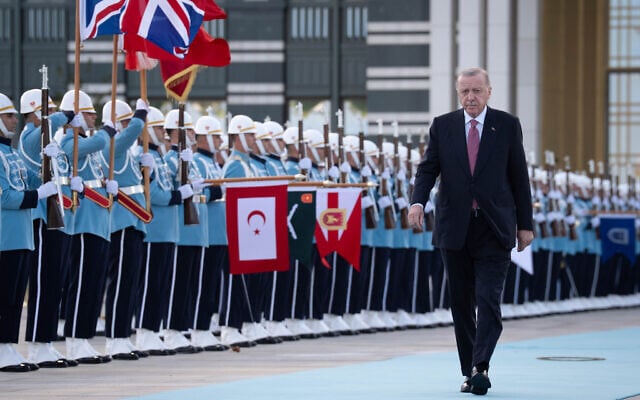
The Israeli government’s refusal to allow a Turkish military presence in Gaza is not just a simple diplomatic incident: it marks the break between two powers once linked by strategic cooperation but separated by “incompatible” visions of the region. In the background, another calculation appears: that of Donald Trump, who could choose between firmness and pragmatism towards Turkish President Recep Tayyip Erdogan.
Erdogan’s repeated criticisms of the Israeli leaders have gone beyond the framework of political disagreement. In every conflict in Gaza, the Turkish president poses as a leader of the Muslim world, accusing Israel of “state terrorism” and supporting the Palestinian cause. This positioning, very popular in Turkey, has led to a collapse of trust and relations between Ankara and Jerusalem.
Turkey’s proximity to Hamas is the most important factor in this rejection. For more than a decade, Ankara has been welcoming political and military cadres from the Islamist movement. For Israel, allowing Turkish soldiers to intervene in Gaza would be like letting in an objective ally of Hamas. No Israeli government, especially in the current climate, can assume such a decision.
To these ideological disputes is added the geopolitical complexity. Erdogan has built a diplomacy of balancing between Vladimir Putin’s Russia and NATO, of which his country is nevertheless a member. He bought Russian military equipment while continuing to benefit from the strategic advantages of the Western alliance. This ambiguity, “tolerated” by the Biden administration, could become “irritating” for the Trump administration.
In Donald Trump’s vision, the alliances are based neither on values nor on historical solidarity, but on immediate interest. And if Turkey becomes a factor of disorder in the Middle East—by opposing Israel, supporting Hamas, and sparing Moscow—Trump would not hesitate to sanction it. (He already demonstrated this in 2018, Pastor Brunson).
President Trump is also pragmatic. He knows that Turkey remains a key geostrategic player: control of the Bosphorus and Dardanelles straits and Incirlik air base. Completely cutting off bridges would be tantamount to delivering Ankara to Moscow—a scenario contrary to the logic of containment that structures American policy.
One can therefore expect a diplomacy of ‘putting things in order’ rather than a rupture. Trump could tighten trade conditions, restrict certain arms transfers or freeze military cooperation, but by maintaining a channel of dialogue with Erdogan.
Erdogan: leader of the Muslim world or isolated player?
Erdogan persistently uses the Palestinian issue to reinforce both his domestic and regional legitimacy. However, this discourse, while useful in the immediate context, causes significant strategic effects. By endorsing Hamas, escalating verbal hostilities against Israel, and strategically aligning with Russia, Turkey is progressively alienating itself from its previous allies. Erdogan show an excess of Islamist behaviors for Western sensibilities, a high level of nationalism for the Arab sphere, and an unpredictability that is disconcerting to Russia.
Ultimately, the Israeli refusal of a Turkish presence in Gaza is a positive illustration of the ongoing realignment in the Middle East. Israel is moving closer to the moderate Arab powers and to the United States of Trump, while Erdogan’s Turkey isolates itself behind its populist rhetoric and its dual geopolitical game.
Trump, for his part, finds himself faced with a classic choice: sanction to assert his authority, or spare to preserve regional balance.
However, in both scenarios, it is evident that Erdogan’s Turkey is no longer a dependable ally, neither for Israel nor for Washington.