The views expressed herein are solely mine.
Israel’s Iraq Gambit: Tehran’s Uranium Encircled
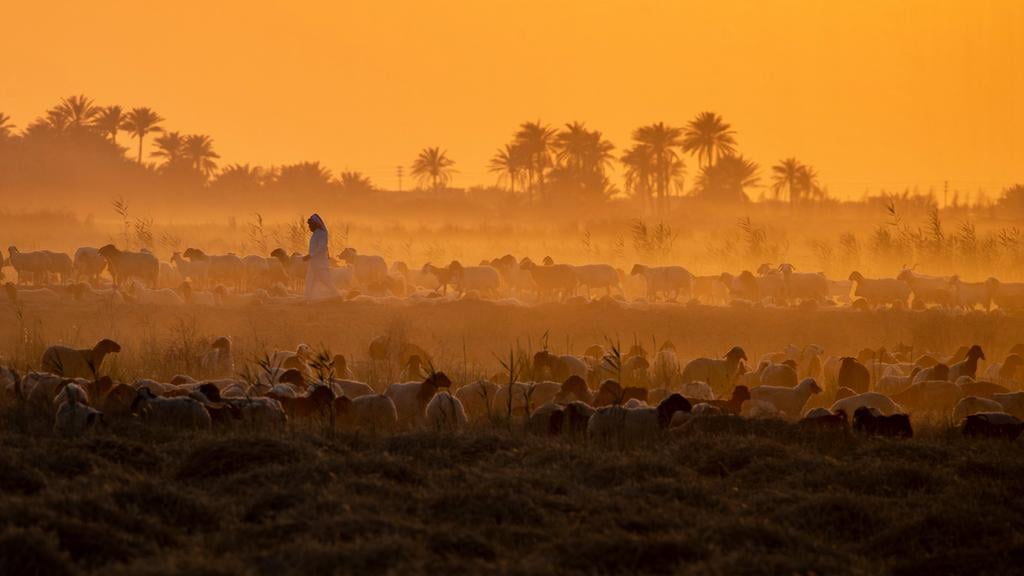
An Iraqi shepherd herds sheep and goats as the sun sets in the Iraqi town of Mishkhab south of Najaf. Picture: AP Photo/Anmar Khalil.
The Wall Street Journal investigation into Israel’s secret forward base in Iraq’s western desert offers more than a wartime footnote. It supplies a proven geostrategic template for decisive action.
Weeks before the February 2026 United States-Israel military offensive against Iran, Israeli special forces established a clandestine logistics and rescue hub on a disused Saddam-era airstrip 1,000 miles away from home. Built with American awareness but zero Iraqi consent, the outpost compressed flight times, sustained resupply, and readied pilot extraction teams. When Iraqi troops approached after a local shepherd’s alert, Israeli strikes preserved secrecy and killed at least one soldier.
Baghdad’s protests ring hollow. For more than two decades, Iranian proxy networks have steadily eroded Iraqi sovereignty. Unlike this pattern, this operation was not improvisation but calibrated power projection—engineered to shorten kill chains and reduce operational risk in strikes that degraded Iranian nuclear and missile capabilities, while underscoring who retains the region’s most advanced intelligence, survivability, and operational ingenuity.
From a realist multidomain perspective, the episode confirms a hard truth: forward basing in hostile territory delivers results where endless diplomacy collapses. Iran’s nuclear program, ballistic missile force, and proxy network from Lebanon to Yemen constitute an existential threat to Israel, the United States, and Gulf stability. The Iraq foothold demonstrated exactly why such a presence matters.
That same model now applies directly to Iran’s remaining stockpile of 440.9 kilograms of uranium enriched to 60 percent. Much of the material reportedly remains cached near Isfahan, enough for roughly 10 nuclear weapons if further enriched. Tehran will not surrender it voluntarily.
Days ago Venezuela proved the contrast works when governments cooperate. The United States, the International Atomic Energy Agency, and British teams removed the last 13.5 kilograms of highly enriched uranium from the Venezuelan RV-One research reactor, transported it 100 miles to port, and shipped it to the United States for secure down-blending at Savannah River. Iran’s leadership, fractured among hardline elements inside the Islamic Revolutionary Guard Corps, “pragmatic” diplomats, and clerical networks, views its uranium as regime survival insurance.
The Iraq precedent offers a clear lesson and points toward a three-phase American-Israeli special operation inside Iran aimed at seizing or destroying that stockpile. Phase one would fuse existing intelligence streams—satellite imagery, signals intercepts, and human sources already tracking cask movements to caches near Isfahan.
Meanwhile, phase two would mirror Israel’s 2007 ground incursion at Syria’s Al Kibar Reactor, when commandos inserted by helicopter collected soil and vegetation samples confirming nuclear activity before withdrawing undetected ahead of the follow-on airstrike. Inside Iran, small teams would similarly extract radioactive signatures to verify precise locations without alerting patrols.
Finally, phase three establishes a layered multidomain perimeter—fighter aircraft providing air superiority, unmanned aerial vehicles delivering persistent surveillance, advanced missile defense systems, cyber operations disrupting command networks, and naval assets in the Persian Gulf offering standoff support. Under that shield, extraction teams load the material into shielded containers and withdraw by airlift or ground convoy.
The Iraq success simultaneously enables synchronized pressure across Iran’s vulnerabilities. Kharg Island processes 90 percent of Iran’s crude exports, which averaged between 1.84 million and 2.15 million barrels per day before the conflict and generated up to 170 million dollars in daily revenue. Precision disruption or temporary seizure would starve Tehran’s war chest.
Concurrent strikes on South Pars—the world’s largest gas field, holding 1,800 trillion cubic feet of recoverable reserves in Iran’s share and supplying 70 percent of national gas production—would trigger nationwide blackouts, fertilizer plant shutdowns, and industrial paralysis. Decapitation operations targeting the 3 rival power centers in Tehran would fracture command cohesion.
At the same time, arming and advising Kurdish opposition groups operating from Iraqi safe havens and Baloch militants would pin the Islamic Revolutionary Guard Corps divisions in the peripheries. The combined effect creates the conditions for genuine internal collapse—energy denial, ethnic fracture, and leadership vacuum—producing real regime change rather than superficial reshuffling.
Geopolitically, this multi-axis approach dismantles Iran’s ballistic-nuclear leverage and coercive blackmail, frees the mine-threatened Strait of Hormuz from hostage politics, denies China and Russia critical energy leverage, secures Gulf oil flows vital to global markets, and clears the path for expanded normalization agreements across the Arab world.
The Iraq outpost was not a gamble, but a strategic investment. Applied to Iran’s core, it becomes the logical culmination of a campaign already in motion.
In the Middle East, sustained presence defeats protest notes. History rewards those who seize the initiative.
Related Topics
Related Posts