


Israel’s Northern Test
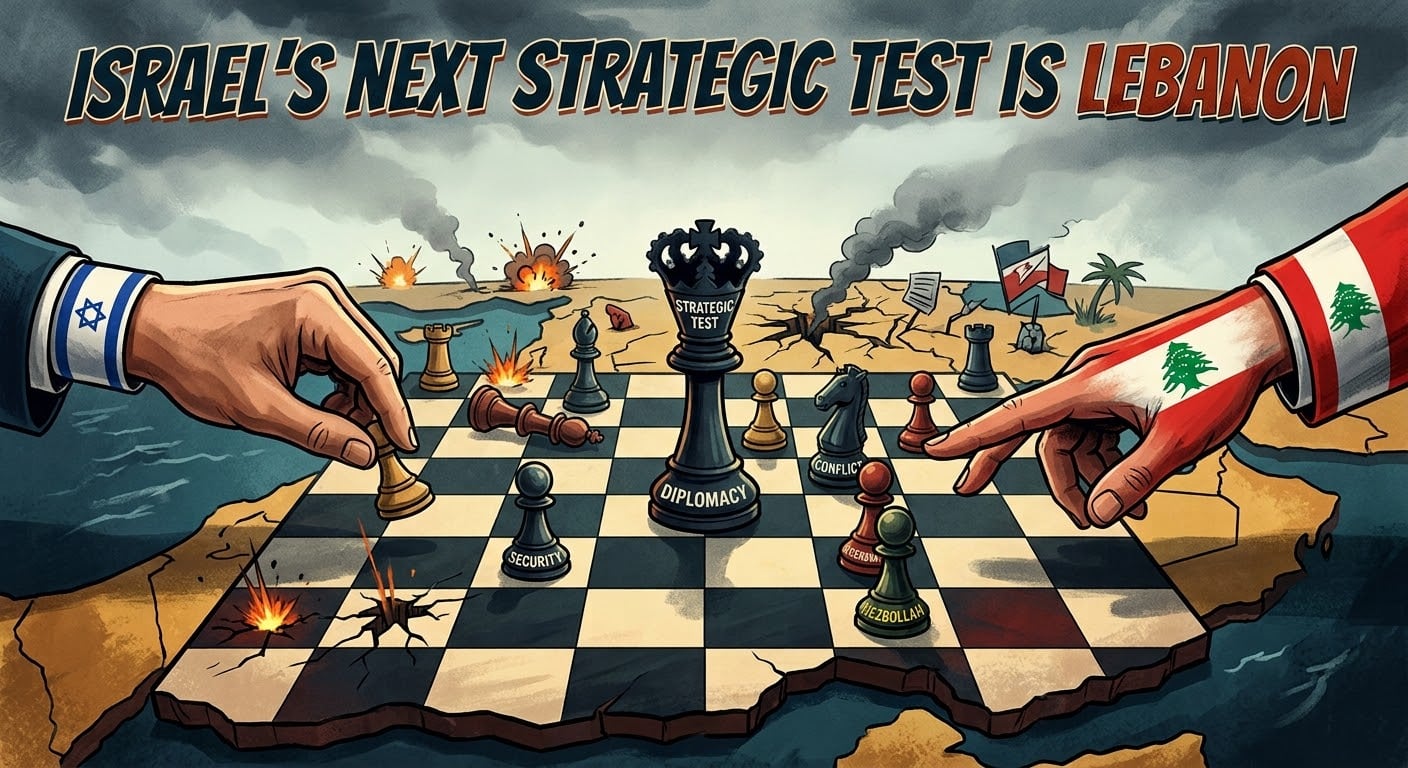
For decades, Israel’s northern border has been defined by a familiar logic: deterrence, escalation, retaliation, and temporary calm. Yet history has repeatedly shown that military strength can prevent some threats without necessarily creating a stable political future.
That is why Lebanon may represent one of Israel’s most important strategic tests.
The question is not simply how Israel can contain threats from Lebanon. The more consequential question is what kind of Lebanon Israel wants to see on its northern border.
A weak, fragmented and economically devastated Lebanon may appear, at first glance, to pose fewer conventional challenges. In reality, instability creates fertile ground for armed groups, political extremism, economic collapse and foreign intervention. A functioning Lebanese state, by contrast, has a greater capacity to control its territory, protect its population and maintain predictable relations with its neighbors.
This distinction matters.
Israel’s security cannot be separated indefinitely from the political and economic condition of the countries around it. Borders may be defended by armies, but long-term stability is also built through institutions, economic opportunity and credible political arrangements.
Lebanon illustrates this problem particularly well.
For years, ordinary Lebanese citizens have paid an enormous price for conflicts that they did not necessarily choose. At the same time, Israelis living in the north have experienced the insecurity of knowing that another major confrontation could erupt across the border.
Neither society benefits from this permanent cycle.
That does not mean Israel should ignore security threats or compromise its right to protect its citizens. On the contrary, a realistic strategy must begin with security. But security should be understood as a means to create a more stable political environment, not as an end in itself.
This is where Israel’s approach to Lebanon requires a broader strategic vision.
Israel should ask what incentives could encourage the emergence of a stronger Lebanese state. What would it take for Lebanon’s legitimate institutions to become capable of exercising meaningful authority across the country? What role could regional and international actors play in supporting Lebanese economic recovery and state institutions? And, eventually, what practical forms of cooperation could emerge if the security environment fundamentally changed?
These are difficult questions. They cannot be solved by slogans.
But refusing to ask them also carries a cost.
Lebanon’s economic potential, geographic position and human capital make it more than a security problem. It is a country with access to the Mediterranean, a highly educated diaspora and significant potential in trade, tourism, technology and services. A more stable Lebanon could become an economic asset for the wider Eastern Mediterranean rather than another arena for regional confrontation.
Israel, meanwhile, has developed technological and economic capabilities that could eventually contribute to regional cooperation in areas such as water management, agriculture, energy and disaster response.
None of this requires pretending that decades of conflict did not happen. Nor does it require ignoring the profound political and security disagreements that still exist.
It requires thinking beyond the next crisis.
The Middle East has repeatedly demonstrated the limits of strategies based exclusively on managing enemies. A different approach would seek to create conditions in which fewer people have an interest in becoming enemies in the first place.
For Israel, this does not mean choosing between strength and diplomacy. It means understanding that the two can reinforce each other.
A secure Israel needs credible deterrence. But it also needs a neighborhood in which states are capable of governing, economies can function and young people can imagine a future that is not defined by war.
Lebanon could become a test case for this idea.
The ultimate measure of Israeli strategy should therefore not be how many years pass between wars. It should be whether the region gradually becomes less dependent on war as a mechanism for resolving political disputes.
That is an ambitious goal.
But strategic ambition is not naïveté.
Israel has demonstrated that it can survive difficult circumstances. The next challenge is to help shape a regional environment in which survival is no longer the highest achievable objective.
For Israel, and for Lebanon, the better future may begin with a simple strategic question:
What would we want the relationship between these two countries to look like if we were designing it from scratch?
The answer may not be peace tomorrow.
But it could be the beginning of a strategy designed to make peace more possible tomorrow than it is today.