
Israel’s “PR Problem” Is Not a PR Problem
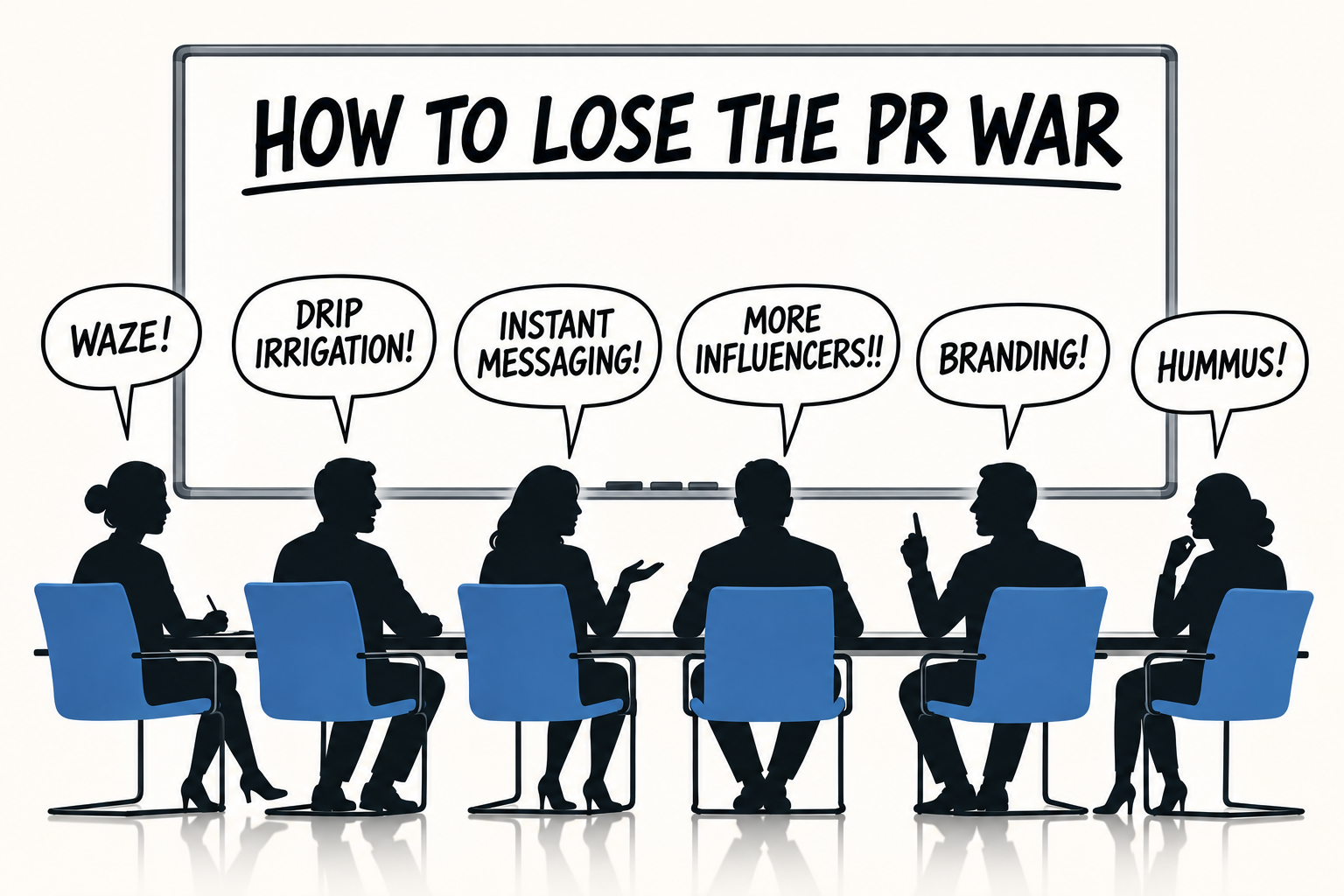
“Israel is losing the PR war” has become a familiar complaint, one often accompanied by claims that Israel’s public relations are terrible, that Jews are failing to tell our story effectively, or that we simply need better messaging. We debate branding, storytelling, public relations, social media strategy, influencers, visual identity, and campaign strategy. Yet when those efforts fail to produce the outcomes we seek, the prevailing response is not to question the approach, but to refine it still further. Rarely do we stop to investigate the problem itself: to ask what is actually producing these outcomes, whether we have a diagnosis at all, and whether the assumptions guiding our response are correct.
We have misunderstood communication itself. We have come to think of communication primarily as the process of crafting and delivering messages from a sender to a recipient. As a result, we have devoted extraordinary attention to the sender and the message while giving comparatively little thought to the audience. Communication is not simply the successful transmission of information. At its core, communication is a process of meaning-making. The sender may craft the message, but the audience determines what that message means. Audiences interpret every message through the narratives they have already internalized, along with their existing beliefs, values, identities, and lived experiences.
If audiences ultimately determine what messages mean, then strategic communication cannot simply be about producing and disseminating those messages. What makes communication strategic is not merely the quality of the message, but the deliberate, long-term cultivation of the conditions in which that message will eventually be interpreted. Messages remain important, but they are no longer the primary focus of strategy. The more fundamental task is cultivating the audiences that will ultimately interpret those messages.
The central question changes. It is no longer simply, What message should we send? It becomes, What audience are we developing?
Audiences are not static recipients waiting for the next message. They are continually formed and reformed through relationships, shared experiences, and repeated social interaction. These interactions build trust, shape identity, and influence how people understand the world around them. Over time, they also shape the narratives through which individuals and communities make sense of what they see and experience.
Those narratives become the framework through which new information and events are understood. New information is never processed in isolation; it encounters what people already believe about the world. Strategic communication, therefore, is not simply about influencing audiences through the messages we send. It is about shaping the environment in which future messages and events will be understood.
The consequences of this misunderstanding become clearer when we look at those who have spent decades advancing anti-Israel, anti-Zionist, and antisemitic narratives, including Islamist movements, their state sponsors, and aligned ideological networks. They understood that influence is achieved not by persuading audiences one message at a time, but by shaping the narrative frameworks through which future information and events will be interpreted. They identified the moral and political frameworks that already resonated within Western societies, including human rights, oppression, liberation, colonialism, and race, and aligned their narratives accordingly. But they did not rely on messaging alone. They invested in relationships, institutions, and sustained engagement within the communities they sought to influence, including on university campuses, creating repeated opportunities for those narratives to be introduced, reinforced, and shared. Over time, audiences internalized those narratives, shaping how they understood stories and events as they unfolded. By the time individual messages reached them, much of the work had already been done. Our adversaries did not simply develop messages. They developed audiences. Whoever shapes the narratives through which audiences interpret the world gains a profound strategic advantage when future events unfold.
This is not an argument against messaging, branding, campaigns, influencers, public relations, or the communications professionals who do that work. It is a fundamental mistake, however, to reduce strategic communication to those efforts. We have invested disproportionately in the mechanisms that produce communication content while neglecting the long-term work required to develop the audiences those outputs are intended to reach. Correcting that imbalance requires rethinking how we invest our time, attention, and resources. Audience development must be treated as a generational undertaking: building relationships, institutions, and sustained engagement both within our own communities and with those we have failed to reach.
We cannot continue responding to a battle over meaning with short-term communications tactics. By the time we need a campaign to reach an audience, much of the work that will determine how it is received has already happened. If we want to change the trajectory of the fight against antisemitism and for Israel’s standing in the world, we must begin shaping the interpretive environments in which that fight takes place—years, perhaps decades, before we need our message to be heard.