NAnews - Nikk.Agency Israel News
Israel’s Tourism Ministry, a Sanctioned Russian Celebrity and Ukraine
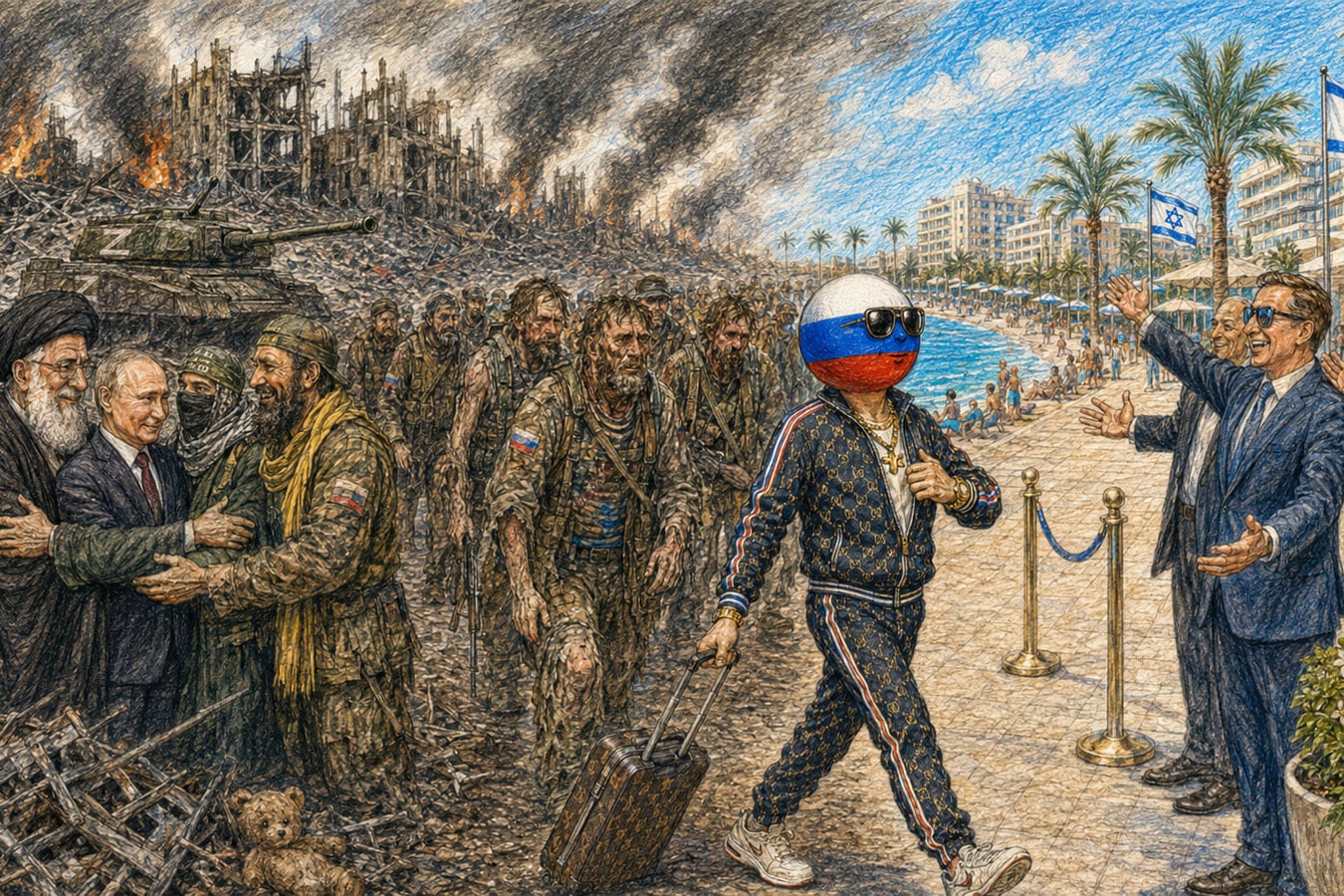
“A Foreign Influencer?” Israel’s Tourism Ministry, a Sanctioned Russian Celebrity, and Ukraine’s Official Protest. The image was created using AI.
“A Foreign Influencer?” Israel’s Tourism Ministry, a Sanctioned Russian Celebrity, and Ukraine’s Official Protest
There are moments when a government agency thinks it is showing efficiency, professionalism and international outreach.
And then, without noticing it, it reveals something much deeper.
That is what happened when Israel’s Ministry of Tourism proudly presented its work on the Russian market through the visit of Denis Ustimenko, better known as Dzhigan / GeeGun. The ministry apparently wanted to show that Israel is again active in attracting foreign tourists, influencers, tour operators, travel agents and airlines.
But why, of all markets, the Russian one?
This is not an ordinary tourist market anymore. This is the market of the country of the so-called “SVO,” the country whose army came to Ukraine with killings, torture, deportations of children, Bucha, Mariupol, Izium and Kherson. It is also the country that has become one of Iran’s key partners, hosts representatives of Hamas and repeatedly acts against Israel on international platforms.
So this is no longer just tourism.
It is a political signal.
On June 23, Israel’s Ministry of Tourism published a post on its official account about hosting Denis Ustimenko in Israel. The wording was not neutral. The ministry wrote that it was hosting, in its own words, a “Russian rapper and influencer” — “one of the best-known content creators in Russia with millions of followers.”
And it even added an enthusiastic emoji — “????”.
That detail matters.
The ministry itself chose to place his Russian media identity, his reach and his influence over audiences in Russia at the center of the story. It did not present the visit mainly as a private family trip, or as a personal journey connected to Jewish roots, or as a visit by someone with a possible Israeli connection. It presented him first and foremost as a Russian media figure.
In the same post, the ministry explained that the visit was part of its activity on the Russian tourism market — including work with influencers, tourism wholesalers, travel agents and airlines. In other words, this was not just a celebrity sightseeing visit. This was part of an official Israeli tourism effort directed at Russia.
Ukraine’s reaction came almost immediately.
The Embassy of Ukraine in Israel issued a protest and reminded the public that Denis Ustimenko has been under Ukrainian sanctions since 2023. According to the embassy, he “openly supports Russian armed aggression against Ukraine.”
The Ukrainian diplomatic mission also said it had “sent a corresponding note to the Ministry of Foreign Affairs of the State of Israel,” called on the Government of Israel to “cease any official cooperation with supporters of Russian terror,” and appealed to Israeli citizens to “boycott any events involving Dzhigan and other Z-propagandists.”
This is no longer a Facebook argument.
This is a diplomatic protest addressed to the State of Israel.
There is also another question that cannot be ignored. In comments around this story, many users wrote that Ustimenko may have Israeli citizenship. Our editorial team has no official confirmation of this information, so it cannot be stated as fact.
But even if such a connection exists, the question to the Ministry of Tourism does not disappear. If the ministry did not know about a possible Israeli status of a person it was involving in an official campaign, how was he checked? And if the ministry did know, why did the official post present him primarily as a “Russian rapper and influencer,” while tying the visit to the Russian tourism market?
This is where the story stops being about one entertainer.
It becomes a question about Israeli state policy.
Because the Russian market today is not just a market of tourists. It is the market of a country waging war against Ukraine, partnering with Iran, hosting Hamas representatives and using diplomacy against Israel’s interests on international platforms.
And after all of that, an official Israeli government body is effectively saying: let us attract this audience again to Israel.
To our beaches.
To our hotels.
To our national parks.
To Jerusalem.
To the Dead Sea.
To Yad Vashem.
And they will come here to “relax” — after what?
After Bucha?
After Mariupol?
After Izium?
After Kherson?
After filtration camps, basements, torture, murders, rapes, deportation of children and daily strikes on Ukrainian cities?
After the Russian army came to Ukraine with war, destruction, mass killings, kidnapped children and cities turned into ruins?
This is not about claiming that every person holding a Russian passport personally committed a crime. That would be wrong and irresponsible.
The issue is different.
The State of Israel cannot pretend that the Russian tourism market exists separately from Russia’s war, Russian propaganda, Russian war crimes and Russia’s support for Israel’s enemies.
When a private person buys a ticket and arrives in Israel, that is one situation. But when the Ministry of Tourism itself builds a campaign on the Russian market, brings in a Russian influencer with millions of followers and publicly presents this as an achievement, that becomes a state choice.
And that choice looks especially dangerous when Ukraine’s Embassy has to send a note to Israel’s Foreign Ministry and call for an end to official cooperation with supporters of Russian terror.
Who decided that Israel should actively work with the Russian tourism market today?
Was this an initiative of officials inside the Ministry of Tourism?
Or was it part of a broader political line approved above them?
And if this is indeed a new line, then another question follows.
Has the Ministry of Tourism already decided how Israel will screen this audience at the border?
How will the state know whether the next “tourist” left his “traces” in Bucha, Mariupol, Izium, Kherson or other occupied territories of Ukraine?
Where was he after February 24, 2022?
What did he do there?
Was he standing with a rifle next to Ukrainian prisoners?
Did he take part in so-called “cleansing,” filtration, torture or deportations?
Did he help guide missiles and drones toward Ukrainian cities, towns, power stations, hospitals and residential buildings?
Was he part of the same war machine that is now being repackaged in the language of “influencers,” “tour operators” and “airlines”?
If the State of Israel officially decides to attract an audience from the country of the “SVO,” it cannot pretend this is an ordinary tourism flow.
This is a security question.
A moral question.
And a question of political responsibility.
This is why we covered the story at NAnews — Israel News by Nikk.Agency not as a celebrity scandal, but as a question of public responsibility: who decided that the Russian tourism market should again become a target for official Israeli promotion, and what checks were made before turning a sanctioned figure into part of that campaign?
Israel needs tourists. Of course it does. The tourism sector has suffered enormously from war, security crises, flight cancellations and international uncertainty. But not every market can be treated as morally neutral, and not every influencer is just a marketing tool.
Tourism is never only about money.
Sometimes it is a message.
And in this case, the message was heard very clearly — in Kyiv, in Jerusalem, and among many Israelis for whom Ukraine is not an abstract place on the map, but family, memory, childhood, graves, homes and living people under attack.
The Ministry of Tourism may have wanted to show that it is working.
Instead, it showed that part of the Israeli bureaucracy still does not understand that after February 24, 2022, work with the Russian market is not just marketing.
It is politics.
It is responsibility.
And it cannot be separated from war.
Related Topics
Related Posts