
Always out of step with orthodoxy
Israel’s War in the Age of Manufactured Truth
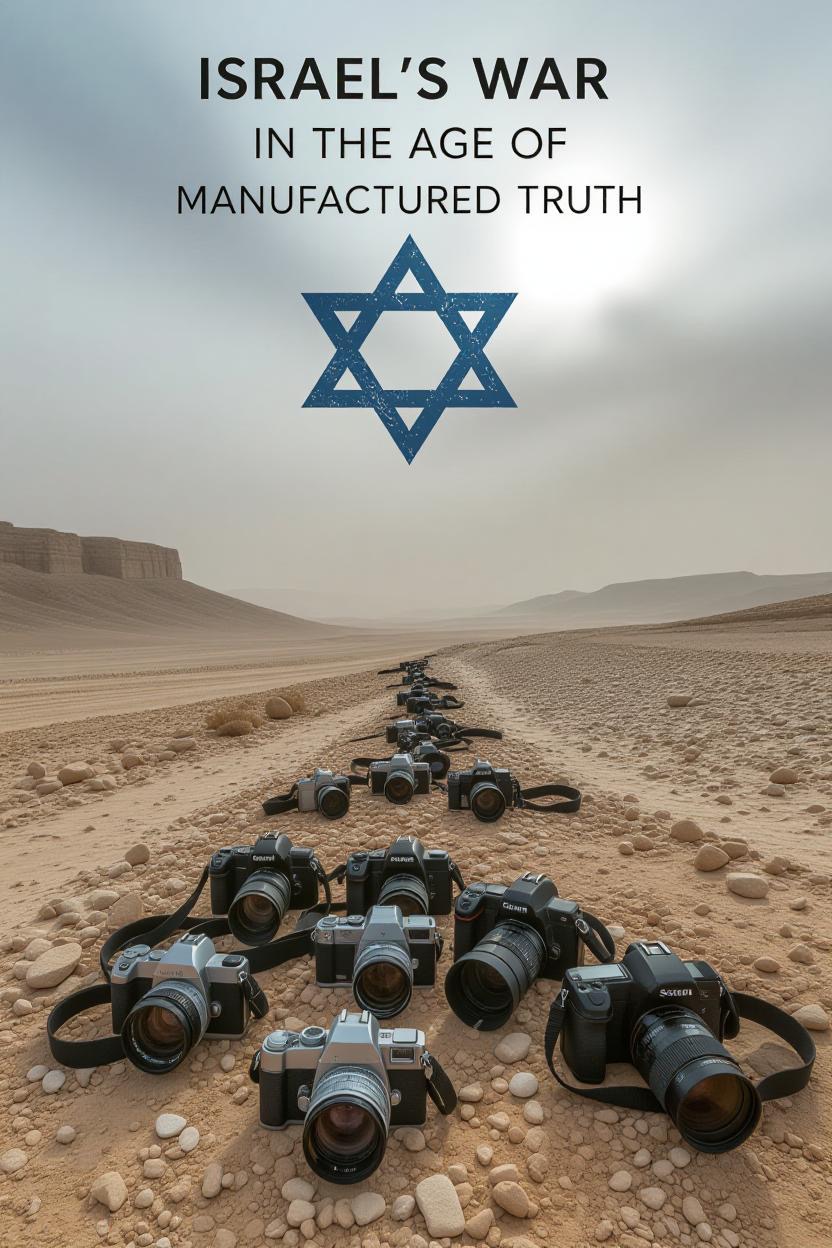
The deadliest weapon isn’t a rocket. It’s the story you believe.
On October 7, 2023, the mask slipped. Hamas’ assault on Israeli civilians, murdering families, burning children alive, kidnapping the elderly, was not simply an act of terror. It was the opening move in a calculated strategy to drag Israel into a prolonged war of attrition, one fought not only with rockets but with perception, patience and political pressure.
This is not just about land or borders. It is about whether a sovereign state has the right to defend itself against annihilation without being delegitimised into inaction. Militarily, Israel’s forces dismantle Hamas’ networks piece by piece. But the wider struggle plays out far from Gaza’s streets, in diplomatic chambers, newsrooms and the digital spaces where opinion is shaped in seconds. The kinetic war can be measured in territory and casualties. The other war, the war of narratives, is harder to track but potentially more decisive. In history’s long arc, victory often belongs to the side that can adapt to changing forms of conflict while keeping its internal strength intact. That is Israel’s challenge now.
The disinformation war against Israel is not just propaganda in the usual sense. It is the weaponisation of selective reality. We are not watching two sides of a debate. We are watching a deliberate collapse of shared facts. The same outlets and activists who cry “apartheid” over Israel rarely mention that Gaza has separate beaches for men and women, or that its Christian population has been driven to near extinction. They speak of “blockades” but never note that Egypt controls Gaza’s southern border with the same restrictions, because the blockade is not about occupation. It is about containing a regime that stockpiles missiles in schools. These narratives work because they are designed for short attention spans and moral vanity. People do not have to understand the complexity of the conflict. They only have to repeat a slogan that lets them feel righteous. The lie becomes a lifestyle accessory.
The deeper risk is not just losing sympathy abroad. It is allowing the outside world’s false picture to influence decision-making inside Israel. Every time an Israeli leader hesitates for fear of what Paris or Canberra might tweet, that hesitation is logged by Israel’s enemies as proof the pressure is working. Historically, the most dangerous moment for a nation is not when it is under siege, but when it begins to adapt its behaviour to please those who would see it dismantled. That is when the enemy’s narrative becomes a form of co-governance.
Global power is moving toward multipolarity. Regional actors are testing American resolve. Authoritarian regimes are using proxy conflicts to weaken democratic rivals without risking direct war. Israel’s enemies understand they do not have to defeat it outright. They can bleed it over time while exploiting divisions among its allies. In Dalio’s terms, the structure of the global order is shifting. Nations that fail to recognise the new rules of engagement are left playing yesterday’s game while their adversaries set tomorrow’s board.
The real risk is not an immediate collapse but a slow corrosion, a situation where Israel remains militarily dominant but politically and diplomatically isolated. This is an endurance contest. Winning requires the capacity to sustain operations, diplomacy and legitimacy over years, not months, without losing the values that justify the fight. The ability to act decisively depends on unity. Israel must articulate not only why the war is necessary but what comes after it, giving citizens a shared vision of security and purpose. Facts must be deployed with speed and precision, backed by hard evidence. Misinformation must be countered in real time, not after it has set like concrete in the public mind.
October 7 was a warning that Israel is entering a different era, one where the tools of warfare are as much informational and economic as they are military. Nations do not collapse simply from a single defeat. They fall when they fail to adapt, cling to outdated assumptions and mistake survival for something that happens automatically. If Israel can adapt, maintain unity and defend truth as fiercely as its borders, it will not just survive but set the standard for what a modern sovereign state must be. If it cannot, the true tragedy will not be October 7 itself, but that it marked the start of a decline that could have been avoided.
Related Topics
Related Posts