CEO of Time to Stand Up for Israel
It Ain’t Over Until It Is Over
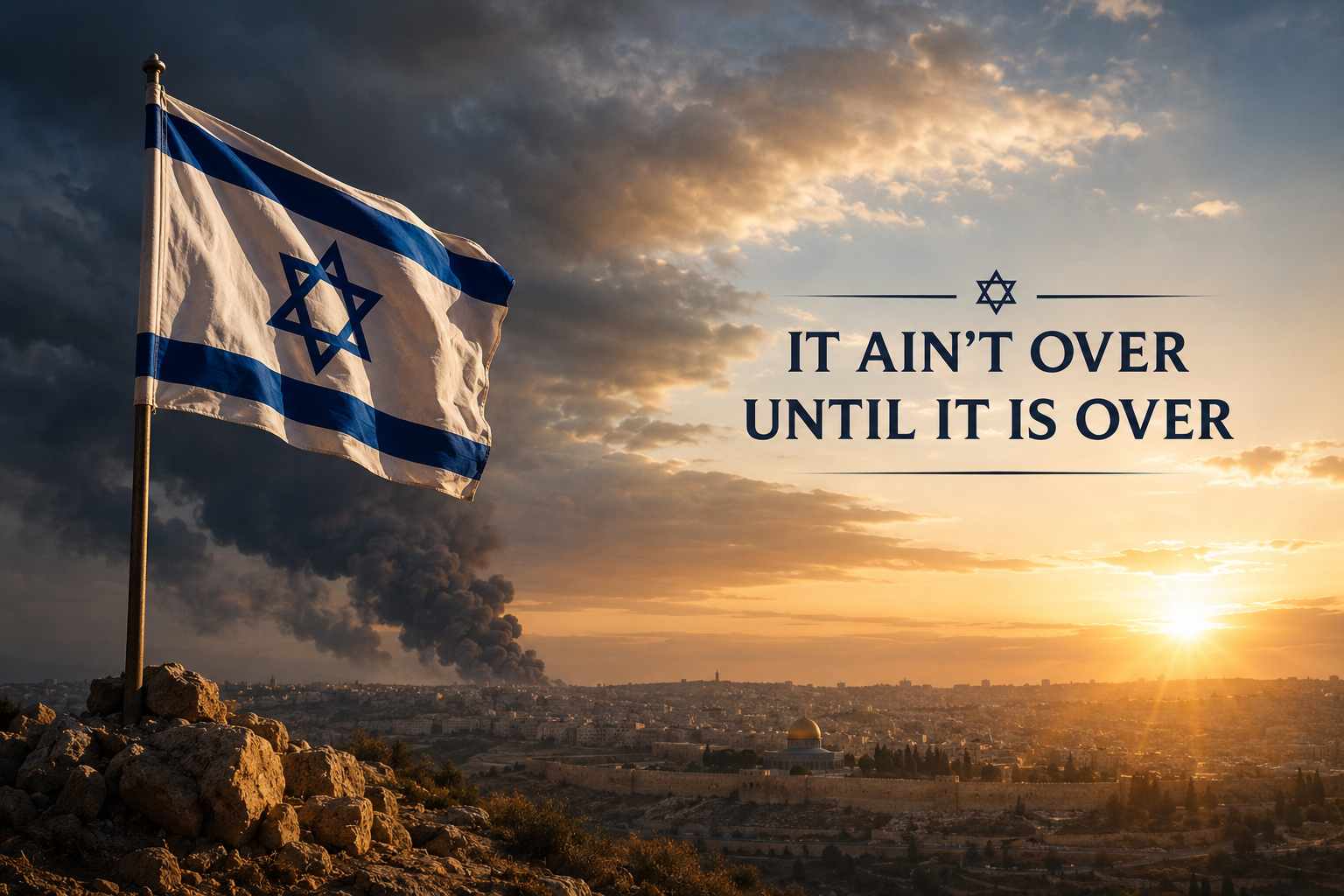
Photo Credits: Sabine Sterk ( AI)
For the first time in a long while, someone looking at Israel and the Middle East from a distance might be tempted to believe that the worst is finally behind us.
The direct attacks involving Iran appear to have stopped for now. Israel is no longer advancing deeper into Lebanon, although the ceasefire remains fragile and incidents have continued. The Houthis in Yemen are, at this moment, no longer launching the relentless attacks that became part of Israel’s reality. There are renewed efforts to remove Hamas as an armed force in Gaza. Airlines are looking again toward Israel. The IDF continues operating in Judea and Samaria against terrorist infrastructure and planned attacks.
From the surface, the picture almost looks reassuring.
Perhaps Israel is finally heading toward peace. Perhaps the region is slowly returning to stability. Perhaps Israelis can begin thinking about normal life again.
I desperately wish that were true.
But it ain’t over until it is over.
What we are seeing today is not necessarily peace. It may simply be a period in which several fronts have temporarily become quieter. Underneath that relative calm lies a Middle East that remains extraordinarily volatile. Recent events in Lebanon alone demonstrate how quickly a ceasefire can come under pressure, with deadly incidents followed by renewed Israeli strikes.
The same caution applies to Iran. A pause in attacks is important and diplomacy should always be given a chance, but a pause should never automatically be confused with the disappearance of the underlying threat. Recent negotiations and pauses in military action have taken place against a background of continuing confrontation and uncertainty.
Gaza remains another enormous challenge. Hamas has been severely damaged, but an organization does not disappear simply because it has lost commanders, fighters and infrastructure. As long as armed terrorist organizations retain the ability to reorganize, recruit, intimidate civilians and prepare future attacks, Israel cannot afford to assume that October 7 belongs permanently to the past.
Judea and Samaria are another pressure point. Israeli security forces continue trying to prevent attacks before they happen, but there is another danger that Israel must confront internally. Some Israeli residents have become so frustrated, frightened and angry that they risk taking justice into their own hands. There is a fundamental difference between defending yourself against terrorism and becoming the person who initiates violence. Israel must preserve that distinction. Terrorism does not become acceptable because the person committing it believes his anger is justified.
Then there is Turkey. The increasingly hostile rhetoric toward Israel should not simply be dismissed as political theater. Words matter in the Middle East, particularly when they come from powerful regional governments. Israel must listen carefully not only to what its enemies and critics are doing today, but also to what they are saying about tomorrow.
And then there is Israel itself.
The coming elections make an already complicated situation even more difficult. Israel is fighting threats from outside while Israelis are increasingly fighting politically among themselves. Political disagreement is normal in a democracy. Demonstrations are normal. Fierce debate is normal. But when political disagreement turns into hatred between Israelis, Israel begins doing something its enemies have repeatedly failed to accomplish. It weakens itself from within.
That worries me enormously.
Israel does not need everybody to agree. It needs people to remember that political opponents are not automatically enemies.
Yet there is also a reason for hope.
Exactly six years ago today, on August 13, 2020, Israel and the United Arab Emirates announced that they had agreed to fully normalize relations. The breakthrough became the foundation of what we now know as the Abraham Accords. Israel and the UAE agreed to establish diplomatic relations and expand cooperation in areas including tourism, investment, technology, healthcare, security and direct flights.
Importantly, the agreement did not suddenly appear on August 13. Behind the scenes, contacts had been developing for considerably longer. Reporting at the time indicated that discussions had been taking place for more than a year before the breakthrough was announced.
That matters today because the Abraham Accords proved something incredibly important.
Different cultures do not have to love everything about each other to live beside each other.
Countries do not need identical religions, histories or political systems to cooperate.
Peace becomes possible when governments decide that building a future is more valuable than endlessly fighting over the past.
That is the mentality the Middle East desperately needs.
For Israel, I believe there are two enormous priorities.
First, Hamas and other terrorist organizations that are committed to violence against Israel must lose their ability to wage war and terror. No sustainable peace can be built while organizations dedicated to destroying the other side retain weapons, military infrastructure and the freedom to prepare the next massacre.
Second, the global mindset surrounding this conflict must change.
For too long, terrorism has been explained, excused or romanticized while Israeli self defense is placed under a microscope. That mentality does not encourage peace. It rewards extremism. The international community should invest far more energy in encouraging coexistence, economic cooperation, education and regional normalization.
The Abraham Accords showed another road.
They demonstrated that Arabs and Israelis are not destined to remain eternal enemies. Six years later, that lesson may be more important than ever.
But Israel cannot build its security on hope alone.
Israel must remain alert. It must continue gathering intelligence. It must defend its borders. It must confront terrorism while maintaining its own moral and legal standards. It must strengthen relationships with countries willing to choose cooperation. And perhaps most importantly, Israelis must understand that national unity does not require political uniformity.
I hope the rockets remain silent.
I hope the airlines return.
I hope Iran chooses a different direction.
I hope Lebanon eventually becomes a peaceful neighbor.
I hope Gaza can have a future without Hamas.
I hope the Abraham Accords eventually become the beginning of something much larger.
But hope must never become complacency.
Israel learned on October 7 what can happen when an enemy is underestimated. That lesson was paid for with an unbearable price.
So enjoy every moment of quiet. Pursue every genuine opportunity for peace. Extend a hand to everyone sincerely prepared to live alongside Israel.
But keep your eyes open.
Because peace is possible, but peace still has to be defended.
It ain’t over until it is over.
Related Topics