


CEO, Sabra Ventures Ranch
It is Better to Be a Warrior in a Garden – Than a Gardener in a War
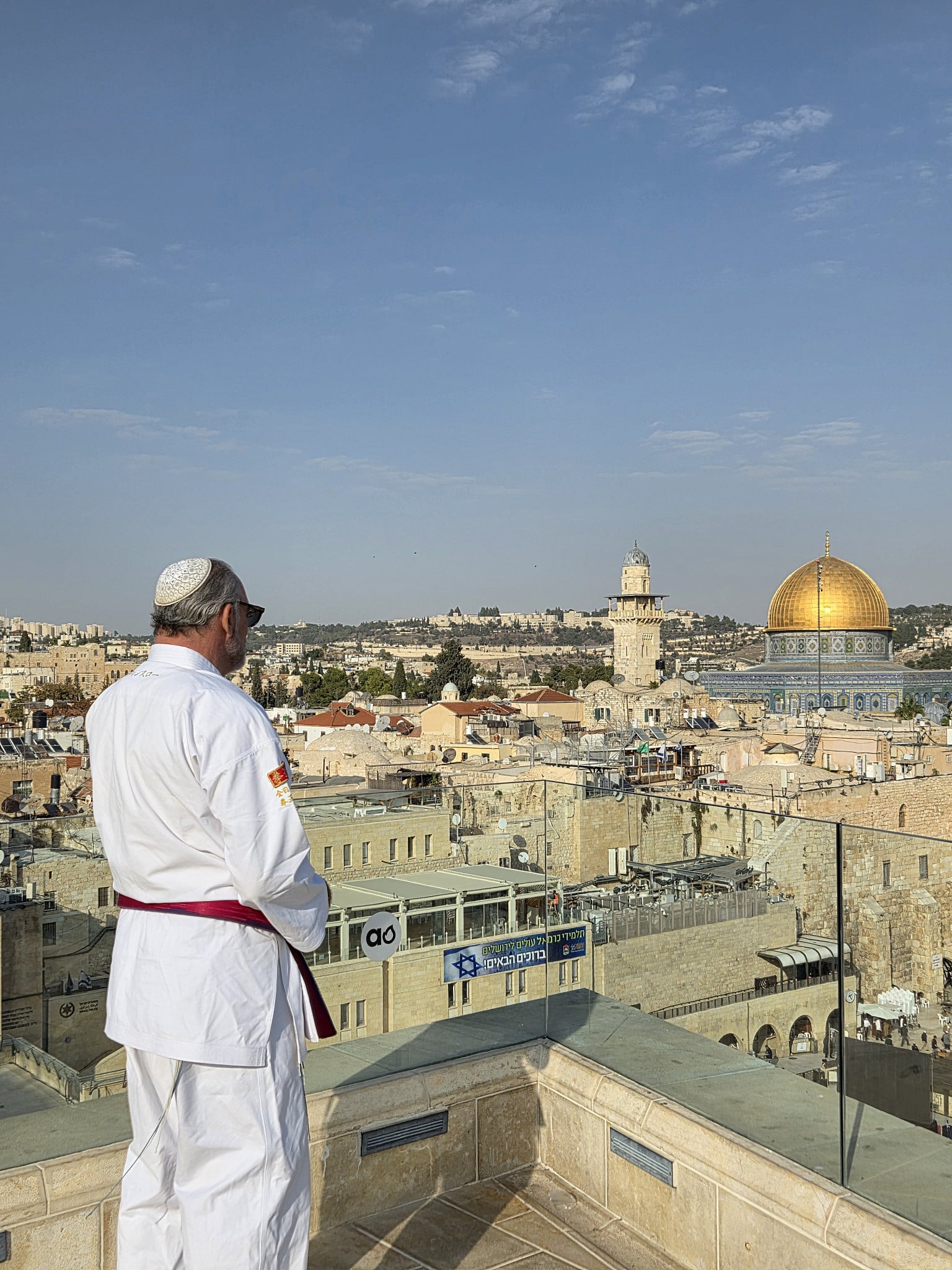
It is Better to Be a Warrior in a Garden – Than a Gardener in a War.
For the past twelve days, I’ve lived in a war zone — in Israel. Rocket and missile sirens have sliced through conversations, dinners, celebrations, services, and sleep. We’ve made 40 runs to shelters and counted many more early alerts on our phones. And yet, amid the chaos, life continues. Families gather for dinners. Shabbat is observed. Children study and play soccer, though sometimes those games are interrupted and continue in the bomb shelter. Markets remain busy. Music fills the air. And work goes on — meetings with Israeli and U.S. partners on innovation, technology transfer, and cross-border trade happen as if nothing has changed — because they must. In these moments, our work becomes more than business: it is a testament to resilience, a declaration that creation, connection, and progress persist even in the shadow of danger.
You learn quickly where the nearest miklat (Shelter) is.
You learn to measure distance in seconds.
You learn that life — faith, family, culture, work — doesn’t stop.
 This moment is an historical one as it sits inside a very long story arc. More than 2,500 years ago, the Jewish people faced the great imperial powers of the ancient Near East. The northern Kingdom of Israel fell to the Assyrian conquest in 722 BCE. Jerusalem was later destroyed by the Babylonian Empire in 586 BCE, leading to the Babylonian Exile. When Cyrus the Great of Persia conquered Babylon, Jews were allowed to return and rebuild Jerusalem, culminating in the construction of the Second Temple.

Centuries later, Jewish fighters rose in the Maccabean Revolt against the Seleucid Greek empire — liberating Jerusalem and rededicating the Temple, a victory remembered each year during Hanukkah. That revolt was the last time Jews successfully fought for freedom in our own lands for nearly two millennia, until the rebirth of the modern State of Israel following World War II and repatriation to our ancestral home.
And now in this current war, just as in the past three years under barrages of tens of thousands of missiles and rockets fired by Iran and their proxies, daily life continues with remarkable normalcy. Shabbat dinners still happen. Conversations about Torah and history continue late into the evening. Children laugh and play. Markets and cafés bustle (somewhat). Life fills the streets.
Even from shelters, cafés, and reinforced abodes, I’ve continued meeting with partners — online and in person — on innovation, technology transfer, and trade between Israel and Texas — the two Lone Star States. Each discussion, each connection about startups, funding, and collaboration, feels emblematic of resilience itself. Even while sirens sound, even when we pause mid-conversation to move to safety, the work continues. It is both a testament to our determination and a reminder of our raison d’être: connecting ideas, people, and resources to turn innovation into impact.

Both Israel and Texas share something deeper than economic alignment. They share a mindset. Frontier cultures. Builders. Risk-takers.
People who believe the future is something you create, not something you wait for.
Israel builds world-changing technologies under constant pressure. Texas builds scale, industry, and markets. When these two ecosystems connect, remarkable things happen — even amid air-raid alerts.
So even while missile sirens interrupt Zoom calls, and shelter runs punctuate the day, our work itself becomes a form of living resilience. It is proof that life, creation, and collaboration persist even in the midst of danger.
After these weeks here, one phrase keeps coming back to me:
“It is better to be a warrior in a garden than a gardener in a war.” – Miyamoto Musashi, 1584 – 1645.
Israelis understand this intuitively. They cultivate extraordinary gardens — of culture, innovation, faith, and family — but we so with the sober awareness that those gardens must be defended.
Strength and cultivation are not opposites. They are partners.
The sirens remind us of the warrior. The dinners, prayers, Shabbat celebrations, startups, and laughter remind us of the garden.
The ongoing tech meetings remind us of why we endure, and why we create.
Resilience is not just the ability to endure hardship. It is the insistence to live fully, to build, and to connect fully under any and all conditions. Including times of war.
“To have the arts of war without the arts of peace is to lack wisdom. To have the arts of peace without the arts of war is to lack courage.”