

It is Easy to Forget What You Don’t Want to Remember
Twenty-five years ago, when we lived near Boston, a young woman I will call Batsheva came to study for a year. Her home was Strasbourg, in the Alsace region of France. We got to know her a bit and invited her for a Shabbat meal on a weekend when her father Pierre came to visit.
Because Pierre spoke no English and we spoke no French, we got by with Hebrew.
“How are things for the Jews of Strasbourg?” I asked.
“They were a bit better for a while after the War,” he said. “Then the French went back to being the anti-Semites they have been for 1,200 years.”
That was France, I thought. An American would never talk that way. America, we knew, was different.
***
Since October 7th, American Jews have been forced to rethink their position in the US. Jews have been attacked and shot, toxic anti-Jewish and anti-Israel rhetoric have been normalized, Jewish schools, shuls, community centers now require guards and security.
Jews are being pushed out of public life: from politics, journalism, publishing, the arts. Even from medicine, long a field in which Jews excelled.
Recently a young Jewish woman was accepted at a prestigious US medical school, joining a shrunken cohort of coreligionist comrades. A few days into the term, she attended a meet-and-greet for new students. The emcee wore a kefiyyeh.
In disgust, she left and enrolled elsewhere. Where she still could.
***
Underlying current American Jewish angst is an assumption: America was never like this. Now it is. We no longer know what to expect.
I don’t pretend to know what will happen. But I know a bit about what did happen, even in my own field of medicine. Some of it happened not long before I joined the profession.
In 1968 I enrolled at the Albert Einstein College of Medicine in New York City, then still part of Yeshiva University. Einstein was founded in 1955, as a place for Jewish students unable to gain admittance elsewhere, and an attractive option for talented and ambitious Jewish faculty and researchers eager to work where they would be welcomed with enthusiasm, not endured on sufferance.
When I finished post-graduate training in pediatrics at Einstein in 1975, my wife and I moved to Hartford, Connecticut. Hartford had three hospitals: Hartford Hospital, the WASP hospital, Saint Francis, the Catholic hospital, and Mount Sinai, the Jewish hospital, where I went to work.
Of the Hartford version of Mount Sinai, locals told me, “If the ambulance takes you to Mount Sinai, get out and crawl to Saint Francis.” But my employer had a new building and an ambitious new executive director. The new pediatrics head was a Jew from Johns Hopkins. Maybe things were looking up.
The pediatric department was in an old, shabby wing, where pediatrics is often placed because it generates less revenue than other departments. The pediatricians I met there seemed rather old and seedy themselves.
Some of them also had staff privileges at Hartford Hospital, but only on the Courtesy staff, not the regular staff. The WASP hospital aristocracy did not welcome Jews. That is why the US medical landscape is dotted with Mount Sinais and Beth Israels, so Jewish doctors would have places to work.
Why did aristocratic hospitals not want Jews? Because they didn’t like Jews. This was a truth held to be self-evident, no further explanation needed.
Yet even in 1975 there were hints of change. The doctor who headed pediatric cardiology at Hartford Hospital had an odd, Greek-sounding name, but was in fact a proudly identified Orthodox Jew,
A couple of years later we moved to Boston, where I retrained in dermatology. One of my teachers at a far-flung clinic was a curmudgeonly fellow who was mostly retired. I was told that for a time he had functioned as Head of the Dermatology Department at Mass General, the renowned WASP redoubt. Of course he was just Acting Chair there. Well, you know. He was Jewish.
In the early 1980’s, to help build my practice, I joined the staff at Brookline Hospital, a small place in the unfashionable part of a tony suburb. I well remember a meeting of the medical staff. There was a tall, ruddy Irishman, the radiologist. All the other docs were short, bald Jews who were GP’s in the old Boston neighborhoods from which the middle class had fled.
All were “Middlesex Men,” graduates of the Middlesex Medical School, which opened in 1914 in the working-class Boston suburb of Waltham. Middlesex had the outlandish notion of judging applicants on their merit. Even Jews.
The “Middlesex Men” had such low status that even Beth Israel Hospital, founded by the Jewish community to serve Jews turned away elsewhere, would not have them on staff, so they admitted their patients to Brookline Hospital.
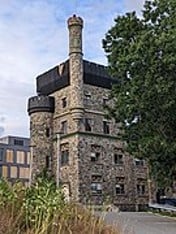
The American Medical Association, eager to limit the number of qualified doctors and to perpetuate discriminatory admission practices, tried for years to decertify Middlesex, finally succeeding in 1947. Their odd, tower-like building became part of the newly-founded Brandeis University, itself set up to help admit Jews spurned by other colleges.
During my years of dermatology practice, I wrote a column for fellow skin practitioners. Some of them replied, by email and even by old-fashioned letter. One such letter came from a gentleman I will call Julian, out in the Midwest, where he had practiced for decades. He shared his story in several pages of longhand.
After graduating medical school, Julian started postgraduate training in Internal Medicine. Then in 1951 he was drafted into the US Armed Forces during the Korean War. While in the military, he grew interested in dermatology.
Back in civilian life, he told his Chief that he wanted to specialize in skin medicine. The chief was sympathetic, but there was a problem: the local Chair of Dermatology did not accept Jews. Fortunately, Julian’s boss was a golfing buddy of the dermatology Chair, and convinced him to accept his protégé, Jew though he was.
Julian recalled that he was quite elated. But his Chief shared the news along with an admonition. “You will have to work very hard to excel,” he said. “The future of your race depends upon your performance.”
Julian indeed worked very hard. When he finished his residency, he got the second highest mark in the country on the dermatology Board Exam.
***
It was a bit jarring to learn that in America, within my lifetime, an aspiring Jewish professional was urged to be a credit to his race. 1951 was a while ago, but it wasn’t the Middle Ages.
Stories prove nothing, but they do teach lessons if you want them to.
As a child born in the US after World War II, I was taught, by osmosis and precept, that America was different. No other country in our Diaspora sojourn had ever accepted Jews as fully, or let us prosper as much, as America. Of course there were some problems, but the story was the story.
If that is the story, then what is happening now in the US is unintelligible. This should not, cannot, be happening. Over time, perhaps with effort, it will go away and life will go back to what we thought was normal.
I make no predictions and offer no advice. I just want to suggest another way of looking at current events through the lens of a different story, which may teach a different lesson. You can look at what is happening and say:
“Well, we had a few good generations, didn’t we? And now those are gone. First, they kept us out because they didn’t like our kind. Then they started to like us. Now they dislike us again. First we were not white enough. Now we are too white. Well, it was a good run.”
Who would talk this way? Pierre the French Jew would, as no doubt some French Jews, watching the riots in Paris, are saying right now. And so might, at various times in history, Jews from Spain, from England, from countries all over North Africa and the Near East where Jews lived for millennia before we were driven out. Baghdad and Damascus had many Jewish citizens, some quite affluent, well into the 20th century. Now they are gone. So, Jewishly, it goes.
Americans have never thought, or talked, that way. Maybe now they will. Maybe not. I don’t know.
Speaking for myself, I will always love America and be grateful that my family has had the good fortune to live there, as most of my family still does. Other American Jews may differ. Some may leave. Most, I suspect, will not.
We Jews have long memories. We recall times when we had to change our minds about prospects that seemed secure. The first of these was back at our very start. Once upon a time a bright, ambitious young Jewish fellow did so well that he made it all the way up, right next to the top man himself. And then, one day,
ויקם מלך חדש על מצרים אשר לא ידע את יוסף
And a new king arose, who did not know Joseph.