
Historian, Librarian, Educator, and Artist
‘It Is True’: Artemisia Gentileschi and Paternalistic Chesed
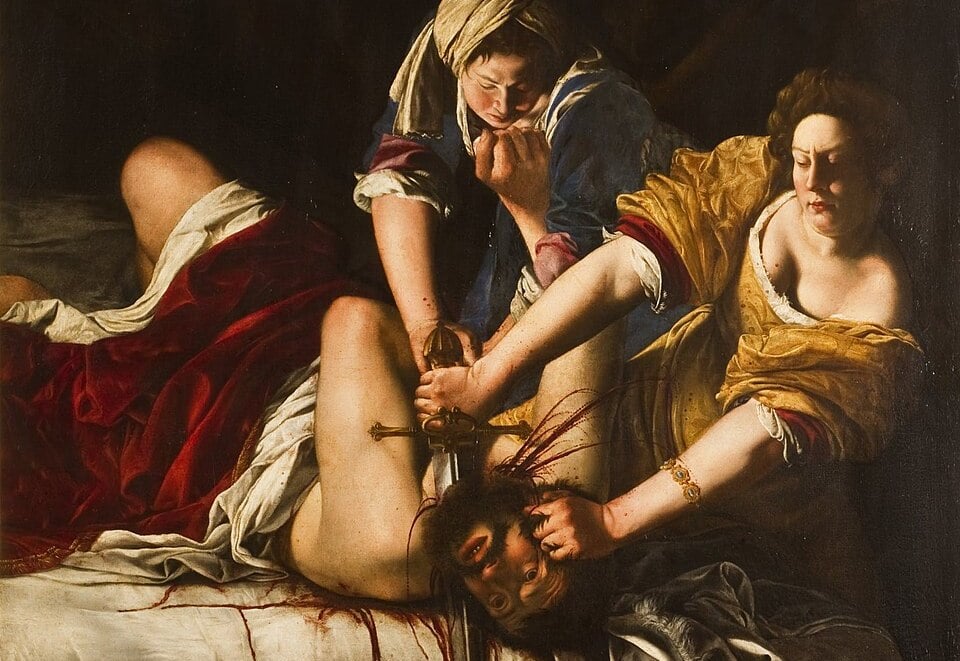
Artemisia Gentileschi, Judith Slaying Holofernes, c. 1620, oil on canvas, Uffizi Galleries, Florence. Source: Wikipedia. Artemisia's Judith is neither passive nor decorative: she leans into the act with force, concentration, and resolve, embodying a woman's refusal to be silenced, erased, or denied possession of her own truth.
This past week marked the birth of Artemisia Gentileschi, born in Rome in July 1593, one of the great painters of the Baroque and one of art history’s most powerful witnesses to what it means for a woman to fight for possession of her own truth.
I had been writing about Artemisia as an artist: her dramatic chiaroscuro, her biblical heroines, her place among the followers of Caravaggio, and her extraordinary career across Rome, Florence, Venice, Naples, and London. But this year, what stayed with me most was a line from the trial transcript after her rape, when, under torture, she repeated:
“È vero, è vero, è vero.”
It is true. It is true. It is true.
That sentence has outlived the courtroom.
More than four centuries later, it still burns because women are still forced into that posture: explaining, documenting, reconstructing timelines, forwarding messages, proving promises, proving pressure, proving harm. Even then, the answer too often comes back as condescension: you misunderstood, you are emotional, you do not listen, you should have done things differently.
Artemisia matters not only because she survived male violence, and certainly not because her art should be reduced to biography. She matters because she painted women who knew the stakes. Her Judith is not decorative or passive. She leans in. She grips. She acts. In Judith Slaying Holofernes, the clenched hand is not merely a Baroque detail. It is refusal: refusal to be erased, refusal to be disbelieved, refusal to let male power have the final word over a woman’s body, story, dignity, and truth.
“È vero”: A Woman’s Possession of Her Truth
I have been thinking about Artemisia while living through a very different kind of crisis. Not the same violence, not the same trial, not the same century. But the same exhausting demand placed on a woman to keep proving what she knows happened.
It is true that I warned people.
It is true that I knew the danger.
It is true that promises were made.
It is true that I relied on those promises.
It is true that my belongings mattered.
It is true that my mother’s memory mattered.
It is true that the crisis was not manageable alone.
It is true that I was not asking to be managed. I was asking to be heard.
And still, the phrase came back again and again:
You don’t listen.
But why, as a woman in her forties, am I being spoken to as if listening means obedience?
When Listening Means Obedience
I was building a life in Israel. It was not easy, and it was not a romantic fantasy. It was complicated, expensive, lonely, unstable, meaningful, and mine. I had work, an apartment, commitments, art, writing, ambitions, and a future I was still trying to hold together.
From Canada came the familiar voice of paternalism: come back, be practical, stop trying to manage so much, this is where you should be, this is what makes sense. It was framed as concern, but underneath it was the assumption that other people knew better than I did what my life should be.
Then, when the emergency in Canada became real — physical, expensive, legal, logistical, and impossible to manage alone — the support was not there in the way it needed to be.
The same paternalism that claimed authority over my decisions did not take responsibility for the consequences.
I needed practical help: witnesses, movers, advocacy, storage, hands, protection, someone to stand beside me before the damage became irreversible. Instead, I was told I did not listen.
But I had listened — to the danger, the costs, the lack of support, and the realities of trying to hold together a life between Canada and Israel. I had warned for months, even years, about the housing crisis, the expense of moving, and the impossibility of managing it without help.
Then the things I warned about happened.
Somehow, the story became that I had failed to listen.
But who listened to me?
That is the question Artemisia’s “è vero” forces us to ask. What happens when a woman’s testimony is treated not as knowledge but as noise? What happens when her insistence on the truth becomes proof, in other people’s minds, that she is difficult, emotional, unstable, ungrateful, or unreasonable? What happens when listening is defined not as hearing her, but as requiring her to surrender?
When Chesed Becomes Paternalism
This is not only a feminist question. It is a Jewish one.
Jewish tradition is profoundly aware of power. Again and again, the Torah commands special concern for the widow, the orphan, and the stranger — not because they are sentimental figures, but because they are people without ordinary protection, easily exploited, pressured, dispossessed, and silenced. The Torah does not romanticize vulnerability. It legislates against its abuse.
“You shall not ill-treat any widow or orphan,” Exodus warns. Deuteronomy insists that justice must not be perverted for the stranger or the orphan. The vulnerable person’s dignity is not optional. It is a measure of whether a community is just.
A single woman today may not fit neatly into the biblical category of widow or orphan, but she can know something of that exposure. No husband standing beside her. No adult children to advocate for her. No local family to lift boxes, witness conversations, confront intimidation, or make people think twice. Not enough money or institutional power to ensure that her version travels as quickly as someone else’s.
In that position, help can easily become control.
In religious communities, control does not always announce itself as cruelty. It arrives as concern. It says: we know what is best. Be practical. Throw it away. You are not listening. Someone else will handle this.
The person supposedly being helped becomes smaller and smaller until she is no longer the subject of her own life.
That is paternalism.
And paternalism is not chesed.
Chesed is one of the most beautiful words in Jewish life, but it does not mean taking over another person’s agency. Tzedakah is not merely paying the easiest bill or satisfying the loudest creditor. At its highest level, as Rambam teaches, tzedakah helps a person stand on her own feet through work, partnership, a loan, or practical stabilization before she collapses into dependency.
Real help asks whether the person will regain the ability to live, work, decide, recover, and move forward. A bill can be paid while a life remains destabilized. A creditor can be satisfied while the woman in crisis is left unable to work, pay rent, access her belongings, preserve her family memory, keep her obligations, or return to the life she was building.
That is not the highest form of tzedakah. It may simply be the management of discomfort.
Kavod habriyot — human dignity — demands more. Dignity is not a luxury reserved for people who are calm, wealthy, organized, and easy to assist. It matters precisely when a person is vulnerable, frightened, cornered, and dependent on others.
Ona’at devarim, the prohibition against verbal harm, matters too. Words can injure. To tell a vulnerable woman that her belongings are junk, that her attachments are irrational, that her grief is clutter, or that she should discard what she promised to protect is not harmless advice. It communicates that her memory, judgment, promises, and life must become smaller because preserving them is inconvenient.
Contemporary language might call this gaslighting: the rewriting of a person’s reality until her own knowledge becomes suspect. Jewish ethics has older language for it — verbal harm, misleading counsel, failure of dignity, and the abuse of vulnerability.
Lo Yachel Devaro: The Weight of a Promise
That Shabbat, I went to a synagogue I do not usually attend. The rabbi was away, and the cantor gave the sermon. The Torah portion could not have been more direct. Parashat Matot-Masei opens with vows and the weight of speech:
“He shall not break his pledge; he must carry out all that has crossed his lips.”
In Hebrew, the phrase is lo yachel devaro — he shall not profane, hollow out, or make empty his word.
I sat there thinking about promises.
Promises made to me.
Promises I relied on.
Promises that shaped financial decisions I never would have made otherwise.
And another promise, quieter but no less binding: the promise I made to my mother.
Before she died, my mother was very clear. Like many parents nearing the end of life, she worried that the things she had saved, collected, bought, loved, and preserved would be discarded after she was gone. These were not merely objects to her. They were part of the beautiful home she wanted me to have and the life she imagined continuing after her death.
I promised her I would not simply throw her world away.
That promise has become one of the most misunderstood parts of this crisis. To others, the boxes are clutter, junk, an inconvenience, something a practical person would discard. Some have even insisted that my mother would not want me to keep these things, as though they can rewrite the meaning of a promise made between a mother and daughter near death.
After the sermon, I spoke to the cantor. I told him about the promise. His response was clarifying. He understood that keeping it was not foolish attachment or irrational hoarding. It was a morally serious act of loyalty, a religiously meaningful act of kibbud eim — honoring my mother — even after she was no longer here.
That mattered.
Everyone else seemed to treat her absence as the reason the promise no longer counted. But Judaism does not teach that honoring a parent ends when the parent can no longer speak for herself. The commandment to honor father and mother is one of the Ten Commandments. It is not framed as convenience, sentiment, or optional memory.
To protect what I could of my mother’s things was not only emotional. It was a form of fidelity.
Some of those things had to go into storage because the house was too small and the emergency move left no proper way to sort, preserve, or place them. These things mattered to me because they mattered to her. The promise mattered because my word mattered.
That is what others kept dismissing.
They dismissed the promise made to me.
They dismissed the promise I made to my mother.
They dismissed the knowledge I had of my own life.
Then they called that dismissal advice.
Parashat Matot insists that words are not empty. Speech creates obligation. A person’s word is not meant to be a temporary emotional gesture that disappears when the consequences become expensive.
A promise is not less real because it was made to a woman in crisis. It is not less real because she relied on it and later became inconvenient. A promise to the dead is not meaningless because the dead can no longer defend it.
The same Torah portion that commands us not to hollow out our words forced me to ask why promises made to me were treated as hollow, while my promise to my mother was treated as a burden I should abandon.
I keep my word. That is part of what others do not seem to understand about me. When I say I will repay, I try to repay. When I say I will work, I try to work. When I say I will protect something, I try to protect it. When I make a promise, especially to someone vulnerable or dying, I do not treat it casually.
That is also why broken promises devastate me. I believe people. I rely on words. I make decisions because someone has given me their word. Then, when they do not follow through, somehow I become the problem because I believed them.
But Judaism does not mock the person who relies on speech. Judaism teaches that speech matters.
There is something morally inverted about a world in which a vulnerable woman is blamed for believing a promise while the person who breaks or narrows it is treated as reasonable. If words create reliance, then words create responsibility.
If someone says, “I will help you with the move,” to a person who cannot move without that help, those words become part of her practical reality. They shape decisions and carry moral weight. Their abandonment can take away rent money, work stability, access to belongings, the possibility of an exit route, and the chance to return to the life she was building.
It is not melodrama to say that unkept words can damage the scaffolding of a life. Jewish tradition has always known that speech is not “just words.”
The rabbis compare certain forms of verbal harm and public humiliation to bloodshed because words can drain life, dignity, and standing from a person. That does not mean every broken promise is literal murder. It means Judaism refuses to pretend that words are harmless when they expose someone to shame, instability, or ruin.
Lo yachel devaro can be read as an ethical warning: do not make your word hollow. Do not speak in a way that another person builds her survival around and then treat those words as if they had no substance.
What others called “junk” was, to me, a trust.
What others called “not listening” was, to me, keeping faith with my mother.
A woman’s promise does not become disposable because the person she promised is no longer alive to defend it. A promise made to a woman in crisis does not become disposable because she lacks the power to enforce it.
Jewish tradition understands the weight of memory. It commands us to honor father and mother. It teaches that names, inheritance, continuity, and the preservation of memory matter.
The daughters of Zelophehad stood before Moses and the leadership of Israel to say that their father’s name should not disappear simply because he had no sons. Their claim was not dismissed as emotional attachment. God says, “The daughters of Zelophehad speak rightly.”
It is one of the great Jewish feminist moments: women standing before male authority and asserting that inheritance, memory, and continuity are not trivial simply because men failed to account for them.
So when a woman says, “These belongings matter,” she may be saying much more than “I like my things.” She may be saying: this is my mother’s memory, my work, my documents, my history, my continuity, my promise, my inheritance, my name.
To tell her to throw everything away without sorting, without knowing what is inside, and without helping preserve what matters can become a demand that she break faith with the dead.
When a woman’s belongings are treated as disposable, it is difficult not to feel that her life is being treated as disposable too.
Whose Voice Counts?
There is a cruel double bind in being a single woman in crisis.
If she resists, she is difficult.
If she cries, she is emotional.
If she explains, she is not listening.
If she insists a promise mattered, she is unreasonable.
This is how a woman becomes cornered.
Jewish feminism has always had to ask: whose voice counts? Whose testimony is believed? Whose knowledge is treated as knowledge? Who needs a male intermediary before her reality becomes credible?
In religious communities, we need to be honest about how often male authority still travels faster than female pain. A mover’s claim becomes urgent. A landlord’s version becomes credible. A rabbi’s intervention becomes the official solution. A donor’s help is directed toward the easiest bill to pay.
Meanwhile, the woman at the center — the one who has lost money, housing stability, work time, access to belongings, and the ability to return to the life she was building — is told to be calm, grateful, realistic, and obedient.
But Jewish ethics does not command obedience to someone else’s convenience.
It commands justice.
It commands dignity.
It commands us not to stand idly by.
“Do not stand idly by the blood of your neighbor” is often invoked in moments of physical danger, but its moral force is broader: do not watch another person be harmed when intervention is possible. Do not see vulnerability and turn it into a lecture. Do not arrive after the disaster and call the injured person irresponsible for bleeding.
There is also lifnei iver, the prohibition against placing a stumbling block before the blind. The rabbis understood this not only literally but ethically: do not give advice that serves the adviser more than the person receiving it. Do not pressure the vulnerable into choices whose consequences they alone must carry.
This is the Jewish feminist heart of the matter: women do not merely need kindness. We need to be believed. We need our knowledge of our own lives to count. We need help that preserves agency rather than replacing it.
We need communities that understand that paternalism can wear a kippah, quote Torah, speak gently, call itself concern, and still leave a woman less protected than before.
“I Am a Woman of Sorrowful Spirit”
There is a scene in the Bible that should haunt every religious authority figure.
Hannah comes to the Mishkan in anguish, praying silently from the depth of her pain. Eli, the priest, sees her lips moving and misreads her. He thinks she is drunk.
Hannah has to correct him:
“No, my lord. I am a woman of sorrowful spirit.”
How many women have had to say some version of that?
No, I am not hysterical.
No, I am not irrational.
No, I am not refusing to listen.
I am a woman of sorrowful spirit.
I am telling you what is true.
To Eli’s credit, he hears her after she speaks. He does not double down. He does not lecture her about her tone. He does not call her difficult. He blesses her.
That is the part too often missing.
Women in anguish are still misread. Their distress is mistaken for instability. Their urgency is mistaken for aggression. Their refusal to surrender is mistaken for disobedience. Their warnings are ignored until the consequences arrive, and then those consequences are used as evidence against them.
But sometimes the woman accused of not listening is the only one who has been listening all along.
She listened to the danger before others acknowledged it.
She listened to the pattern before others admitted it.
She listened to the promises, costs, pressure, and risks.
She listened to the life she was trying to preserve.
The real question is not: why did she not listen?
The real question is: who listened to her before the crisis became irreversible?
Who listened when she said she could not absorb the cost? Who listened when she said the belongings mattered? Who listened when she said the move would determine whether she could work, pay rent, and return to Israel? Who listened when she said she was being pressured from every side? Who stood beside her when standing up for herself was neither safe nor simple?
A person cannot be pressured to leave the Jewish life she was building in Israel and then abandoned when the practical crisis of that return becomes unbearable.
A woman cannot be told to be realistic and then left alone with the consequences of everyone else’s realism.
A single woman should not need a man beside her in order to be believed.
Artemisia’s “è vero” echoes because women are still asked to prove the obvious: that what happened happened, that what was promised was promised, that what was lost was real, and that what they know about their own lives is knowledge.
Sometimes a woman repeats herself not because she is hysterical, but because nobody has listened.
Sometimes she documents everything not because she is obsessive, but because her reality keeps being denied.
Sometimes she refuses to throw things away not because she is irrational, but because those things are memory, work, duty, grief, continuity, and love.
Sometimes she believes someone’s word not because she is foolish, but because she still lives by the idea that words matter.
And sometimes the woman accused of not listening is the only one who truly understands what is at stake.
It is true.
It is true.
It is true.
–
Sources
“Artemisia.” The National Gallery, National Gallery, London, www.nationalgallery.org.uk/exhibitions/past/artemisia.
“Artemisia.” The National Gallery: Press Releases Archive, National Gallery, London, www.nationalgallery.org.uk/about-us/press-and-media/press-releases-archive/artemisia.
“Artemisia Gentileschi.” The National Gallery, National Gallery, London, www.nationalgallery.org.uk/artists/artemisia-gentileschi.
“Artemisia in Her Own Words.” The National Gallery, National Gallery, London, www.nationalgallery.org.uk/exhibitions/past/artemisia/artemisia-in-her-own-words.
Bava Metzia 49a. Sefaria, www.sefaria.org/Bava_Metzia.49a.
Bava Metzia 58b. Sefaria, www.sefaria.org/Bava_Metzia.58b.
Berakhot 19b. Sefaria, www.sefaria.org/Berakhot.19b.
Cosslett, Rhiannon Lucy. “The History of Art Is Full of Female Masters. It’s Time They Were Taken Seriously.” The Guardian, 7 Oct. 2020, www.theguardian.com/commentisfree/2020/oct/07/history-of-art-female-masters-artemisia-gentileschi.
Deuteronomy 23:24. Sefaria, www.sefaria.org/Deuteronomy.23.24.
Exodus 20:12. Sefaria, www.sefaria.org/Exodus.20.12.
Exodus 22:20–23. Sefaria, www.sefaria.org/Exodus.22.20-23.
ffolliott, Sheila. “Artemisia Gentileschi.” Oxford Bibliographies in Art History, edited by Basile Baudez, Oxford University Press, 24 Feb. 2021, doi:10.1093/obo/9780199920105–0164.
Garrard, Mary D. Artemisia Gentileschi: The Image of the Female Hero in Italian Baroque Art. Princeton University Press, 1989.
— -. Artemisia Gentileschi and Feminism in Early Modern Europe. Reaktion Books, 2020.
Hebcal. “Matot-Masei 5786.” Hebcal Jewish Calendar, www.hebcal.com/sedrot/matot-masei-20260711.
“Judith Beheading Holofernes by Artemisia Gentileschi.” Uffizi Galleries, www.uffizi.it/en/artworks/judith-beheading-holofernes..
Leviticus 19:14. Sefaria, www.sefaria.org/Leviticus.19.14.
Leviticus 19:16. Sefaria, www.sefaria.org/Leviticus.19.16.
Maimonides. Mishneh Torah, Gifts to the Poor 10:7–14. Sefaria, www.sefaria.org/Mishneh_Torah%2C_Gifts_to_the_Poor.10.7-14.
Numbers 27:1–11. Sefaria, www.sefaria.org/Numbers.27.1-11.
Numbers 30:2–3. Sefaria, www.sefaria.org/Numbers.30.2-3.
1 Samuel 1:9–18. Sefaria, www.sefaria.org/I_Samuel.1.9-18.
Treves, Letizia, editor. Artemisia. National Gallery Company, 2020.
Related Topics
Related Posts