Life in an antizionist small town.
Ithaca, NY: Ground Zero for Small Town Jew Hate Part II
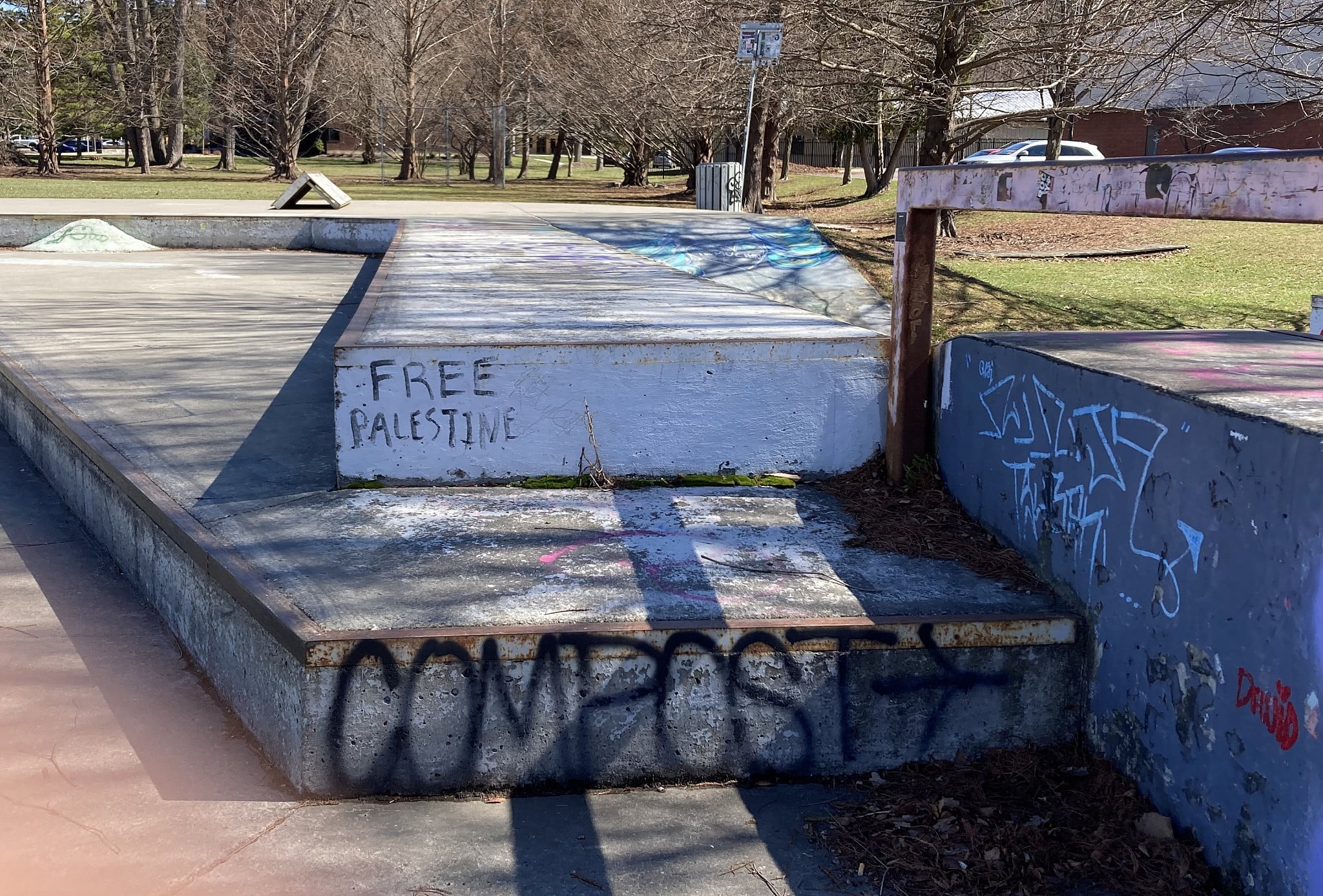
Graffiti in a popular playground, Ithaca, NY, April, 2026. photo©Stacey Lehman
Ambient antisemitism. When I first encountered this phrase several weeks ago, a condition I had sensed but was unable to name snapped into focus. The term gave language to the uneasy, inchoate feeling that something in Ithaca, New York, has gone deeply wrong — a feeling my Jewish friends and neighbors experience not as abstraction, but as daily reality.
Dr. Jonathan Boyd, executive director of Britain’s Institute for Jewish Policy Research, defines ambient antisemitism as an atmosphere that communicates to Jews, often subtly, that we do not count and are not welcome. Yael Silverstein expanded on the concept in the Spring 2026 issue of Sources: A Journal of Jewish Ideas. What makes the idea so powerful is that it describes a phenomenon that is more difficult to quantify than overt hatred. Ambient antisemitism is not always a swastika spray-painted on a wall or a shouted slur. More often, it is a cultural atmosphere — a steady accumulation of signals, omissions, double standards, and silences that tell Jews they we exist outside of the moral community.
Ithaca has certainly seen explicit antisemitism. There have been swastikas on public property, “Free Palestine” graffiti in public parks, inflammatory posters near schools, and social media images depicting blood-soaked politicians who support Israel. The city government backed a mural that many residents viewed as Hamas propaganda, prominently painted on a major thoroughfare. Supporters of Israel have been denied service at a popular coffee shop, emboldened by workplace policies that tolerate political discrimination. Public officials who express support for Israel are skewered on social media and in person.
Those incidents are ugly, but they are recognizable. They can be named, condemned, and confronted directly.
Ambient antisemitism is more pernicious. It resembles a carbon monoxide leak: invisible at first, easy to dismiss, yet slowly poisoning the atmosphere. At first it produces only discomfort — a faint headache, a sense of unease. Over time, the pressure becomes impossible to ignore. We hesitate before wearing Judaica in public, we speak about Israel in hushed tones so as not to attract attention, our Israeli friends discourage their children from speaking Hebrew when they’re out shopping.
In Ithaca, that atmosphere emerges through a pattern repeated across cultural and civic life.
Wide Awake Bakery, a popular local institution known for artisanal bread and pastries, offers one example. Its owner, a former academic who often writes in purple prose about farming and community, uses his newsletter and social media after October 7 to accuse Israel of genocide and of deliberately targeting bakeries in Gaza. At the same time, his establishment continues to bake and profit from the sale of traditional Jewish staples like challah and babka, though he has refused to publicly condemn antisemitism. The contradiction is difficult to ignore: Jewish culture is welcome as cuisine, but our fears and grief are not.
A similar pattern prevails at Cinemapolis, the city’s sole independent movie theater. Since October 7, the theater has screened multiple films centered on Palestinian suffering and anti-Israel activism, including No Other Land, All That’s Left of You, and The Encampments. These films present one moral narrative: Israel as oppressor, Palestinians as victims.
Yet despite repeated requests, the theater has not screened a single documentary exploring the trauma experienced by Israelis or diaspora Jews after October 7. A film such as October 8 — which examines the surge of antisemitism on college campuses and beyond — could easily have been paired with The Encampments to encourage genuine dialogue. Instead, only one side of the story is given cultural legitimacy.
The message may not be explicit, but it is unmistakable: Jewish suffering is less worthy of attention.
The same atmosphere pervades Ithaca bookstores. During Jewish American Heritage Month, the display window at Autumn Leaves Used Books features anti-Israel titles and imagery. A few blocks away, Buffalo Street Books publicly aligned itself with the “Booksellers for Palestine” campaign, one of many activist statements demanding a ceasefire and an end to aid for Israel, without so much as a passing nod to the hostages.
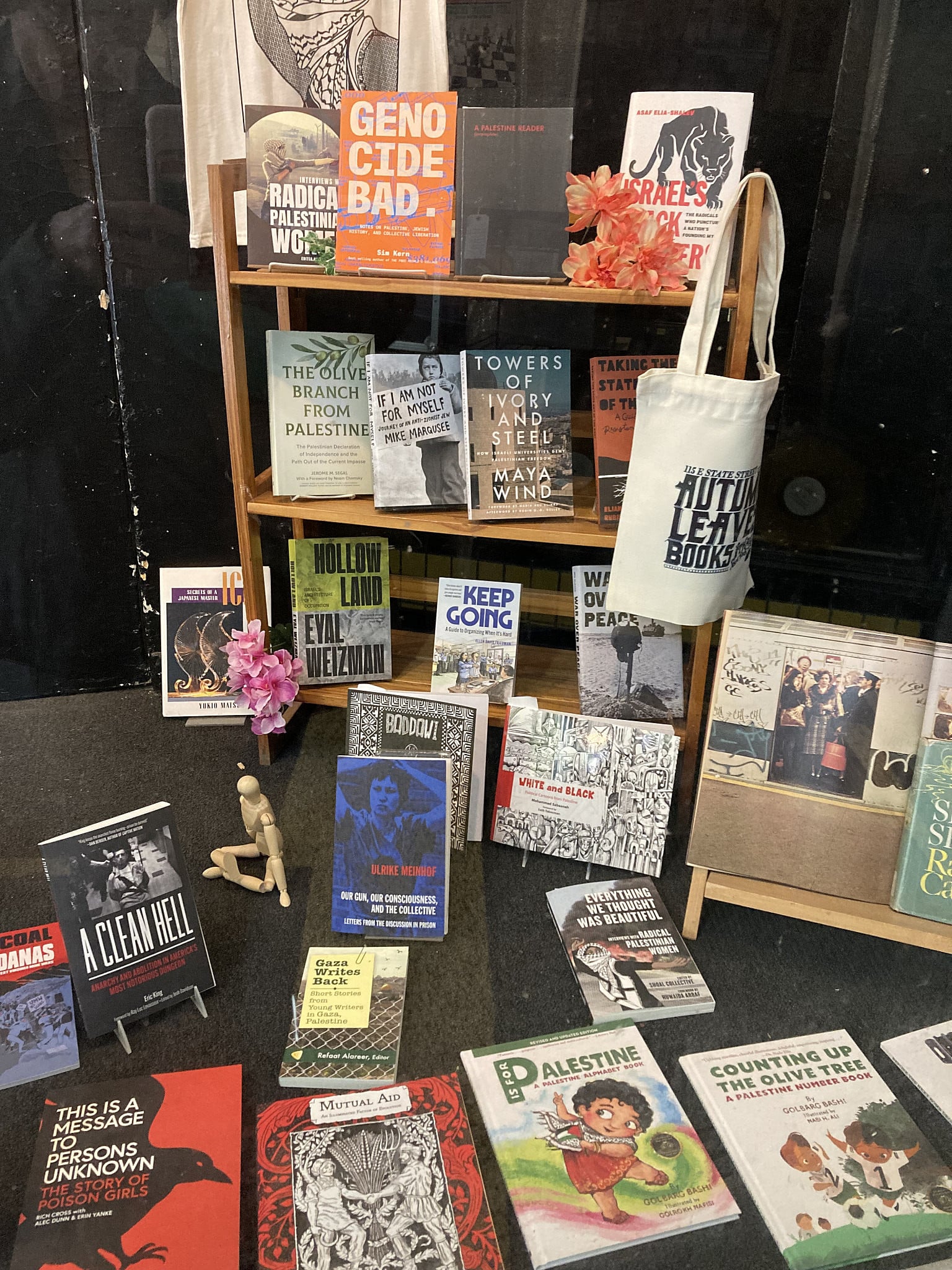
Autumn Leaves Used Books, Ithaca, NY, May 16, 2026. Photo©Stacey Lehman
Many celebrated books about Israeli hostages, antisemitism, Israel’s history, or Jewish trauma have been published since October 7 — memoirs like Eli Sharabi’s Hostage or Rachel Goldberg-Polin’s When See You Again are readily available — yet they are absent from the Buffalo Street Books shelves. Instead, shelves display titles framing Israel through the language of colonialism and genocide. Again, the issue is not the existence of Palestinian narratives; those stories deserve to be told. The issue is the near-total absence of Jewish ones.
Even ostensibly apolitical spaces contribute to the noxious atmosphere. Yoga Farm, a studio that celebrates “diversity and inclusion,” decorated its flower boxes with Palestinian flags and commissioned artwork expressing solidarity with Palestinians. Yet there has been no corresponding acknowledgment of Jewish fear, Israeli victims, or the antisemitism that exploded globally after October 7.
None of these incidents, taken individually, would necessarily prove antisemitism. That is precisely the point. Ambient antisemitism operates through accumulation. A bakery post here, a movie screening there, a bookstore display, a mural, a social media campaign, a silence where empathy should be. Each signal alone may seem minor or defensible. Together, they create an environment in which Jewish experiences are ignored, Jewish grief is invisible, and Jewish belonging feels conditional.
Ithaca is a small town. We have few alternatives to these businesses and institutions. They exist within blocks of one another. Their messages overlap and reinforce each other until they form a kind of civic chorus. The result is an intellectual and moral monoculture in which the Middle East can be understood only through the lens of hostility toward Israel, while Jewish voices are dismissed, silenced, or treated as suspect.
That is what ambient antisemitism feels like.
Not always hatred shouted from a street corner. More often, it is the quiet but relentless suggestion that Jews alone are denied the complexity, compassion, and moral consideration readily extended to everyone else.
Over the next couple of weekends, the population of Ithaca will nearly double as roughly 30,000 visitors from around the country and world descend to watch their loved-ones graduate from Cornell University and Ithaca College. These visits typically involve visits to some of Ithaca’s popular attractions, including the downtown area. How can Jewish visitors feel welcome when the message communicated to them by the city is that they’re not worthy?
Related Topics
Related Posts