Teach Peace!
It’s a Great Day for Democracy
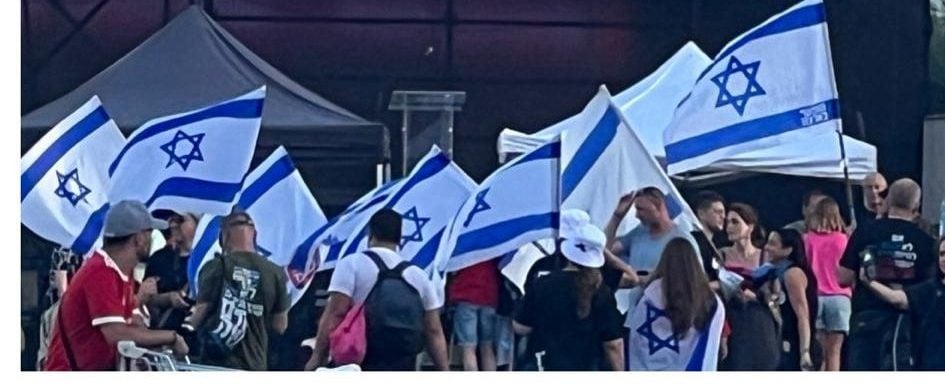
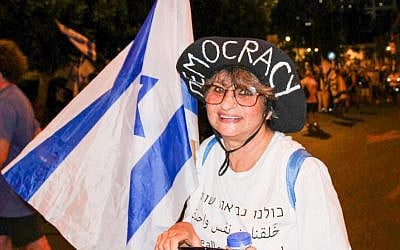
Israelis march in Tel Aviv. Photo: Nili Bresler
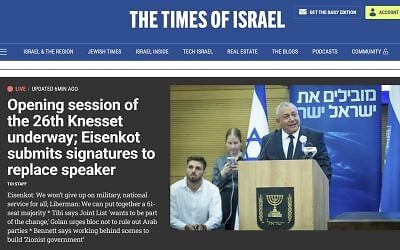
Today, Israel’s 26th Knesset held its inaugural session. This newly elected parliament comprises a majority of members opposed to Netanyahu’s far-right government. And although the road to a ruling coalition is complicated for both sides, the odds are much better for the Change Bloc, led by Gadi Eisenkot, who has been given the mandate to put together our next government.
In both my countries: the USA, the country of my birth, and Israel, my country of choice, fair and free elections were held. And in both countries, a majority of citizens voted for change. True, the blue tsunami in the USA is far more impressive than the 56% vote for change in Israel. But in both cases, the message is clear. On both sides of the ocean, this was a clear vote of no-confidence for the incumbents.
Simple Math is Never Simple Around Here
It’s true, I had dared to hope that after the national election, the bloc for change would claim a more decisive victory. On Oct. 27, over 56% of Israelis voted for change. This is why President Herzog gave the mandate to form a new government to Gadi Eisenkot.
The simple math is that the election results sum up to 67 definite mandates for change, versus 46-53 mandates for more of the same. The discrepancy in numbers is because at least one ultra-Orthodox party, generally aligned on the far right, has stated that it would NOT support Netanyahu for Prime Minister. They did say they could support a government led by Eisenkot, but their terms, including across-the-board draft exemptions for their young men, are not acceptable to the Eisenkot bloc.
The fact is that simple math is never simple in this complicated country.
I know the Israeli parliamentary system is near-impossible for people from the West to understand. It’s complicated even for us here in Israel, though we’ve lived with it for 78 years. Hell, it’s hard to comprehend even for the Brits, who also have a parliamentary system. The Brits have two main parties and two houses of Parliament. Here in Israel, we had 37 parties running in this past election. Eleven of those parties won mandates. Each mandate is one seat in our parliament, which has just one house.
Israel’s parliament, the Knesset, has 120 members. Fun fact: our Knesset is based on the historical Anshe Knesset HaGedolah (the Men of the Great Assembly), the legislative and governing body of ancient Israel from the Second Temple period that consisted of 120 leaders and prophets. But I digress. Bottom line: In the 120-member Knesset, a coalition traditionally needs a majority of 61 seats (or mandates) to form a government.
But this is not an absolute requirement according to Israel’s Basic Law. Since we don’t have a written constitution, the Basic Law is the closest we come to a constitution. So, a minority government is one option that would be possible. In fact, minority governments are not unusual in parliamentary democracies around the world. And there are precedents here in Israel as well. In fact, Yitzhak Rabin led a minority government from 1993 until his assassination in November 1995.
And even before a new government coalition is formed, there is plenty that can be done by the new Knesset members. First order of business for the change bloc is to replace the Knesset Speaker, removing Netanyahu’s man, Amir Ohana in favor of the progressive Matan Kahana (no relation to Meir Kahana, founder of the far-right militant party, Kach).
Israeli Demographics: It’s complicated.
Former Israeli president Reuven Rivlin described the “four tribes” of Israel – the modern tribes comprising our demographic and cultural groups: Secular Jews, Orthodox (Religious/Modern Orthodox) Jews, Ultra-Orthodox (Haredi) Jews, and Arabs. And these demographic groups do not fit neatly into right / left categories.
At least two of the ultra-orthodox parties define themselves as non-Zionist. They oppose compulsory military service for their young men, while somehow having no problem taking billions of shekels in government funding.
The 67 mandates for change break down into 48 mandates for the Jewish parties (the anti-Netanyahu bloc) and 19 mandates for the Israeli Arab parties. And some of the parties in the anti-Netanyahu bloc, notably Avigdor Lieberman’s party, reject the idea of including any of the Arab parties in the next government.
And it is wrong to throw all the Israeli Arabs into one category. The Israeli Arab parties span different ideologies – from the non-religious communist party to Arab nationalist and Islamist parties. Some, like Mansour Abbas’ Ra’am party have declared that they are open to joining a government coalition, while others demur. Some of the Israeli Arab parties have denounced Hamas as a terrorist movement, while others refuse to do so.
I want to clarify here that the Israeli Arabs are citizens of the State of Israel who have ALL rights of citizenship, regardless of ethnicity or religion. Israeli Arabs are Muslim and Christian. They comprise over 20% of the country’s population. They are educated, hard-working members of Israeli society, especially prevalent in healthcare: Approximately 25% of doctors in Israel are Arab. My doctor is Arab. I trust him with my life, literally. Over 50% of the pharmacists in Israel are Arabs. Israeli Arabs are also dentists, nurses, teachers, engineers, and farmers.
There is understandable confusion outside of Israel about Israeli Arabs and Palestinians. While many Israeli Arabs may identify as Palestinian, they are full citizens of Israel, because they live within the borders of the State of Israel. The Arabs residing in the West Bank and Gaza are not Israeli citizens. They have their own governing authorities. In the West Bank, the people are governed by the Palestinian Authority. In Gaza, the government is (sadly) led by Hamas, a terrorist organization.
The picture is further complicated by the fact that two of the leaders have confusingly similar names. The President of the Palestinian Authority and Chairman of the PLO is Mahmoud Abbas. He is not related to Israeli citizen, Mansour Abbas, who leads the Ra’am party. Palestinian leader Mahmoud Abbas, also known as Abu Mazen, is 91, and has been in power since 2005. He was due to serve only 4 years, until 2009, but he has repeatedly postponed elections. Bottom line: the Palestinians in the West Bank have not been able to vote for two decades. This has nothing to do with Israeli policy. It has everything to do with Mahmoud Abbas’ desire to stay in power.
So yes, as stated above: It’s complicated! Nevertheless, today a new, non-Netanyahu majority parliament was sworn in. I say, it’s a great day for democracy!
Related Topics
Related Posts