It’s Later Than You Think
At the funeral, the only fully living person in the room is dead. His photograph looks down upon government officials who are breathing, drinking and arguing, but who have surrendered so completely to habit and hierarchy that they appear less alive than the man they have come to bury. Akira Kurosawa’s Ikiru is the clearest artistic exposition I have ever encountered of the Talmudic teaching that the righteous remain alive even in death, while others may be dead even during life.
The man in the photograph is Kanji Watanabe, a minor bureaucrat who has spent nearly thirty years behind the same desk. Early in the film, the narrator tells us that he has not really lived during that time. He has kept himself busy while carefully avoiding anything that might require him to act. Papers move across his desk; petitions move from one department to another; years move silently past him. His colleagues call him “the mummy.” He is not approaching death. In the sense that matters most, he is already dead.
Then Watanabe learns that he has terminal cancer.
At first, the diagnosis does not teach him how to live. It merely terrifies him. He tries pleasure, nightlife and distraction, as if intensity could compensate for decades of absence. It cannot. Stimulation is not life. Nor can he simply borrow the vitality of a young employee whose delight in ordinary things fascinates him. What she possesses cannot be transferred to him. He must discover his own reason to live.
He finds it in a petition that his office had previously helped bury. A group of mothers wants a fetid neighborhood cesspool drained and replaced with a playground. Until then, the women and their children had been abstractions to him, another complaint to stamp, redirect and forget. Now he sees them.
Dr. Robert Rhondell Gibson, a teacher whose work influenced me, distinguished between the man-made world and the real world. The man-made world consists of our titles, procedures, categories, expectations and hierarchies. It is not inherently evil; much of it is necessary. But it becomes spiritually dangerous when the map replaces the territory, the role replaces the person and the procedure relieves us of the burden of responding to what is actually before us.
Watanabe’s city office is the man-made world perfected. A cesspool is converted into a petition. The petition becomes paperwork. The paperwork is passed between departments until no person remains responsible for the suffering that produced it. Everyone is working, yet nothing is being done.
The playground belongs to the real world: mud, sewage, mothers, children, sickness, earth and eventually laughter. In attaching himself to something real, Watanabe becomes real again. He does not merely find a project. He reclaims the soul he had gradually surrendered to his position.
This is why his transformation gives him such extraordinary power. Officials can reject him. Colleagues can obstruct him. Gangsters can threaten him. Yet his face renders them mute. He does not defeat them through force or superior status. He has simply ceased to live in the world from which their power comes.
What can they take from him? His position? His reputation? His future? Death has already exposed the limited value of all three. He does not become aggressive or self-righteous. He becomes patient, almost serene. Having accepted the one thing he cannot change, he discovers how little authority the other obstacles possess.
Watanabe does not build the playground because he has conquered the bureaucracy. He conquers the bureaucracy because he has first conquered himself. Once fear, approval and habit no longer govern him, the supposedly immovable world begins to move.
The Talmud, in Berakhot 18a makes a startling distinction: “The righteous, even in their death, are called living,” while the wicked, even during their lives, are called dead.
Ikiru gives this teaching cinematic form. At the beginning, Watanabe is alive according to every biological measurement, yet he is described as a corpse. At the funeral, the condition is reversed. Watanabe has stopped breathing, but his photograph is the most living presence in the room. Everyone speaks about him, argues about him or defends himself against what Watanabe’s final months have revealed. The dead man has become the moral center around which the living revolve.
Some of the officials remain almost completely untouched. Others, helped by alcohol, briefly understand. They reconstruct Watanabe’s struggle, recognize his courage, confess their own cowardice and vow to change.
But their emotion never matures into a plan of action.
The next morning, they return to their desks. A new petition arrives and the old machinery resumes. They encountered the truth at the funeral, but the encounter was not enough. Their feelings were sincere, yet sincerity alone could not keep them awake.
That may be the film’s most unsettling lesson. We imagine that transformation begins with a sufficiently powerful feeling or insight. If only we could be moved deeply enough, frightened sufficiently or shown the truth clearly enough, we would change. But human beings awaken all the time, they just go back to sleep shortly thereafter. Beauty can awaken us. Love can awaken us. Illness, suffering, death and works of art can awaken us. The more difficult question is what happens the following morning.
An experience can interrupt our sleep without teaching us how to remain awake.
This is precisely the work of Elul. As Rosh Hashanah approaches, Jewish tradition does not ask us merely to feel the passage of another year. It asks us to wake up. Rambam hears this summons in the sound of the shofar: “Wake up, you sleepy ones, from your sleep, and you who slumber, arise. Inspect your deeds, repent, remember your Creator”
The shofar is an interruption but, like the funeral in Ikiru, an interruption can pass. Its call must be carried into the life that follows it.
Jewish tradition does not treat wakefulness as a single revelation. It must become a practice. Mesillat Yesharim, the Ramchal’s great work on ethical and spiritual development, calls its first practical discipline “zehirut” – watchfulness or vigilance. It means examining where our actions are carrying us instead of allowing habit and social momentum to carry us unconsciously.
This is more demanding than what is often called self-awareness. We can become highly articulate about our fears, patterns and motivations without changing any of them. We can even turn self-observation into another refuge from action. “Zehirut” asks a less comfortable question: What am I actually doing with my life?
Watanabe’s diagnosis awakens him, but the diagnosis does not build the playground. He must choose one responsibility and then return to it through delay, rejection, humiliation and threat. His awakening becomes durable because it takes the form of a mission.
This is also why his colleagues cannot follow him. They make a sweeping promise to become different men, but choose no particular thing to do differently. Watanabe does not vow to “live more fully.” He decides to build a playground. The definite act succeeds where the elevated sentiment fails.
The same realism appears in the teachings of the sages. Hillel asks “If not now, when?” The question exposes one of the most persistent constructions of the man-made world: later. Later, when circumstances improve. Later, when other people understand. Later, when we feel courageous, inspired or certain. Later, when a more capable version of ourselves arrives to live the life we already know we should be living.
Rabbi Eliezer taught “Repent one day before your death.” His students asked the obvious question: How can anyone know which day that will be? He answered that one should return today, lest one die tomorrow; in that way, all one’s days become a life of return.
Watanabe receives the terrible advantage the rest of us lack: he is told that his time is nearly gone. His colleagues know abstractly that they will die, but continue to live as though another day is guaranteed. Watanabe allows death to destroy the fiction of an unlimited later.
We should not need his diagnosis.
We are called to awaken while ordinary life is still occurring and then to take up the practice of awakening again and again. This becomes more difficult in societies where freedom is constrained and the price of defying the man-made world is high. But no society makes wakefulness automatic. Free societies offer their own forms of sleep: comfort, status, distraction, ambition, entertainment and the desire for approval.
The way back is not withdrawal from the world. Watanabe does not leave society to contemplate the brevity of life. He enters life more completely by accepting responsibility for one neglected part of it.
Each of us needs a playground: not necessarily a grand calling, but something real enough to demand action and meaningful enough to call forth strength we did not know we possessed. A person to serve. A truth to speak. A neglected work to begin. Something we already know needs to be done, but which we have allowed fear, routine or bureaucracy to postpone.
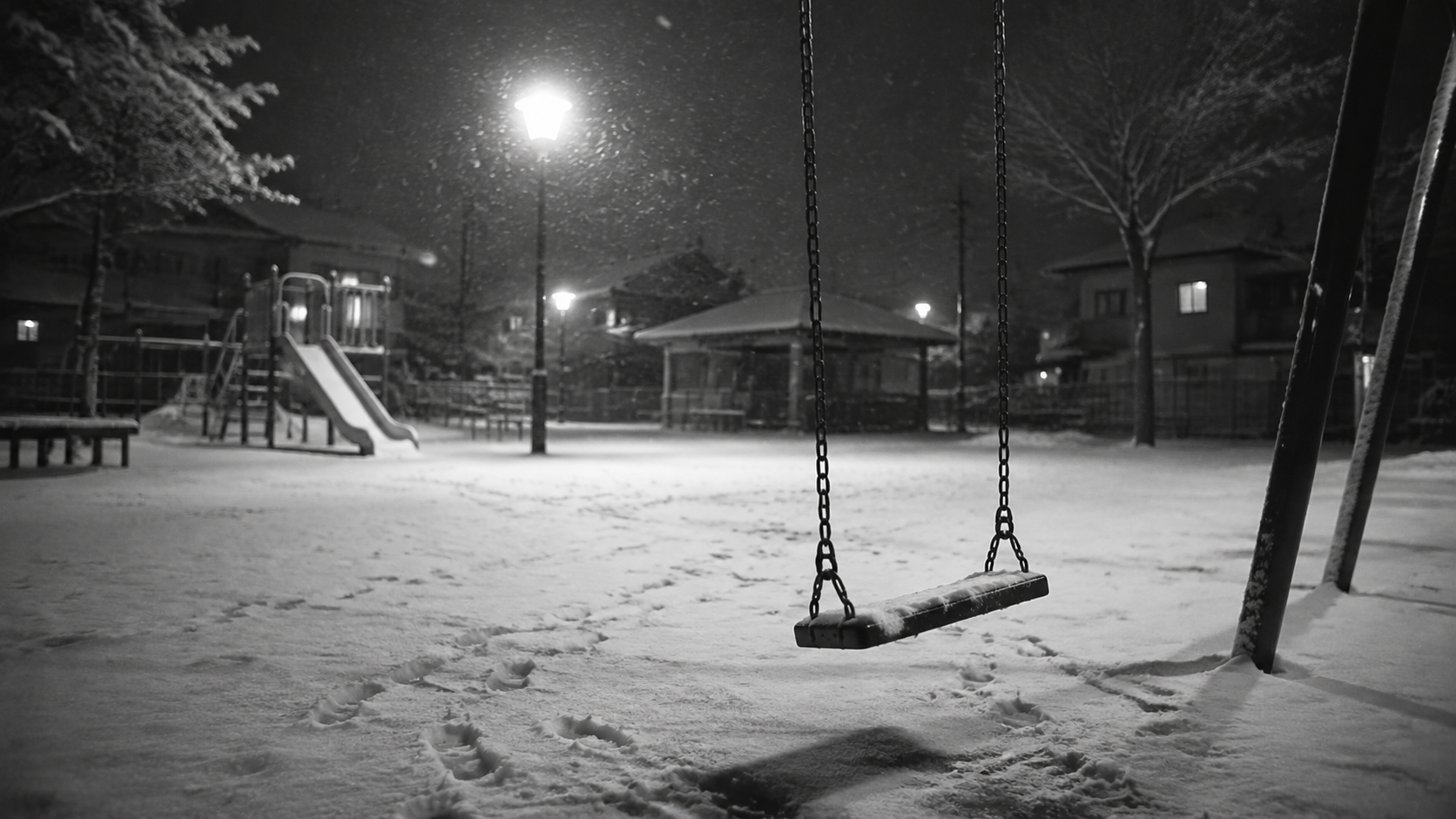
Near the end of Ikiru, Watanabe sits alone on a swing in the playground as snow falls around him. He sings about the brevity of life. He is joyful, though not in any conventional sense. He is dying, cold and alone, yet he may be more fully awake and fully alive in that moment than he has ever been. From a higher vantage point, the games that once governed him have fallen away. He has accepted his fate without resigning himself to his life.
Death has not defeated him. It has run out of ways to prevent him from living.
Watanabe was given a diagnosis that told him it was later than he thought. We have been given no such timetable, only the knowledge that the same thing is true. The question is whether we can awaken before death awakens us and whether, once awake, we will choose our playground and begin.
It is later than we think. But it is not too late.