Looking forward
It’s the People that Give Me Hope
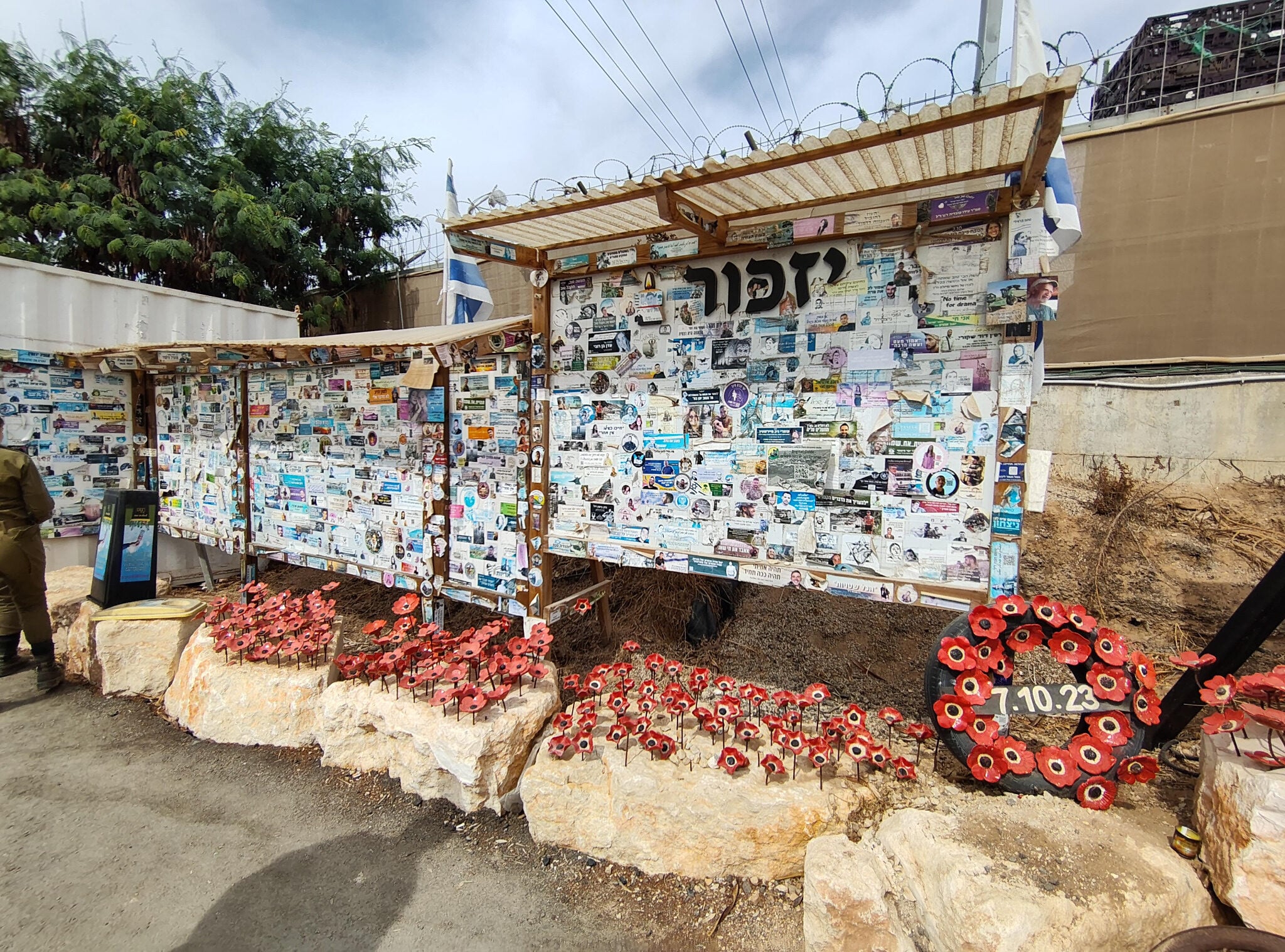
A photo of one of the many memorials created and maintained by volunteers. Photo by the author.
Why the coming Israeli elections matter, but not as much as we think
On October 14, 2026, three years and a week after the horrific attacks Israelis think about every day, I finally had the courage to head down to see Nova, the site of the massacre of partygoers by the hordes of shock troops sent by the government of Gaza on October 7th, 2023. Together with my hevruta, Aharon Horwitz, I spent the day in Sderot, among the Kibbutzim on the border of Gaza, immersed in the memorials set up by broken families and friends for the loved ones they lost on that day. And it was there, witnessing the outpouring of individual initiative in the aftermath of October 7th, that Aharon and I realized something that gave us hope: whatever the outcomes of the coming elections, Israel’s future will be defined by its people and not by its politicians.
I realize that is an odd statement to make, especially when it comes to a democratic society where its people vote for their politicians and the politicians purportedly represent the people. Especially before an election that many (including myself) believe is historic if not existential. Yet it is true nonetheless. And important to note given the confusion caused by the lack of passion experienced by many in this current electoral campaign and muddle of polls that pundits have taken for a lack of decisiveness of the Israeli public. For a number of reasons I’ll enumerate in a moment, the Israeli public is not well represented by its political class, and is voting for the current crop of politicians more out of inertia than belief. It is not for love of Benjamin Netanyahu and his government policies that his coalition maintains its heft, but a lack of leadership that explains why the election isn’t a foregone conclusion. And that is why I believe the coming elections are the last elections of the old Israel, no matter their outcome, as the new Israel is built from the ground up.
The best evidence for this shift can be found on Route 232, the single road down to Re’im where the Nova Music Festival was held. If you drive along the route you immediately notice that each of the minor and major memorials to those tragically murdered on October 7th were built and are maintained by volunteers, some by families, some who had not lost a loved one in the tragedy itself. If you listen to the people visiting the memorials, you’ll hear why they came to bear witness and how they’d like to help however they could. And if you visit the ruined cars from the day itself, you’ll see on them the stories posted of the brave souls who rushed down to help when the government didn’t function, when the army was paralyzed, when our sitting prime minister took hours to apply make-up before making his appearance. Everywhere you go you see evidence of the absence of government and the presence of tens of thousands of volunteers who, in the face of chaos and tragedy, rolled up their sleeves to staunch the bleeding, and feed and house and clothe the refugees among us still.
It is only now, in retrospect, that I have come to understand the implications of that moment on Israeli democracy. When we needed our government most, when we might have expected those individuals whose literal job it is to care for our wellbeing to jump into action and calm us by showing that we were in good hands, they were absent. In their absence – in the vacuum of leadership and representation that developed – Israeli civil society rose to the occasion. Israel became a participatory republic in its purest sense, an anarcho-syndicalist’s or altruistic libertarian’s dream. And the contract of representation broke with our political class.
It is hard to expect Israelis to return to representative democracy as usual after that experience. Especially of the kind we have in Israel, where the central government in Jerusalem controls everything from your local school’s budget to where to put a bus stop. It is hard to expect Israelis who spent the past four years attending weekly protests against this government and its policies, independent of any direct political guidance or organization from even the parties in opposition, to now be expected to give their trust to the same politicians who sat in this Knesset and watched as our country was nearly burned to the ground. Only a few – Yair Golan from the Democratim, Ofer Winter from Amha Israel among them – rose to the occasion on that day, which is why their parties have attracted more votes than they would have in a previous election cycle.
For this reason, I believe, it would be incorrect to conclude that the results of this current election will accurately define Israel’s citizens, and incorrect to assume that the coming government will have the mandate to represent what most Israelis want. And while I hope Gadi Eisenkot, leader of the Yashar party, will be Prime Minister (even as I vote for the Democratim), I would hope that he recognizes this limitation of electoral support, and spends the time he has rebuilding trust between the politicians and the people by midwifing a new political system for Israel. One that decentralizes power, that returns much of it to the people in their communities, one that builds on the incredible initiative and social solidarity we saw in spades these past four years and reflects the potential of our people to self-govern as we self-define.
Walking among the memorials at Nova I was filled both with a deep sorrow for the families, for the friends, for the country that lost such beautiful souls, and with a deep love for what we built here: a country that is a community of communities, a society with social solidarity that cares for the widow and the orphan and clothes the needy and heals the sick. A people who can show sustained support for one another, who can rise to replace their representatives and build on the fly solutions to the challenges they face, is a people who will survive this current government and whatever missteps made by the next one. The elections matter, sure. But the people matter more. It is the people that give me hope, not the polls, and the people I am betting on for the long run, not the politicians who may or may not rise to the occasion.
Related Topics
Related Posts