


It’s Time to Stop Playing Defense
The rockets began at 6:29 a.m.
Over the next four hours, approximately 3,000 were fired from Gaza toward Israel. Back in the summer of 2014, during the entire fifty-day war between Israel and Hamas, the terrorist group had fired more than 4,500 rockets at Israel. A decade later, launching an average of one rocket every five seconds, Hamas fired roughly two-thirds as many in mere hours. What had once taken weeks now took moments.
Indiscriminately targeting civilian population centers, rockets rained down across southern and central Israel. Homes, cars, and civilian infrastructure were damaged and destroyed. Sirens blared across the tiny country. In the Bedouin village of Kukhleh, a rocket crashed into the home of a 57-year-old woman, killing her and her 13-year-old granddaughter. Nearby, another rocket killed four young cousins, ranging in age from 10 to 16.
Yet despite the unprecedented barrage, much of Hamas’s intended destruction never materialized. Blowing apart incoming rockets before they could reach the civilians below, Israel’s Iron Dome—the critical line of defense standing between millions of Israelis and the rockets raining down on them—intercepted the overwhelming majority of the rockets it engaged. Every successful interception meant one fewer rocket striking an apartment building, one fewer school destroyed, and one fewer family burying a loved one. The system did exactly what it had been built to do. It saved lives.
It was extraordinarily successful. It was also entirely defensive.
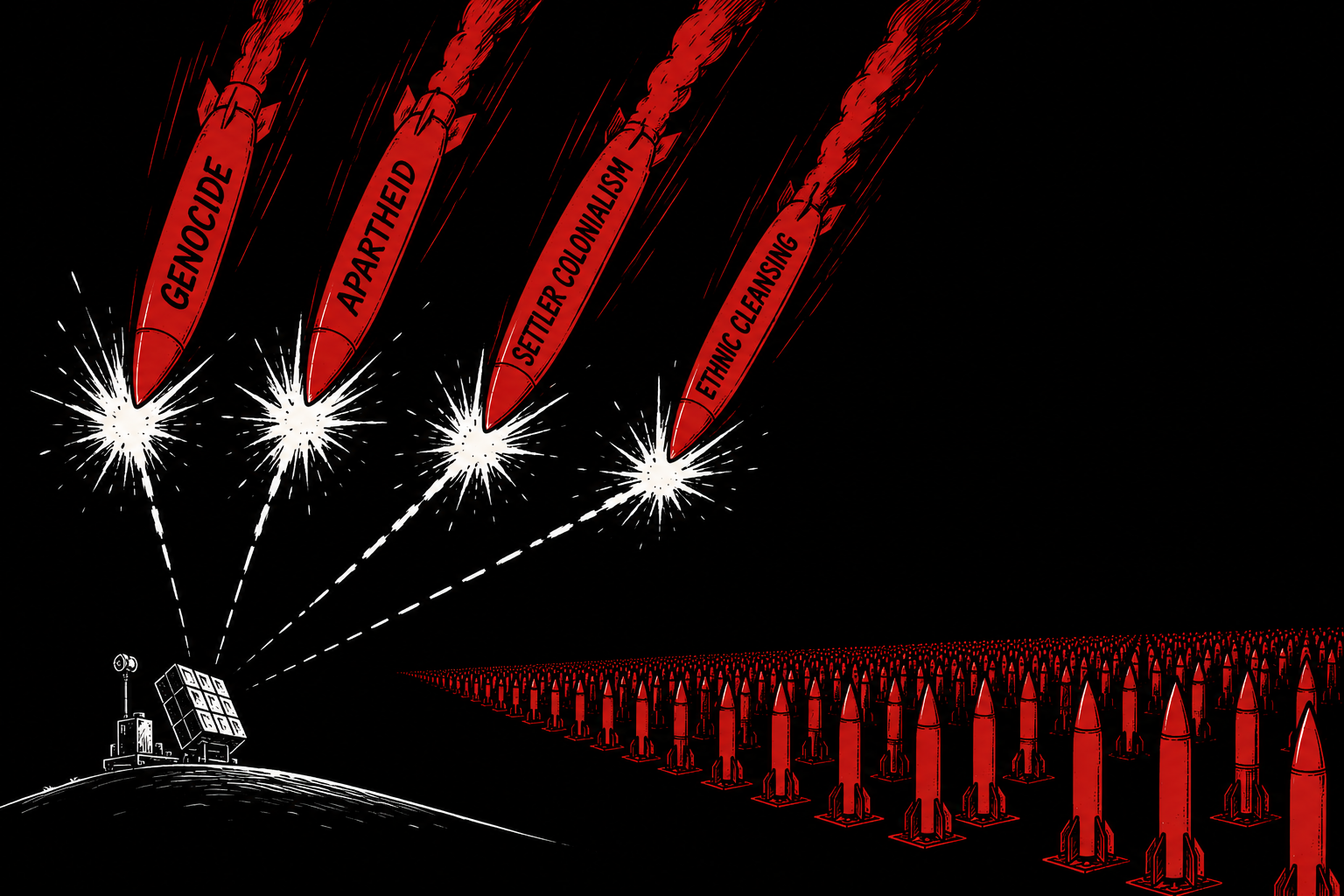
The very next day, while Israelis were still identifying the murdered and searching for the missing, another front opened thousands of miles away. Lobbing libels rather than rockets, those fighting on this new front launched accusations instead of explosives. Though their weapons did not rain from the sky, their danger was no less real. As Jews around the world faced accusations of settler colonialism, apartheid, genocide, ethnic cleansing, and Jewish supremacy, this time there was no Iron Dome to keep them safe.
These weaponized libels had not been assembled overnight. Just as Hamas had spent years stockpiling rockets for the physical war, activists and academics across American cities and college campuses had spent decades stockpiling accusations for another kind of war. Seizing the moment to deploy an arsenal amassed over decades, they targeted anyone—Jew and non-Jew alike—who refused to renounce the Jewish people’s right to self-determination in their ancestral homeland. The weapons had been stockpiled. The strategy had been developed. The ideological war over how millions of people would understand what had just happened—and what would happen next—had begun.
At the center of this new front was what I call American Intellectual Antisemitism, a hateful ideology that falsely recasts Jews as White oppressors, Jewish self-determination as uniquely illegitimate, and the Jewish homeland as the embodiment of everything wrong with the world. Relying heavily on lies, libels, and the cynical manipulation of language, American Intellectual Antisemitism flooded the battlefield not with rockets, but with falsehoods.
Accusing Israel of “genocide,” American Intellectual Antisemitism weaponizes every civilian death into evidence of a nefarious extermination campaign rather than a horrific consequence of war requiring an examination of military intent, urban warfare, and Hamas’s tactics. Accusing Israel of “apartheid,” it weaponizes checkpoints and security barriers into evidence of racial supremacy rather than security measures shaped by years of indiscriminate terrorist attacks against Israeli civilians. Accusing Israel of “settler colonialism,” it weaponizes Jewish presence in the land into evidence of foreign conquest rather than a history requiring an examination of Jewish indigeneity, displacement, exile, and return. Turning the complexities of an intractable conflict into an endless supply of ideological ammunition, American Intellectual Antisemitism lobs accusation after accusation at anyone who supports Israel’s right to exist and defend itself.
The natural response to accusations like these is, of course, to fight back. When people spread misinformation about us, the groups to which we belong, or the causes dearest to our hearts, correcting the record feels not merely reasonable but morally necessary. With silence feeling like surrender and walking away feeling like conceding defeat, we often convince ourselves that every distortion demands dismantling, every exaggeration demands exposing, and every falsehood demands fact-checking.
That instinct is entirely human. It is also a trap. By reactively rebutting your opponents’ accusations, you hand them control of the conversation, letting them decide which questions must be answered, which accusations must be denied, which language must be adopted, and which assumptions will frame the discussion. You may spend hours demonstrating why a particular accusation is false and walk away convinced you have won the argument, only to discover that your opponents have dictated what the argument is about. You may feel like you have won the war, but all you have done is successfully intercept another attack.
The problem is that by the time a correction enters the conversation, the falsehood has already done much of its intended damage. Every rebuttal keeps the accusation in circulation. Every attempt to extinguish it gives it more oxygen to keep burning. Every minute spent defending ground your opponent chose is a minute you are not taking ground of your own.
Unfortunately, the problem does not end when a rebuttal succeeds. Because people understand the world not as a collection of disconnected facts but through stories about why events occur, who causes them, and what those events mean, telling them what did not happen does not tell them what did. Once a false claim becomes part of a larger story, removing it can leave behind a hole where an explanation used to be.
Rebutting the “genocide” libel without explaining how Hamas operates from densely populated civilian areas and uses civilian infrastructure for military purposes leaves people without an alternative explanation for the horrifying death and destruction they see in Gaza. Rebutting the “apartheid” libel without explaining how suicide bombings and other terrorist attacks led Israel to construct a security barrier and establish military checkpoints leaves people without an explanation for why those measures exist. Rebutting the “settler colonialism” libel without explaining the Jewish people’s millennia-old connection to the land and the historical circumstances that produced the modern State of Israel leaves people without an explanation for why millions of Jews live there at all. Asking people to abandon an explanation without giving them another through which to make sense of the world risks creating a hole in their story without offering anything with which to fill it.
None of this means lies should be ignored. Some accusations cause immediate harm and must be answered quickly, clearly, and forcefully. Falsehoods can destroy reputations, influence institutions, inspire violence, and become accepted wisdom if no one challenges them. Defense matters. Yet the moment adherents of American Intellectual Antisemitism force us to debate whether their accusation is true, they have already secured an important victory: dictating what everyone else must discuss.
Playing offense means doing something fundamentally different. It means choosing your own questions rather than merely answering theirs. It means deciding which ideas deserve attention, which values should frame the conversation, and which facts people encounter before someone else tells them what those facts mean. It means telling people who the Jewish people are, why we remained connected to our homeland through two thousand years of dispersion, and what happened during centuries in which we lacked the power to protect ourselves. It means explaining why Jewish self-determination emerged, how Israel became the national expression of an ancient people, and why Jewish sovereignty matters in the first place. Instead of spending all our time explaining what Israel is not, we must tell people what it is. We must stop letting our opponents choose the story and start telling the story we actually want people to understand.
On October 7, 2023, Israel’s defensive systems did what they were meant to do: they detected incoming rockets, calculated their trajectories, and destroyed those threatening populated areas before they reached their targets. Over the months that followed, they intercepted thousands more attacks and saved countless lives. Yet no general would confuse successful missile defense with victory.
What is true about the physical war against Hamas is equally true of the ideological war against American Intellectual Antisemitism. If all you ever do is shoot down whatever your opponent fires at you, your opponent still chooses the targets, timing, and tempo of the war. Correct the lies that must be corrected. Defend the truth that must be defended. Shoot down the attacks that cannot be allowed to land. But never confuse successfully intercepting your opponent’s attacks with defeating the ideology launching them.
Defense can keep you alive. Only offense can change the battlefield.
It is time to stop playing defense.
*
American Intellectual Antisemitism: The Anti-Jewish Movement Tearing Through Our Universities (Wicked Son/Post Hill Press) is now available for pre-order.