Jacob Without Illusions
Jacob Without Illusions: An Existential Reading of the Torah
Jacob is often presented as a righteous man whose morally ambiguous actions are absorbed into “the divine plan”. In a literal reading, everything he does — deception, flight, manipulation — is justified because “God wanted it so”. His responsibility disappears behind a theological curtain.
But in an existential reading of the Torah, this approach is not only weak — it is false. It removes the most vital element of the narrative: Jacob’s agency, his failure, his struggle, and his transformation.
(This critique does not apply to traditions — including some strands of rabbinic thought and process theology — that understand divine presence as working through human freedom rather than erasing it.)
1. The Puppet Problem
If Jacob acts only because “God made him”, then:
- he did not deceive — God deceived through him;
- he did not flee — God pushed him;
- he did not wrestle — God choreographed it;
- he did not change — God rewrote him.
What remains?
No character.
No interior life.
No transformation.
No Torah.
Such a reading may offer comfort, but it easily becomes a spiritual sedative — something that replaces inner work with passive obedience.
2. The Torah’s Jacob Is Not a Saint — He Is Human
Read without commentary, the text shows Jacob plainly:
- deceiving his father,
- seizing his brother’s place,
- calculating, fearing, hiding,
- manipulating the world to survive.
The Torah does not sanitise him.
Literal interpretation often tries to do so:
“It was not deception — it was holy cunning.”
But excusing what the Torah presents directly removes its force. The text does not give us perfect heroes; it gives us human beings who can change.
3. Jacob’s Transformation Is Human, Not Magical
Jacob does not change because of sudden divine intervention. His transformation comes from something far more recognisable:
suffering, mirroring, repetition, consequence, and exhaustion.
Everything he sends out returns to him:
- He deceives Esau → Laban deceives him.
- He uses disguise → Leah is veiled.
- He grows up in conflict → he creates conflict.
- He avoids confrontation → confrontation surrounds him.
One concrete example makes the mirroring plain:
Jacob covers himself with goatskins to deceive Isaac.
Laban covers Leah with a veil to deceive Jacob.
The same structure.
Returned to the sender.
Life holds Jacob accountable until he recognises himself.
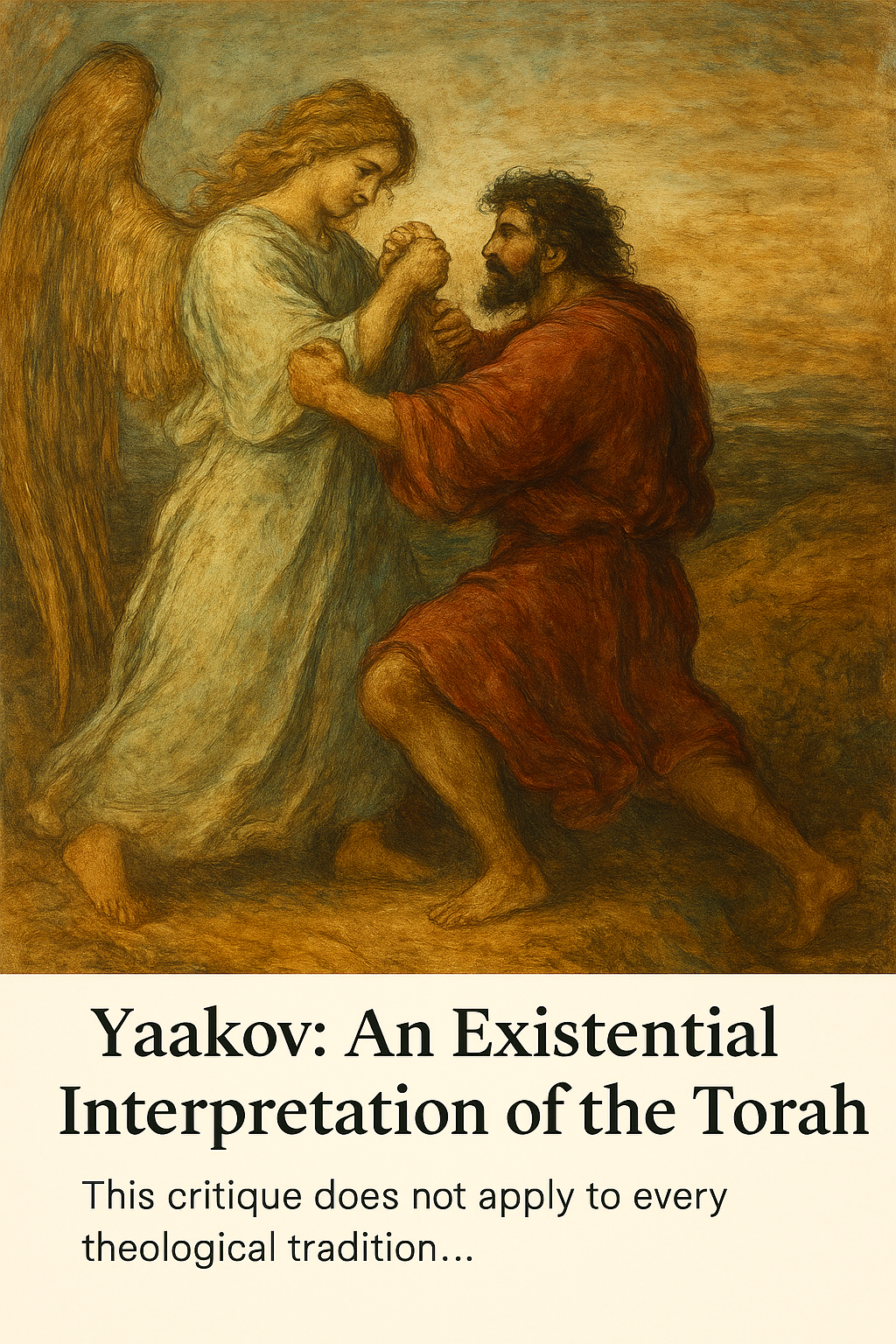
4. The Night Struggle Is Responsibility, Not Intervention
The Torah does not say:
“God transformed Jacob.”
It says:
“A man wrestled with him.”
The identity is left deliberately ambiguous. What matters is the struggle — the refusal to let go, the wound that marks him, and the decision to limp into morning rather than return to who he was.
Jacob is not purified from outside.
He is broken open from within.
Yes — the name is given to him.
But it is not arbitrary: the naming acknowledges the transformation he has already earned through struggle.
5. Responsibility and the Divine
A reading that requires responsibility does not diminish the divine.
It honours the seriousness with which the Torah treats human freedom.
Divine presence is not found in the erasure of agency,
but in the depth of a story that expects human beings to change.
Jacob, Without Illusions
Seen existentially, Jacob is no longer a saint protected by theological varnish. He becomes something far more compelling:
- a man shaped by a wounded home,
- surviving by manipulation,
- confronted by his own patterns,
- broken open by experience,
- and finally willing to stop hiding.
Not holy — responsible.
Not pure — transformed.
Not directed — confronted.
Israel is not the name of someone perfected.
It is the name of someone who wrestles and remains alive.
Jacob’s story is not about divine puppetry.
It is about a human being who enters the night, emerges wounded,
and still chooses to walk toward the brother he once wronged.
Not a miracle of heaven —
the miracle of becoming human.