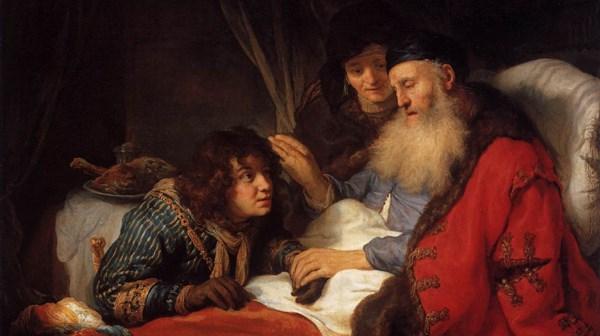
After the troubles with Laban, Esau and Shechem, Jacob wants tranquility. But G^d says, the saintly people already have a great afterlife – should they also have it easy in this life?
Our Commentator the Mizrachi explains why this comment from Rashi, from the Midrash, is written on the second verse (Genesis 37:2), that mentions Joseph already (his next troubles), and not on the first word of the first verse, And he settled. He says, that’s because the first verse should be reserved as a contrast to the last verses of the previous Portion (Genesis 36:1-42), contrasting Jacob’s conduct with Esau’s.
I know another contrast besides those mentioned by Rashi. Jacob (Genesis 37:1) Vayeishev, goes to settle himself, as G^d commended, while Esau (Genesis 33:16) and Laban (Genesis 32:1), after their encounter of years with a total saint like Jacob, Vayashov (same Letters, different vocalization), still returned to where they came from – implying: they did not change a bit. That’s how steeped in evil they were. Only in his presence, they shaped up a bit (after years) but as soon as they left, they went back to their old evil ways.
Our lesson: It’s most important that after our thrice daily Standing Prayer, our encounter with G^d, we don’t return to our place the way we were before our prayers. Our prayers should transform us.
Let’s return to our initial point that Jacob wanted to take it easy. I want to protest the thought that this Midrashic idea would be connected to And he settled (Better: And he was settling) at all. To settle the Land is a Commandment for Jews until this day. As Yaakov Fogelman famously said: G^d is a religious Zionist too. That verse cannot be tainted by mistakes. Jacob himself wanted to return (Genesis 30:25), and was even explicitly ordered by G^d to return to the Land and his birthplace (Genesis 31:13) (and before, when he also received travel insurance, Genesis 31:3). To do so could not be wrong in any way.
Let me suggest that rather, he wanted to take it easy before starting to settle down already immediately after the drawn-out troubles with Laban and Esau. And that was the problem.
What does one do if one narrowly escapes great danger? Builds a great life? No. At first, one takes a break. To catch one’s breath. That is fine for average people but not for complete saints.
(BTW, Jewish Law teaches that we should not stretch or cross our legs, yawn or sleep in the synagogue because – I believe – that’s a place to exert ourselves.)
But that is exactly what Jacob does. After finally escaping Laban (Genesis 31:22-32:1), prevailing in his fight with G^d and Man (Genesis 32:29) and at last, reconciling with his brother Esau (Genesis 33:1-16), he doesn’t rush home – though his father must have been waiting for him. His punishment is measure for measure. The apple of his eye, Joseph, disappears without a sign for 23 years too – Genesis 37:14-46:29, including payment for his long journey home.
We could say that maybe, Jacob wasn’t ready to meet his father again, that he had wanted to get into spiritual shape first. But it looked bad and that is not fitting a saint.
Instead of rushing home, he builds himself a house with shelters for his livestock in Succoth (Genesis 33:17) and bought a field and pitches his tent near Shechem (Genesis 33:19). Not to exaggerate, Succoth means temporary dwellings and a tent is short-term settling again. He never intended to stay there.
Meanwhile, G^d says nothing. Which should have been an ominous sign for a Prophet. One may take a vacation, but G^d doesn’t.
And then it happened, the violation of Dina (Genesis 34). (Which, dreadful as it was, in the larger picture, needed to happen, as I will explain elsewhere.)
BTW, Shechem loves her very much (Genesis 34:3) but we don’t hear Dina reciprocate. She was more into girls (Genesis 34:1). Also, when the wife of Potiphar make advances to Joseph, he doesn’t give his version (Genesis 39:19-20).
Joseph’s refusals and adherence to “he has denied me nothing but you” (Genesis 39:9) might be a correction of the First Sin where we were also denied only one thing (Genesis 2:16-17) but succumbed.
The Midrash tells us that Dina was supposed to be a boy but Rachel prayed successfully that it was her turn to have a boy so Dina came out a girl. And before Rachel’s prayer, Joseph was meant to be a girl. It showed. Joseph was taking excessive care of his appearance (Rashi on Genesis 37:2), colorful clothes were important to him (Genesis 37:4) and so was his beautiful look (Genesis 39:6) after his mother Rachel (Genesis 29:17). The first transgender stories? But then, their lines marry (Joseph and Osnat, daughter of Dinah and Shechem) and the a-typicalnesses balance out and disappear from their children. We often see loving couples where the man is more effeminate and the woman more butch but their children are more standard.)
Back to Jacob. Only after the tragedies around Dina, G^d talks to him again (Genesis 35:1, 9-12), hinting that the reasons for leaving his father’s home had expired. He fled Esau (Genesis 35:1) and he now had offspring (Genesis 35:11). And the Land was his (Genesis 35: 12). What was he waiting for?!
So, now he does as he should have all along, return home – just in time to see his father Isaac (Genesis 35:27-28) and bury him – and settle (Genesis 37:1). Emotionally, though, he will never settle. He keeps sojourning (Genesis 47:9). He missed his chance by taking a break when he should have marched on.
The rabbis teach that a third of all suffering of Jews will befall us in the time of the coming of the Messiah (that may have been the Holocaust), a third during the Crusades and a third was suffered by our Founding Fathers.
We know that not only are righteous people dealt with more harshly than the common folks, but also that they carry much of the punishments that others couldn’t. They are also held responsible for people around them who don’t repent. But may I suggest that they didn’t only carry hardship for their contemporaries but also for all Jews of all times who’re not total saints yet. (Yes, yet another idea that Classical Christianity borrowed from Judaism without crediting the source. Only, we don’t teach that we need to love our saints in order for this to happen….)
Happy Chanukah!
MM is a prolific and creative writer and thinker, previously a daily blog contributor to the TOI. He often makes his readers laugh, mad, or assume he's nuts—close to perfect blogging. He's proud that his analytical short comments are removed both from left-wing and right-wing news sites. None of his content is generated by the new bore on the block, AI. *
As a frontier thinker, he sees things many don't yet. He's half a prophet. Half. Let's not exaggerate. Or not at all because he doesn't claim G^d talks to him. He gives him good ideas—that's all. MM doesn't believe that people observe and think in a vacuum. He, therefore, wanted a broad bio that readers interested can track a bit what (lack of) backgrounds, experiences, and educations contribute to his visions. *
This year, he will prioritize getting his unpublished books published rather than just blog posts. Of the 15 (!) books he has in mind, the next two are about homosexuality in Judaism and new rabbinics. Next year, he hopes to focus on activism against human extinction. To find less-recent posts on a subject XXX among his over 2600 archived ones, go to the right-top corner of a Times of Israel page, click on the search icon and search "zuiden, XXX". One can find a second, wilder blog that also may contain updates to Times of Israel posts, to which one may subscribe, here: https://mmvanzuiden.wordpress.com/ or by clicking on the globe icon next to his picture on top. *
He's getting ready to publicize books on: "Free Will, "Judaism and Homosexuality, "His parents in the Holocaust, "Judaism, "A New Torah Translation and "A New Hebrew Grammar, "Co-Counseling, "Vegan Facts, "Immortality, and more. *
Like most of his readers, he believes in being friendly, respectful, and loyal. However, if you think those are his absolute top priorities, you might end up disappointed. His first loyalty is to the truth. He agrees that in a post-truth world, that's irrelevant, but then this is for the record. He will try to stay within the limits of democratic and Jewish law, but he won't lie to support opinions or people when don't deserve that. (Yet, we all make honest mistakes, which is just fine and does not justify losing support.) He admits that he sometimes exaggerates to make a point, which could have him come across as nasty, while in actuality, he's quite a lovely person to interact with. He holds - how Dutch - that a strong opinion doesn't imply intolerance of other views. *
Sometimes he's misunderstood because his wide and diverse field of vision seldomly fits any specialist's box. But that's exactly what some love about him. He has written a lot about Psychology (including Sexuality and Abuse), Medicine (including physical immortality), Science (including basic statistics), Politics (Israel, the US, and the Netherlands, Activism - more than leftwing or rightwing, he hopes to highlight reality), Oppression and Liberation (intersectionally, for young people, the elderly, non-Whites, women, workers, Jews, LGBTQIA+, foreigners and anyone else who's dehumanized or exploited), Integrity, Philosophy, Jews (Judaism, Zionism, Holocaust and Jewish Liberation), the Climate Crisis, Ecology and Veganism, Affairs from the news, or the Torah Portion of the Week, or new insights that suddenly befell him. *
Chronologically, his most influential teachers are his parents, Nico (natan) van Zuiden and Betty (beisye) Nieweg, Wim Kan, Mozart, Harvey Jackins, Marshal Rosenberg, Reb Shlomo Carlebach, and, lehavdil bein chayim lechayim, Rabbi Dr. Natan Lopes Cardozo, Rav Zev Leff, and Rav Meir Lubin. This short list doesn't mean to disrespect others who taught him a lot or a little. One of his rabbis calls him Mr. Innovation [Ish haChidushim]. Yet, his originalities seem to root deeply in traditional Judaism, though they may grow in unexpected directions. In fact, he claims he's modernizing nothing. Rather, mainly basing himself on the basic Hebrew Torah text, he tries to rediscover classical Jewish thought almost lost in thousands of years of stifling Gentile domination and Jewish assimilation. (He pleads for a close reading of the Torah instead of going by rough assumptions of what it would probably mean and before fleeing to Commentaries.) This, in all aspects of life, but prominently in the areas of Free Will, Activism, Homosexuality for men, and Redemption. *
He hopes that his words will inspire and inform, and disturb the comfortable and comfort the disturbed. He aims to bring a fresh perspective rather than harp on the obvious and familiar. When he can, he loves to write encyclopedic overviews. He doesn't expect his readers to agree. Rather, original minds should be disputed. In short, his main political positions are among others: anti-Trumpism, for Zionism, Intersectionality, non-violence, anti those who abuse democratic liberties, anti the fake ME peace process, for original-Orthodoxy, pro-Science, pro-Free Will, anti-blaming-the-victim, and for down-to-earth, classical optimism, and happiness. Read his blog on how he attempts to bridge any tensions between those ideas or fields. *
He is a fetal survivor of the pharmaceutical industry (https://diethylstilbestrol.co.uk/studies/des-and-psychological-health/), born in 1953 to his parents who were Dutch-Jewish Holocaust survivors who met in the largest concentration camp in the Netherlands, Westerbork. He grew up a humble listener. It took him decades to become a speaker too, and decades more to admit to being a genius. But his humility was his to keep. And so was his honesty. Bullies and con artists almost instantaneously envy and hate him. He hopes to bring new things and not just preach to the choir. *
He holds a BA in medicine (University of Amsterdam) – is half a doctor. He practices Re-evaluation Co-counseling since 1977, is not an official teacher anymore, and became a friendly, powerful therapist. He became a social activist, became religious, made Aliyah, and raised three wonderful kids. Previously, for decades, he was known to the Jerusalem Post readers as a frequent letter writer. For a couple of years, he was active in hasbara to the Dutch-speaking public. He wrote an unpublished tome about Jewish Free Will. He's a strict vegan since 2008. He's an Orthodox Jew but not a rabbi. *
His writing has been made possible by an allowance for second-generation Holocaust survivors from the Netherlands. It has been his dream since he was 38 to try to make a difference by teaching through writing. He had three times 9-out-of-10 for Dutch at his high school finals but is spending his days communicating in English and Hebrew - how ironic. G-d must have a fine sense of humor. In case you wonder - yes, he is a bit dyslectic. If you're a native English speaker and wonder why you should read from people whose English is only their second language, consider the advantage of having an original peek outside of your cultural bubble. His posts are spell, grammar, and style polished by AI, but all written by himself. *
To send any personal reaction to him, scroll to the top of the blog post and click Contact Me. *
His newest books you may find here: https://www.amazon.com/s?i=stripbooks&rh=p_27%3AMoshe-Mordechai%2FMaurits+van+Zuiden&s=relevancerank&text=Moshe-Mordechai%2FMaurits+van+Zuiden&ref=dp_byline_sr_book_1