
Leadership With Heart
JD Vance: A Korach for Our Time
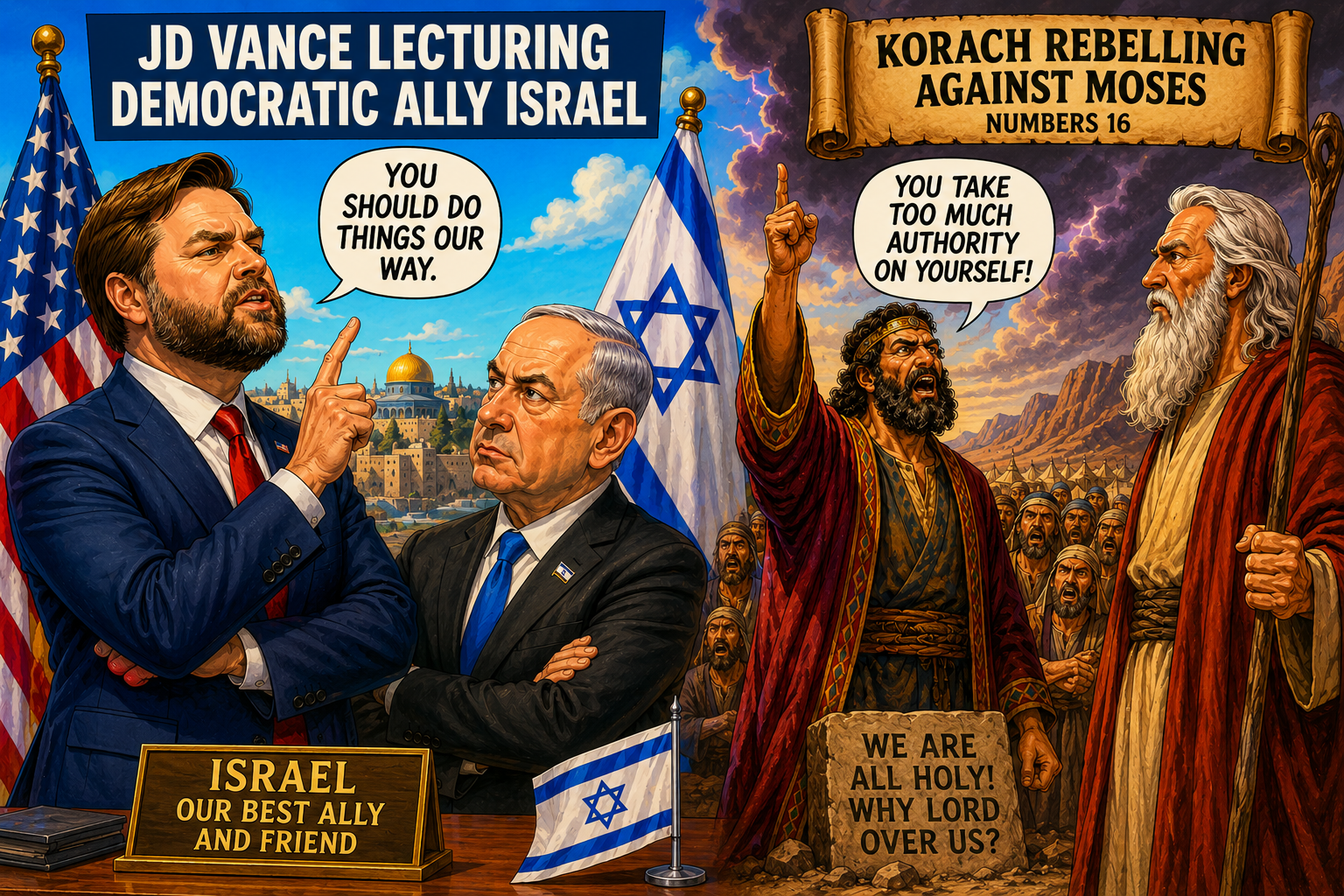
AI generated image
Vice President JD Vance’s recent remarks about Israel were not merely misguided—they were a striking display of moral weakness, strategic ignorance, and political arrogance. At a moment when Israel is fighting for its very survival against an Iranian regime dedicated to its destruction, Vance chose to lecture an ally instead of standing with it.
To tell Israel that it “cannot kill its way out” of its security problems is the kind of shallow advice only someone safely removed from the battlefield could afford to give. Israel is not participating in an abstract policy seminar. It is confronting Iran—a radical Islamic regime that finances and directs terror proxies across the region while aggressively pursuing nuclear weapons and ballistic missile capabilities. When American leaders speak as if Israel’s core dilemma is simply a matter of poor messaging or excessive force, they reveal a profound misunderstanding of the Middle East and the existential threats Israel and the West faces.
The Modern Echo of Korach
This is why the biblical comparison to Korach in this week’s Torah portion is so fitting. In the Book of Numbers, Korach did not simply disagree with Moses; he mounted a rebellion cloaked in the language of principle. He exploited resentment, presented himself as a champion of the people, and undermined the moral order holding the nation together. He offered no real solution, only a posture of defiance disguised as wisdom.
Vance’s posture carries that same odor of self-righteousness. He offers no serious strategic alternative, no workable path to peace, and no credible answer to a fundamental question: How is Israel supposed to survive if it is denied the right to decisively defeat its enemies?
The 250 Parallel
Korach gathered 250 community leaders to give his rebellion a veneer of legitimacy. This detail is chillingly resonant as America approaches its 250th anniversary. A nation founded on the conviction that moral law stands above raw power should not surrender that principle for the illusion of peace. The same number that lent false authority to Korach’s revolt now serves as a warning for America. We must ask whether our leadership is veering toward the same dangerous vanity: pressuring our friends, rewarding our enemies, and pretending that concessions to Iran amount to statesmanship.
Capitulation Masked as Diplomacy
Let us be clear: a deal that delivers sanctions relief to Tehran, leaves the Strait of Hormuz vulnerable, and fails to dismantle Iran’s terror apparatus is not diplomacy. It is surrender dressed up as pragmatism. It signals to the world that aggression pays, that proxy warfare will be tolerated, and that the safest political course is to lecture the democracies under attack while indulging the regimes that threaten them.
Israel does not need sermons about restraint from Washington—especially from politicians who have never had to decide, in real time, how to protect their people from rockets, tunnels, drones, and existential threats. Security is not a political slogan; it is the first duty of government.
Furthermore, it is grievously hypocritical for American leadership to claim the right to ruthlessly scrutinize Israeli policy while denying Israel the same right to criticize American blunders, such as Washington’s recent Memorandum of Understanding (MOU) with Iran. If Israel is held to an impossibly high standard of restraint, the United States must be held to the same standard of accountability when it makes deals that weaken its allies and jeopardize regional security. Hypocrisy is not a viable foundation for a lasting alliance.
The Political Fallout
Vance’s remarks do more than criticize a policy; they invite the world to look at Israel through the lens of blame rather than survival. This is not statesmanship. It is a betrayal of the moral clarity that true alliances require. Allies do not turn on one another when the stakes are highest. They do not reward hostility or confuse pressure on a friend with prudent policy. Leaders who do that risk losing both credibility and trust.
This episode may also carry serious political consequences for Vance at home. By alienating a core ally during a hot war, Vance may have severely damaged his future presidential prospects. In doing so, he has strengthened the case for figures like Marco Rubio, who increasingly projects himself as the more experienced, disciplined, and morally credible alternative in American foreign policy. In politics, as in Scripture, hubris has a way of exhausting itself.
The Lesson of Korach
Korach’s rebellion ended in catastrophe because it was rooted in pride, not truth. The lesson is not subtle. Those who confuse personal ambition with wisdom and performative dissent with moral clarity eventually expose themselves.
Vance may imagine that distancing himself from Israel makes him sound principled to an isolationist base. In reality, it makes him look small, detached, and badly out of step with both history and justice.
Israel is not the problem. The terror regime in Tehran is the problem. And any American leader who cannot say that plainly is failing the most basic test of moral seriousness.
Related Topics
Related Posts