

Jerusalem: The Cost of Christian Unity (I)
Notes from the First Half of the Week of Prayer (Part I)
Introduction
In Jerusalem, the Week of Prayer for Christian Unity is neither a routine observance nor an abstract theological exercise. It unfolds in a city where Christian history is layered with empire, trauma, survival, and rivalry, and where unity is less a slogan than a daily trial. What follows are reflections from the first half of this Week – from Saturday to Wednesday – tracing how different Christian communities embody, test, and sometimes strain the meaning of “one body and one Spirit” in the concrete reality of the Holy City.
Saturday, Jan. 24 — Anastasis (Holy Sepulcher), Golgotha
Greek Orthodox Office of Apodeipnon (Compline)
At Golgotha, where stone still carries the memory of blood and prayer, the Week of Prayer for Christian Unity begins not as a symbolic gesture but as a fragile act of trust. In Jerusalem, even the calendar resists abstraction: the Week begins later than elsewhere, out of fidelity to Eastern Christian rhythms and to the Armenian celebration of the Nativity and Theophany on January 18–19. This postponement is not administrative; it is theological. Unity here is never detached from concrete histories, calendars, wounds, and negotiated reconciliations.
That this year’s prayers and reflections were prepared and hosted by the Armenian Apostolic Church, together with Armenian Catholic and Evangelical communities, gives the opening a particular depth. Christianity was not born in an abstract theological space but in Hebrew, Aramaic, and Greek, quickly in Gheez, Coptic, Armenian, Georgian… – in a land where covenant, language, and community were inseparable. When the Apostle Paul writes to the Ephesians, “There is one body and one Spirit, just as you were called to the one hope of your calling,” the words still carry their Semitic weight here: unity as shared breath and shared destiny – eḥad / אחד, ḥadā / ܚܕܐ — not uniformity, but fidelity.
And yet, within Christendom, these words are often repeated until they risk becoming hollow. Unity is proclaimed, reaffirmed, ritualized, while the fractures remain not only visible but structuring ecclesial life. Even when Church leaders rightly lament that divisions hinder the world’s capacity to believe, repetition can slide into insulation from lived reality. Nowhere is this more striking than in Jerusalem, where Christian life is shaped by parallel jurisdictions, competition over sacred space, inherited suspicions, and unhealed memory. To say “there is one body” in this city is not a statement of fact; it is an act of faith against the evidence.
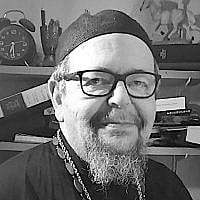
For years, I stood as a representative of the Orthodox Patriarchate of Jerusalem, and later as one who could reintegrate it from another angle, learning again what confidence and mutual recognition demand. In this land, marked by war, fear, and survival logic, unity is not a pious slogan. It is a risk – a podvig/подвиг, an ascetic exploit against habits of exclusion, institutional reflexes, and the temptation to define who is or is not “truly of Christ.” The Semitic foundations of Christianity remind us that covenant precedes system, and fidelity precedes ideology. The Church as “one body” is not a legal construct but a living organism, wounded and healing at once.
To embrace unity here is not to negotiate doctrinal compromise, but to return to the Cross and the Empty Tomb – to Golgotha itself, the place of both division and reconciliation – and to allow the Spirit to breathe life into what fear has hardened. As Gregory Palamas insists, unity is not produced by agreement but by participation:
“The Spirit unites those who are separated by nature and reconciles those who are divided by will.” / «Τὸ Πνεῦμα τοὺς κατὰ φύσιν διεστῶτας συνάπτει καὶ τοὺς κατὰ γνώμην διῃρημένους καταλλάσσει.»
Homily 24, On the Holy SpiritBecause the unity of the Church is not consensus, but koinōnia – communion in the life of God – Paul’s appeal addresses not only institutions, but persons. Unity begins where memory is healed, mistrust laid down, and the other recognized as a bearer of the same hope. Only then does faith cease to be formula and become again a lived, costly, radiant podvig.
Sunday, Jan. 25 — Anglican Cathedral of St George
Looking and Searching for Unity in a Layered Land
In Jerusalem, unity is never an idea floating above history. It is woven into fragile continuities and improbable graftings. The Anglican presence is one such grafting. Its modern form emerged through nineteenth-century colonial arrangements, when Anglican structures were encouraged in the North and Lutheran ones in the South of what is now Israel, Palestine, Jordan, and Gaza. Yet from the beginning, this presence took on a local texture.
The first Anglican bishop of Jerusalem – a Russian Jew who converted to Christianity – arrived in 1840 and translated the Book of Common Prayer into Hebrew in 1841. That Hebrew liturgy was used until 1947 at Christ Church near Jaffa Gate, a quiet witness to a moment when Anglican prayer spoke the ancient language of the land. Today, the Anglican Diocese of Jerusalem stretches from Cyprus to the Gulf. Though unmistakably Anglo in spirit, shaped by British and American ecclesial cultures, it is profoundly multilingual: Arabic, English, Tagalog, Romanian, Spanish and many other tongues sound in its parishes. Its present Archbishop, Hosam Elias Naoum, is a young local Arab deeply connected to the region’s communities.
Even Orthodox leadership bears traces of this shared atmosphere. Patriarch Theophilos III studied at Durham, and something of the Anglican ethos – restraint, listening, attention – still colors his Greek way of leading prayer. Here unity is not negotiated in documents; it is absorbed through proximity, shared study, shared wounds.
The theme chosen by the Armenian hosts – “There is one body and one Spirit” – resonates sharply in a land where churches once grew along lines of European patronage and imperial protection. Anglican phrases long familiar here still echo with force: “We are members one of another.” In Jerusalem, these words are not ornamental. They echo in corridors where Orthodox monks, Armenian clergy, Anglican chaplains, Catholic sisters, and Evangelical pastors pass daily – not as abstractions but as neighbors.
This presence has also expressed itself through quiet mediation and practical solidarity. During the 2002 siege of the Church of the Nativity in Bethlehem, Anglican clergy played a discreet but crucial role in maintaining channels of communication and humanitarian concern. This practical ecumenism resonates with the vision of former Archbishop of Canterbury Rowan Williams, who wrote that “unity is not about constructing a single structure, but about learning to recognize Christ in one another across bitter boundaries”. In Jerusalem, that recognition appears in hospitals, schools, and chaplaincies where service precedes confession. Unity here is not invented; it is guarded as a fragile gift.
Monday, Jan. 26 – Lutheran Church of the Redeemer (Muristan)
At the Erlöserkirche in the Muristan, Jerusalem’s layered history quietly converges. This church is a witness to a distinctive moment of encounter between Europe and the Ottoman world, diplomacy and devotion. The gift of land by Sultan ʿAbd al-ʿAziz, the Prussian firman, and the dedication in 1898 in the presence of Kaiser Wilhelm II belong to a long chapter of German engagement with the Holy City.
From the Muristan to Augusta Victoria, from hospitals to schools, German scholarship and discipline left a deep imprint on Jerusalem and the region – not merely colonial, but part of the shared urban and spiritual memory of the land. Voices formed here continue to shape reflection on unity. Gustaf Dalman insisted that Jerusalem cannot be reduced to the possession of one people or confession. Friedrich-Wilhelm Marquardt, marked by post-Shoah theology, warned that unity built on abstraction collapses unless theology learns to listen to wounded history. Martin Buber’s words still resonate: “All real living is meeting.”
As International Holocaust Remembrance Day approaches, these voices remind us that unity is not a slogan repeated annually, but a work of encounter, repentance, and responsibility.
Yet the Lutheran witness here is not only historical. Since the founding of the Evangelical Lutheran Church in Jordan and the Holy Land in 1959, and especially in recent decades, the ordination of Arab clergy – including Arab Palestinian women – has become one of its most prophetic features. Under leaders such as Munib Younan and Sani Ibrahim Azar, now Dr. Imad Haddad the Lutheran presence chose not distance but local embodiment.
This unity is practiced daily. At Augusta Victoria Hospital, founded by Germans, sustained by international solidarity, staffed largely by Palestinians, and serving patients from Jerusalem, the West Bank, and Gaza, unity takes the form of shared responsibility. In schools and diaconal projects, German commitment and Palestinian agency meet in concrete service. Unity here is not achieved; it is lived.
Tuesday, Jan. 27 – Armenian Cathedral of St James
A Non-Imperial Christianity
In the Armenian Convent of St James, unity acquires a depth that is historical and embodied. The Armenian Apostolic Church is not only among the most ancient Christian communities; it was the first officially recognized Christian Church, in 301. Its presence in Jerusalem predates most later patriarchates, and its liturgical memory reaches back to the earliest strata of Christian worship.
When the Greek primate left Jerusalem after the Muslim conquest, the Armenians appointed their own bishop in 368, later elevated to patriarch. This was not rivalry but continuity, ensuring that prayer would not fall silent. Pre-Chalcedonian, like their Syriac, Coptic, and Ethiopian brethren, Armenians carry a prestige born of fidelity rather than power.
In Jerusalem they are not a diaspora but an indigenous ecclesial body – one of the three historic custodians of the Holy Sepulcher – woven into the fragile Status Quo. Yet this rootedness stands today under severe strain. The Armenian Quarter has become a compressed enclave, burdened by legal uncertainty, property disputes, and demographic pressure. Clergy often arrive young and isolated; laity face restricted economic horizons. And yet, within these walls, the Patriarchate sustains clinics, feeding programs, and mutual aid – not symbolic charity, but daily survival.
This paradox – cultural splendor and civic fragility – is sharpened by constant rivalries at the Holy Sepulcher. Yet within the convent lies one of the world’s great manuscript collections, preserving voices older than our modern fractures.
The Armenian experience embodies a non-imperial Christianity, rooted in place rather than expansion. Saint Gregory of Narek gives voice to this spirituality of brokenness and hope:
“I speak to you not with the confidence of the righteous, but with the trembling of one who has lost his way; receive my sighs as prayer, my tears as incense.
On this day of remembrance, Armenian memory stands as a bridge between histories that must not compete in suffering. Unity here cannot be proclaimed by slogans. It must grow from shared responsibility and the courage to protect endangered communities.
Wednesday, Jan. 28 – St Saviour’s Latin Parish Church
At St Saviour’s, the Latin Patriarchate reveals a distinctive face of Christianity in Jerusalem: Roman, structured, universal — and profoundly mobile. Re-established in 1847, it returned Rome institutionally to the Holy City, bringing governance, diplomacy, and a dense network of schools and charities.
This universality, however, comes at a cost. Sustained largely by international circulation, the Latin presence is marked by constant arrival and departure. Clergy, religious, volunteers, and pilgrims assemble and disperse, creating a visibility that can feel strangely abstract to those who cannot “tour” ecclesial life – local faithful, long-term residents.
Alongside stable communities, one encounters many ecclesial singletons: generous, committed figures, but often transient and loosely connected. Over decades, this tension has been embodied by very different patriarchs, from Michel Sabbah’s local rootedness to Pierbattista Pizzaballa’s distinct configuration, shaped by engagement with Jewish society.
Yet the Latin presence cannot be reduced to diplomacy alone. It absorbs political pressures few others can carry, while religious orders – especially the Franciscans – remain among the most exposed Christian actors in Jerusalem.
Voices shaped by this city have long pointed toward another path. Fr. Paul Couturier, a French priest born in Lyons, envisioned unity as conversion of the heart, borne patiently by those who suffer division. This vocation is quietly summed up by the inscription at the Tantur Ecumenical Institute:
“Phôs Christou phinei pâsin — The Light of Christ shines for all.”
Here unity is not produced by structures, but received as shared light – demanding patience, rootedness, and endurance. The Franciscan blessing prayed in the Holy Places captures this call:
“I bless You, O most holy Lord Jesus Christ,
here and in all Your churches throughout the whole world,
because by Your holy Cross
You have redeemed the world.”
A Final Word – On Restraint
Jerusalem teaches restraint the hard way. Not the restraint of politeness or diplomacy, but the restraint born of proximity to excess – excess of memory, excess of meaning, excess of projection. Few places on earth have carried so many dreams, promises, fears, and absolute claims within such a confined geography. Here, faith has never been innocent of power, nor power innocent of faith. Scripture, liturgy, and prayer have too often been conscripted into conflicts they were never meant to serve.
This is why unity in Jerusalem cannot afford exalted language divorced from lived responsibility. The city itself resists pure interpretation. It is at once historical and meta-historical, concrete and overdetermined – a place where holiness and hallucination stand dangerously close. Jerusalem generates covenant and khaloymes/כאלוימעס (“wild dreams” or “wishful thinking” in Yiddish), fidelity and fantasy, prayer and Pitchipoi. It can reveal the deepest resources of faith, and at the same time expose how quickly faith, when unrestrained, turns into justification, exclusion, or violence.
In such a landscape, restraint is not weakness. It is spiritual discipline. It is the refusal to absolutize one’s own narrative, one’s own suffering, one’s own truth – even when that suffering is real, even when the truth is costly. It is the courage to remain within limits, to accept that no confession, no people, no theology exhausts the meaning of this city or the God invoked in its name.
The Week of Prayer for Christian Unity, especially in a year marked by irrational wars and sacralized conflicts, matters precisely because it imposes this restraint. It slows speech. It suspends rivalry. It obliges presence without mastery. For a few days, Christians do not come to Jerusalem to explain it, conquer it, or redeem it symbolically. They come to stand, pray, and listen – to one another, to history, and to what resists resolution.
If unity has any credibility here, it will not be proven by statements or structures, but by this discipline of restraint: the willingness to protect the vulnerable rather than instrumentalize them, to remember without competing, to believe without weaponizing belief. In Jerusalem, faith survives not by escalation, but by containment – by the difficult art of remaining human together where meaning itself burns.