


From Kibbutz to the global stage
Jerusalem to Judean Desert: Was Persian Qanat system Adapted in the Biblical Age?
Was the Persian Qanat Technology Adapted in the Land of Israel for Flash Flood and Surface Runoff Management?
It is intriguing to consider the possibility that as early as the sixth century BCE, during the late First Temple period and the beginning of the Persian period, engineering knowledge related to water management was exchanged between the Persian world and the Land of Israel.
Technologies developed in ancient Iran for the efficient utilization of water resources may have reached the Land of Israel with the expansion of the Persian Empire—or perhaps even earlier—and were subsequently adapted and refined to suit the local climate and landscape.
The hypothesis presented here is a direct continuation of the article published last week on the unusual tunnels at Nahal Sekhakha. It also draws on the recent discovery, about two months ago, of a mysterious tunnel on the northern slopes of Kibbutz Ramat Rachel, a site that served approximately 2,600 years ago as the administrative center of the Persian Empire in the Land of Israel.
The recent discovery of the tunnel at Ramat Rachel prompted a comparison with the previously known tunnels at Nahal Sekhakha. The similarities observed between the two sites led to the broader hypothesis presented in this article, suggesting that both may represent a regional adaptation of hydraulic principles associated with Persian Qanat technology.
It is important to emphasize that this article does not claim to prove that the proposed model actually existed. Rather, it offers a new interpretive framework for archaeological findings, raises new research questions, and encourages further excavations, documentation, and scientific investigation that may eventually confirm or refute the hypothesis.
According to the proposed model, both Nahal Sekhakha and Ramat Rachel may have contained water systems based on hydraulic principles similar to those of the Qanat (also known as foggara) technology, which developed in the Persian world around 3,000 years ago. However, in the Land of Israel this technology may have undergone a significant adaptation to local environmental conditions.
Thousands of Qanat systems still operate in Iran today, transporting water solely by gravity without pumps or external energy.
Here, however, lies what may be the most significant difference.
In the classical Qanat system, the purpose of the tunnel is to intercept groundwater and bring it to the surface.
At Nahal Sekhakha and Ramat Rachel, by contrast, the system may have operated in the opposite direction.
Instead of extracting groundwater, it may have collected flash-flood water or surface runoff, conveyed it by gravity, and recharged it back into the subsurface.
At Nahal Sekhakha, the water source may have been flash floods descending from the Jerusalem Mountains into the Judean Desert.
At Ramat Rachel, the water likely consisted of rainfall collected from the higher elevations and conveyed through the tunnel toward the drier southern part of the site, or into its water supply system.
Preliminary volume estimates illustrate the possible engineering logic behind this model.
At Ramat Rachel, the tunnel’s internal volume is estimated at approximately 750 cubic meters. If it functioned solely as a plastered storage reservoir, this would also represent its maximum storage capacity.
However, if it served primarily as a water conduit, a similar volume might have passed through it during each significant rainfall event. Assuming roughly 40 rainy days per year in the Jerusalem Hills, the cumulative seasonal capacity could have reached approximately 30,000 cubic meters.
A similar calculation can be made for Nahal Sekhakha. Instead of storing only about 300 cubic meters during each flood event, the tunnel may have functioned as a conveyance system that directed water into the subsurface. Under this model, approximately 2,000 cubic meters could have been recharged during each flood, for a seasonal total of around 8,000 cubic meters, with the aquifer itself serving as the true storage reservoir.
From a Static Reservoir to Dynamic Infrastructure
If these tunnels are viewed merely as underground cisterns, their storage capacity appears surprisingly small relative to the enormous effort invested in excavating them.
However, if they are understood as hydraulic infrastructure designed to transport water and recharge groundwater, an entirely different engineering picture emerges.
Under this model
At Ramat Rachel, the tunnel may have served as a conveyance channel carrying runoff toward the southern part of the site while allowing part of the water to infiltrate gradually along its route, thereby enriching the local groundwater.
At Nahal Sekhakha, the tunnel may have intercepted peak flood flows and transferred the water directly into the natural fracture system and aquifer rather than storing it within the tunnel itself. In this scenario, nature itself became the reservoir, largely eliminating evaporation losses.
If this hypothesis is correct, it may suggest that ancient engineers adopted hydraulic concepts that developed in the Persian world but creatively adapted them to the unique climate and topography of the Judean Hills and the Judean Desert.
Such an adaptation could represent one of the most remarkable engineering modifications of Qanat technology outside Iran.
How Were Sediment and Maintenance Managed?
One of the central questions raised by this model concerns how these systems coped with the sediment carried by flash floods and surface runoff.
In Iranian Qanat systems, vertical shafts are well known for serving both as construction access points and as maintenance shafts that allowed periodic cleaning of the tunnels. A similar maintenance system may also have existed at both Nahal Sekhakha and Ramat Rachel.
At Ramat Rachel, these shafts may also have played an additional hydraulic role. They could have functioned as pressure-relief structures during periods of intense flow, protecting the tunnel from hydraulic damage while allowing trapped air to escape during water inflow and outflow.
At Nahal Sekhakha, there also appears to have been a floodwater capture system located above the streambed, potentially reducing the amount of sediment entering the tunnel. A 1960 photograph showing British archaeologist John Allegro and the Bedouin shepherd Muhammad edh-Dhib, one of the discoverers of the Dead Sea Scrolls, standing on a structure above the entrance to one of the tunnels, may indicate the existence of a hydraulic construction designed to facilitate water intake while reducing sediment entry and protecting the tunnel walls.
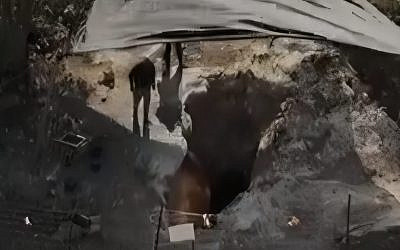
Similarly, photographs released following the discovery of the Ramat Rachel tunnel about two months ago reveal structures that may be associated with a water collection system. At present, however, this remains speculative and requires detailed archaeological documentation and further investigation.
If, as reported in the initial publications, no clear evidence of water flow was observed inside the Ramat Rachel tunnel, an important question arises: how did hundreds of cubic meters of sediment accumulate within it? In our view, this is an important research question deserving further study.
At both sites, the original hydraulic systems were modified during archaeological excavations. Consequently, part of the original configuration can now be reconstructed primarily through historical photographs and documentation.
It is also possible that biodegradable filtering materials, such as reeds or ropes, were incorporated into these systems. If so, no physical remains would be expected after more than two millennia.
The Two Additional Tunnels at Nahal Sekhakha
According to researchers’ reports and previous publications by the Hebrew University, two additional tunnels were discovered east of the main tunnel system at Nahal Sekhakha.
Visitors have also reported moisture and even standing water inside the northern tunnel over the years.
In classical Qanat systems, secondary tunnels were sometimes excavated to connect with the main water channel and improve water conveyance.
It is possible that the two eastern tunnels at Nahal Sekhakha served a similar function, although no evidence currently confirms this interpretation.
Their location, east of the main system and in the direction of the biblical settlement of Sekhakha (generally identified with Khirbet es-Samra), justifies further research. Their precise locations should be published and examined to determine whether they fit the proposed model.
At Ramat Rachel, another possibility has not yet been investigated: that an additional tunnel may approach from the southern slopes. If such a tunnel is eventually discovered, it could significantly improve our understanding of the site’s overall hydraulic design.
Historical Background
The proposed model is consistent with the currently accepted chronological framework.
Qanat technology is generally associated with the Achaemenid Persian Empire beginning in the sixth century BCE. However, the engineering knowledge on which it was based had already begun developing in Iran during the early first millennium BCE.
Historical sources indicate that the Persian administration actively encouraged the development of new water resources and even granted tax incentives to those who developed water and agricultural systems throughout the empire.
Evidence for the classical use of Qanat technology to exploit groundwater is already known from the Land of Israel, including Einot Tzukim (Ein Feshkha) and other locations along the Dead Sea and the Arava.
The present hypothesis does not concern this classical application. Instead, it explores the possibility that similar engineering principles were adapted in the Land of Israel for the management of flash floods and surface runoff.
International Interest in the Hypothesis
Last week’s article on the tunnels of Nahal Sekhakha received international recognition when it was featured in the July 2026 Bible News Roundup published by Bible Gateway News & Knowledge, one of the world’s leading biblical websites.
The roundup stated
“A new hypothesis suggests some unusual ancient tunnels at Nahal Sekhakha in the Judean Desert may have been part of a sophisticated water-management system… If validated, the theory could reshape understanding of ancient desert engineering in the biblical or Hasmonean era.”
This recognition does not validate the hypothesis. However, it demonstrates that the proposed model has attracted interest within the international biblical archaeology community.
Conclusion
This article expands the hypothesis previously proposed for Nahal Sekhakha and Ramat Rachel by presenting a broader interpretive model.
According to this model, Qanat technology, originally developed to convey groundwater, may have been adapted in the Land of Israel to recharge and manage flash-flood water and surface runoff.
If future excavations identify additional sites with similar characteristics—such as unplastered tunnels, water capture systems, ventilation shafts, and groundwater recharge features—it may indicate that Nahal Sekhakha and Ramat Rachel were not isolated examples, but part of a broader regional engineering tradition that operated during the Persian period, and perhaps even earlier.
This hypothesis is fully testable and falsifiable through further archaeological research. Should future discoveries support it, our understanding of the engineering capabilities of the ancient inhabitants of the Land of Israel—and of the ways they adapted imported technologies to local environmental conditions—could be significantly expanded.
Perhaps one day, when peace and stability return to the region, international scientific cooperation can also be renewed around one of the most remarkable water technologies developed in the ancient world.
About the Author
Rafi Glick is a writer, lecturer, farmer, and business executive with decades of experience at the intersection of academia, technology, agriculture, and international trade.
• He has served as a Senior Teaching Associate at Ben-Gurion University of the Negev, Ono Academic College, Ariel University, Ruppin Academic Center, and as a guest lecturer at Sofia University’s Faculty of Economics and Business Administration (FEBA). At Ben-Gurion University he also advised the BGU–NHSA Accelerator in the Faculty of Science.
• In business, Rafi was CEO of Bidsnet Ltd., a pioneer in deploying fiber-optic cables through unconventional infrastructure (in partnership with CableRunner), delivering high-speed connectivity to homes, enterprises, institutions, and cellular networks. Earlier he held senior roles at ECI Telecom and served on the board of RLF Venture Capital, working with partners such as Intel, Teva, and the Jerusalem Development Authority.
• He contributed extensively to Israel’s trade and investment ecosystem: he directed industrial and agricultural technology divisions at the Israel Export Institute, founded Israel’s AGRITECH as international exhibition, and served on the board of the Israeli Investment Center at the Ministry of Industry and Trade.
• In his early career, Rafi established and served as the first director of the Cargo and Aircraft Supply Security Department in the Security Division at Ben-Gurion Airport (1972–1976). He lived in Kibbutz Parod until 1974.
• Rafi has also been recognized for his writing: in 2008 he was named Best Economic Blogger by TheMarker, Israel’s leading business daily.
• Today he continues to publish essays and commentary—with a special passion for astrophysics, space exploration, technology, economics, and social issues.
From Kibbutz Parod to the global stage, Rafi Glick’s career reflects a lifelong commitment to building connections—between people, industries, and ideas.
Email: rafi.glick@gmail.com
Related Topics
Related Posts


Rafi Glick