Jerusalem’s YMCA: An Island of Peace and Humanity in a Conflicted City
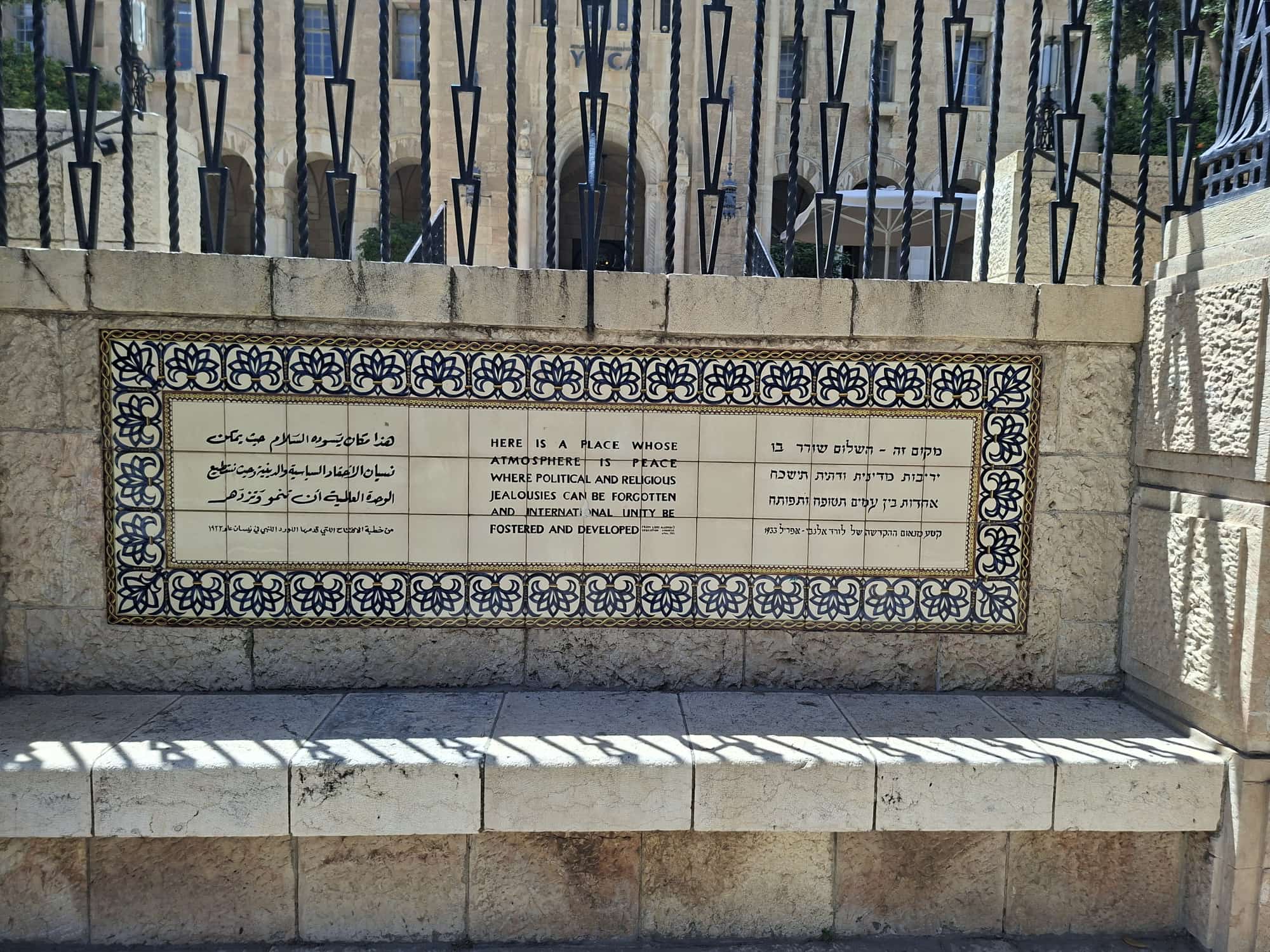
Ahead of Jerusalem Day, let me pay tribute to a unique institution in this unique city – the local branch of the international YMCA (Young Men’s Christian Association). When dedicating the building in 1933, Lord Edmund Allenby, the British general who led the conquest of Jerusalem from the Ottomans in 1917, declared: “Here is a place whose atmosphere is peace, where political and religious jealousies can be forgotten, and international unity fostered and developed.” His words were immortalized on an Armenian ceramic plaque in three languages – Hebrew on the right, Arabic on the left, English between them – greeting all who enter the compound.
Had Allenby found himself in the YMCA sports center during a siren alerting us to an incoming missile from Iran, he would have seen his vision realized. In the safe area, he would have found Jews and Arabs, Muslims and Christians, religious and secular, diplomats and tourists. All sharing the same desire for a healthy body, all waiting to hear that the episode is over and it is safe to exit.
Three languages are spoken by teachers and toddlers in the “Peace Preschool,” housed in the historic building. Children raised in such an environment do not grow up regarding speakers of another language as enemies, largely because their parents – among them women in hijabs and men in knitted kippot – understand that they, that we, must live together. Not in rivalry, domination, or competition; not as service providers or recipients, but as partners.
Thus, one may see two women sharing a lane in the swimming pool. One, whose religion cannot be guessed, covers herself in a modest swimsuit, and the woman beside her is covered in tattoos. As for staff – when the CEO is Jewish, the chair of the board is Arab, and vice versa. The current CEO is a Christian from Haifa; he was preceded by a Muslim woman from Jerusalem, and before her the institution was headed by a Jewish Jerusalemite.
Respect is reflected in the closing days: for Jews, Independence Day and Yom Kippur; for Muslims, Eid al-Fitr and Eid al-Adha; and for Christian members and employees, Easter and Christmas. The place was founded by Christians, and naturally the building contains more Christian symbols in its ornamentation, yet its builders took care to ensure that everyone would feel comfortable. They avoided an excess of crosses; the chapel contains a Bible, a New Testament, and a Quran; and verses from all three holy books are engraved into the stone façade. Recently, I learned that the wooden ceiling in the lobby had been brought from a synagogue in Damascus, and only then did I notice that the triangular patterns form Stars of David.
Over the years, many thousands have been exposed to all this, including concertgoers who sit on the original chairs in the auditorium, beneath period light fixtures, and generations of local children who learned to swim in the city’s first heated indoor pool. About a decade ago, a new sports center opened adjacent to the historic structure. Its marble and glass are free of symbols, and seasonal religious décor is limited to a plastic Christmas tree and strings of lights, a Hanukkah menorah, and a few Ramadan decorations. This year, because the holidays fell close together, a crescent-and-star decoration still stood in the lobby when YMCA began collecting leaven products for needy communities ahead of Passover.
If all this paints a picture of idyll, honesty is required. I often hear “Look how many ‘cousins’ are sitting in the jacuzzi,” as though the code – we don’t want to see Arabs around us – is not clear to all. Presumably, such sentiments are shared on the other side. In my experience, people therefore choose to avoid conversations about hard subjects. Instead, they wish luck to the daughter who studied medicine abroad ahead of her Israeli licensing exam (she passed!); offer condolences on the death of a parent; and complain together when an exercise class is canceled. This is coexistence at eye level, not born of ideology but of natural human interaction, as befits people who share time and place, and whose lives are intertwined.
When grim statistics about Jerusalem’s condition provide background for the annual bombastic declarations about our “eternal united capital,” it is comforting to take part in the founders’ vision as expressed by Allenby, and to find solace in the simple reality, in any language, of: “I forgot to bring shampoo; do you have some to give me?”