


Just Pro humanity
Jesse Jackson, Antisemitism, and Zionism: A Complicated Legacy.
History rarely hands us clean stories. It hands us people.
Rev. Jesse Jackson was nothing if not a person: charismatic, consequential, imperfect, and—depending on the year you met him, either a walking political lightning rod or an unlikely bridge-builder.
For many Jews, the name “Jesse Jackson” still comes with a reflexive flinch. Not because of policy disagreements or partisan theater, but because of language. Because when a public figure steps into words that carry centuries of threat, it doesn’t land as a “gaffe.” It lands as something older. Something with a history.
“Hymietown” wasn’t a mistake — it was a wound
In 1984, Jackson was reported to have used “Hymies” and “Hymietown.” People can debate intent all day. But the impact was obvious: it wasn’t merely offensive—it was historically loaded. Jews don’t hear that kind of language in a vacuum. We hear it with echoes: the long record of being reduced to a caricature and then treated as a problem that needs solving.
That episode hardened mistrust at exactly the moment coalition politics needed moral discipline and mutual restraint. It became shorthand, headline, and scar tissue. Antisemitism has always had a talent for hiding in plain sight. It’s not always swastikas and violence. Sometimes it’s a wink. A slur. A casual phrase that treats Jews not as neighbors or citizens or a people with a story—but as a monolith.
A pivot that mattered, even if it wasn’t the ending
Years later, Jackson did something that surprised many who only remembered the controversy: he entered Jewish spaces and spoke the language of reconciliation. He condemned antisemitism outright, called for renewed Black–Jewish cooperation, and described Zionism as a liberation movement.
That phrase matters. It signaled recognition—explicit or intuitive—that Jews are not merely a religious community floating through history. Jews are a people. And peoplehood has consequences: national memory, national trauma, and national aspirations.
But we should resist turning that moment into a tidy ending. Zionism is experienced by many Jews as the national liberation movement of the Jewish people—the insistence that a people who have been expelled, hunted, and scapegoated do not have to outsource their safety forever. Yet in today’s discourse, it’s also contested, argued over, weaponized, and reduced to slogans. Jackson’s later embrace of “Zionism as liberation” was real, but it did not erase the duality of his politics, including long-standing support for Palestinian rights and Palestinian statehood alongside secure Israeli borders.
Coalition memory: MLK, Jewish allies, and the standard we inherited
This story sits in the shadow of Martin Luther King Jr., a man Jackson truly was close to in the movement. But King’s movement was never “only” Black and Christian. It drew strength from allies who understood what it meant to be targeted as a people. King marching beside Jewish leaders—most famously Rabbi Abraham Joshua Heschel—was not cute symbolism. It was a declaration: dignity is not a private possession.
And that partnership wasn’t invented in the 1960s. People sometimes confuse this history with the NCAA, but the relevant institution here is the NAACP’s early coalition of Black and Jewish leaders and supporters. That’s the tradition. That’s the standard. Which is why antisemitic language from someone in King’s lineage felt so jarring: it violated not only Jewish dignity, but coalition memory.
A real-world test: Iranian Jews
If speeches are words, then advocacy is a receipt.
Jackson later became publicly involved in efforts connected to the case of Iranian Jews who faced severe charges and the fear of execution. Jewish leadership engaged him, and coverage at the time framed it as part of a longer arc—“a long way from Hymietown,” as one account put it.
Again: this doesn’t make him a saint. It makes him human—capable of causing harm, and later capable of showing up in ways that many didn’t expect.
A personal note: the man in the room
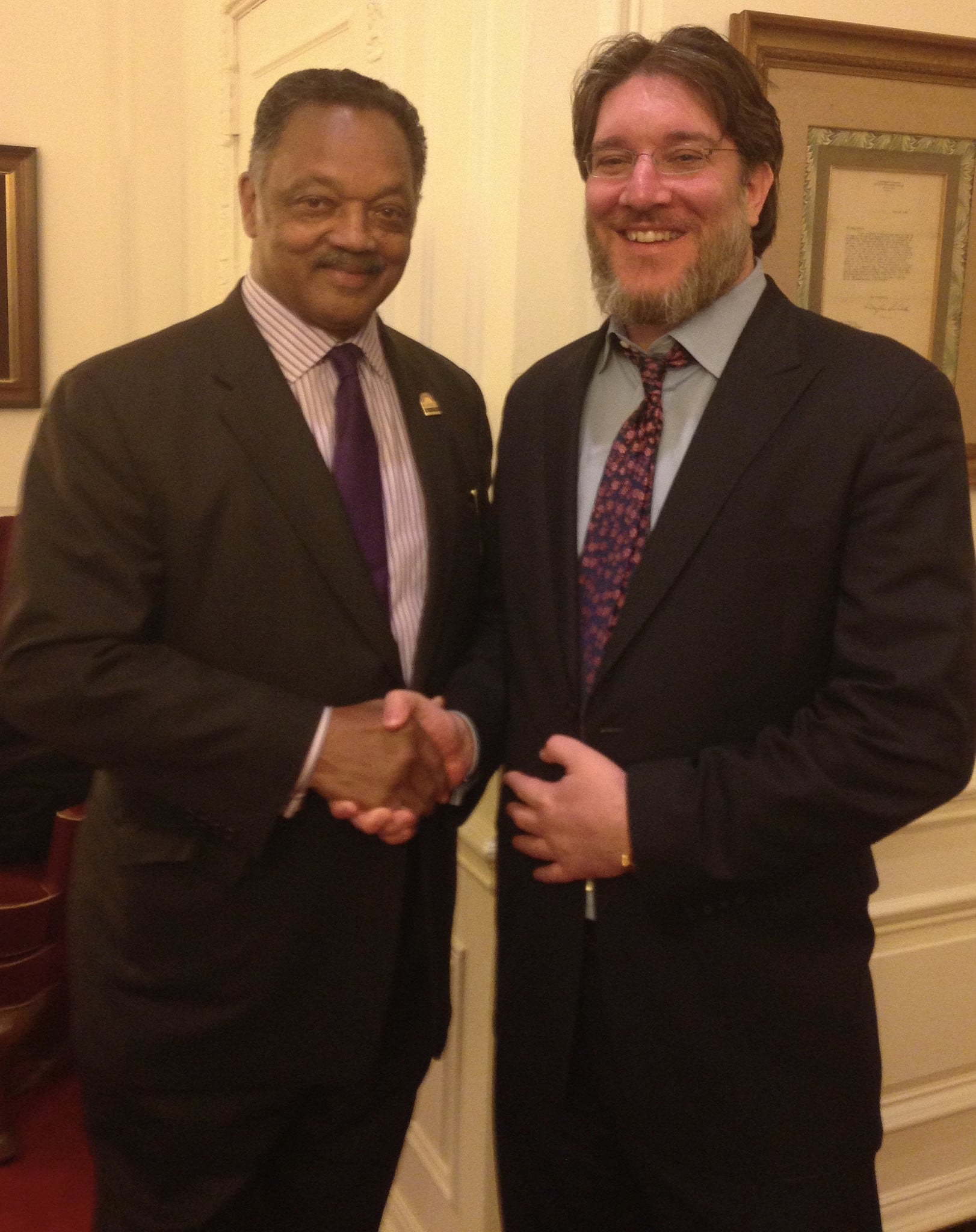
I met Rev. Jackson on several occasions, including at our Wall street offices about a decade ago.
And here’s what I can say plainly, without spin: he was always a pleasure to speak with every time we met. Warm. Present. Disarmingly personable. The kind of person who could make you feel, for a moment, like the room got quieter because he decided to listen.
That doesn’t settle the historical debate. It doesn’t grant retroactive absolution. It simply adds something that gets lost when we flatten public figures into cardboard villains or porcelain heroes: the texture of the human being.
So what do we do with his legacy?
We do what grown-ups do: we hold two truths at once.
He said things that were ugly and harmful, and they deserved condemnation.
He also took steps—real steps—to repair, to reconcile, and at times to defend Jewish dignity and Jewish peoplehood, including explicitly affirming Zionism in the language of liberation.
And if you want reconciliation, you accept that it’s not clean. It’s not performative. It’s not a trending hashtag. It’s work. It’s listening. It’s showing up when you’re not guaranteed applause.
Rev. Jackson’s legacy will always be complicated. It should be. Complication is not evasion. It’s reality.
May his memory be a lens, not a weapon.