CFO | Empower Society for Good I Author
Jewish Civilization: Family, Values and Land
Chayei Sarah: The Journey of Becoming
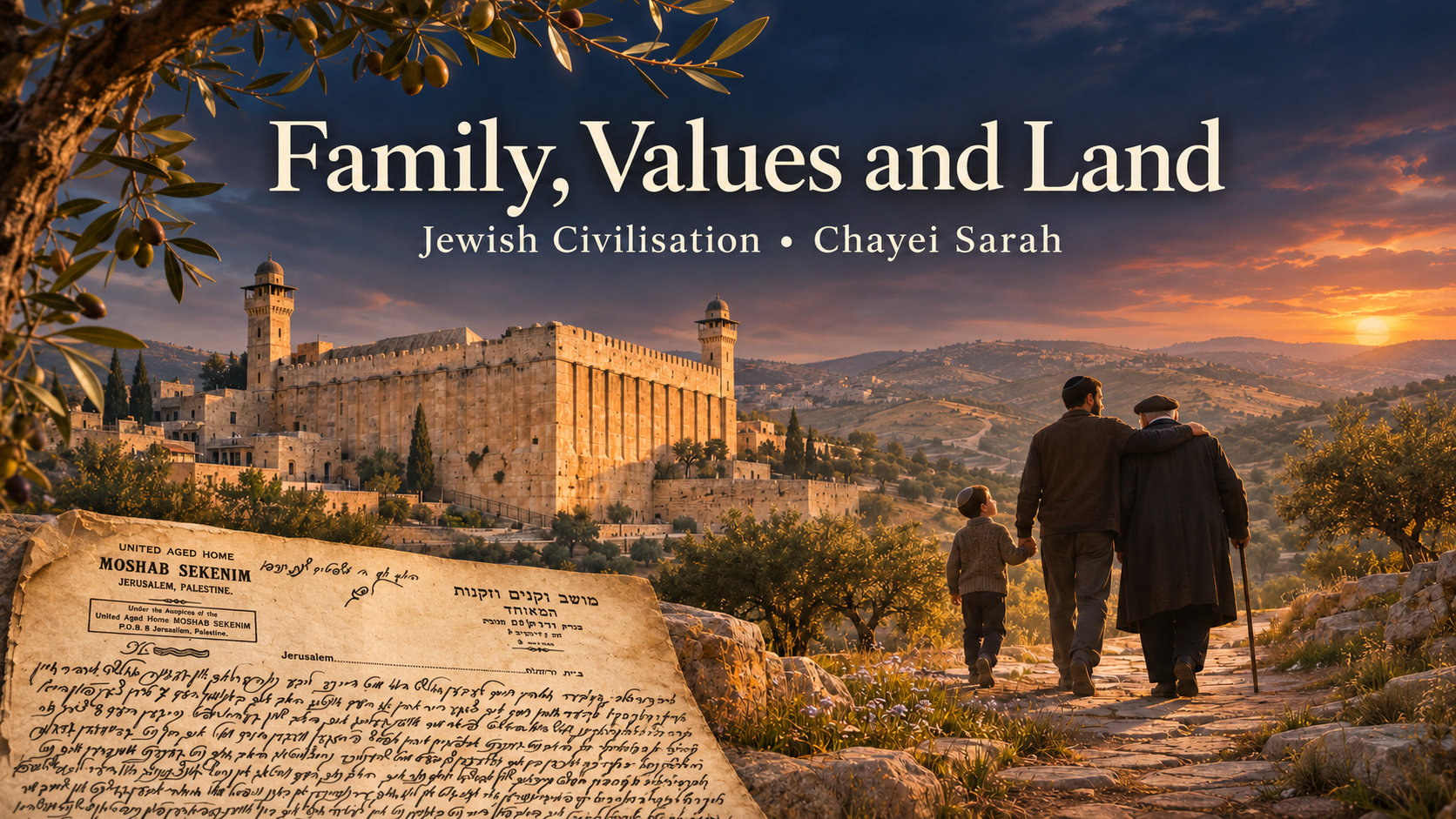
A grieving husband stands before the people of Hebron and asks for somewhere to bury his wife.
Avraham has received a promise of land and descendants. Now Sarah is dead, and he needs a burial place. The Torah records the negotiation with Ephron, the witnesses, the four hundred shekels of silver, the field and the cave. Then Avraham buries Sarah at Machpelah.
A family’s loss becomes an enduring connection between a people and a place.
Judaism is a civilization—encompassing peoplehood, nationhood and religion, yet extending beyond any one of them. Here, its story unfolds through a family, its values and its attachment to the land.
In my reflection “Jewish Civilisation: I Would Begin the Story in Hebron”, I explored that inheritance. This reflection follows it into our lives: how we receive it, struggle with it and pass it on.
Rabbi David Milston writes: “Hevron was and is the starting point of the Jewish people. We cannot move an inch without the values represented by Hevron.”
He connects the patriarchs and matriarchs with Torah, service of God and acts of loving-kindness. Their lives reveal how demanding those values can become.
We remember Avraham for chesed, loving kindness; Yitzchak for gevurah, strength and restraint; Yaakov for emet, truth. Yet each encounters circumstances that challenge his defining quality.
Avraham welcomes strangers and pleads for Sodom, but must also fight to rescue Lot. Kindness requires confrontation when someone is in danger.
Yaakov deceives his father, endures Lavan’s manipulations and later suffers his children’s deception over Yosef. The patriarch associated with truth lives amid its painful contradictions.
My Hebrew name is Yaakov. His challenge feels personal: honesty in business, keeping my word when it costs me, ensuring my actions match my principles. In a world of greed and lies, truth is tested through everyday decisions.
Yitzchak’s name evokes laughter. Yet he experiences the trauma of the Akedah.
Rabbi Shai Held explores his subsequent appearance near Be’er Lahai Ro’i, where Hagar encountered God. Drawing on midrash, Held suggests that Yitzchak may seek to comfort Hagar, receive consolation and restore a fractured family. Perhaps he also needs to rediscover divine tenderness.
The patriarch associated with strength reaches towards compassion.
Kabbalah describes tiferet, associated with Yaakov, as harmonising chesed and gevurah. Life asks us to develop that capacity: love with boundaries, conviction with humility, courage with restraint.
I recognise this work within my own family.
My children span the Jewish spectrum: Haredi, Dati Leumi and secular. One family, different paths. I cherish traditions that do not carry the same significance for all of them. That can hurt. Through our shared journey, I have been learning unconditional love.
Even Yitzchak’s sons, Yaakov and Esav, followed profoundly different paths.
Why does God allow these struggles? Does He like drama? Raising a family, earning a living and trying to live faithfully provide enough. Living in this land brings extraordinary blessings alongside fear and uncertainty.
I have no simple answer. I can ask what these experiences require of me.
My father, Saul Levine, died at fifty, when I was twenty. His example of fairness in business and treating people well has stayed with me. I hoped to pass on what he gave me. My children have taught me how much growing I still have to do.
Another family voice reaches me from a century ago.
My great-great-grandfather, Tzvi Shewach, came here in 1925 and is buried on Jerusalem’s Mount of Olives. His hundredth yahrzeit falls on 17 Tevet 5787—27 December 2026.
His surviving Yiddish letter to his son-in-law, Chaim Levine—my great-grandfather—describes illness, financial worries and the pain of receiving no letters. Yet he remembers his annual contribution for an elderly man and asks that the children receive matzot for Pesach.
He needed support himself. He was still thinking of others.
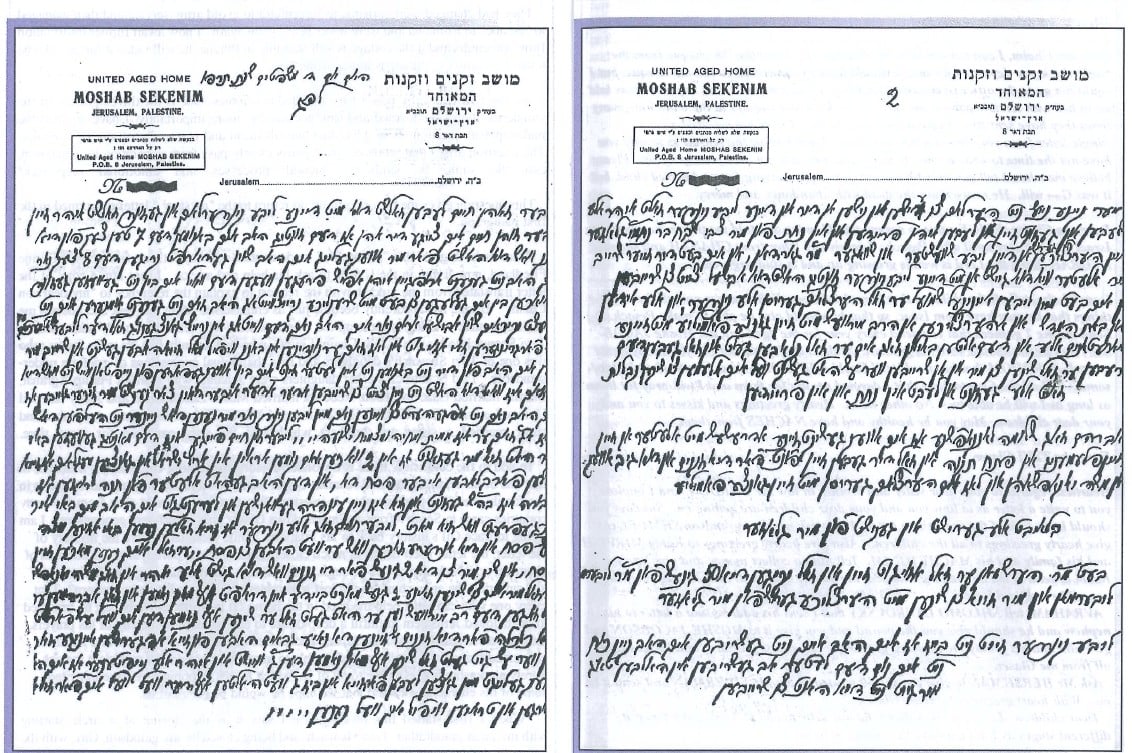
His grave connects us to the land. His letter carries an example of chesed into our lives.
Rabbi Milston’s three pillars bring these threads together: Am Yisrael, Torat Yisrael and Eretz Yisrael—our people, our Torah and our land.
Nitsana Darshan-Leitner, president of Shurat HaDin, has called for coordinated action against antisemitism and efforts to undermine Israel. Alongside that work, we have a responsibility to tell our own story.
I have made a short video outlining how we could bring Hebron’s story to the screen—a first sketch of the larger historical film I imagine.
The monuments and historic events matter. So does a handwritten letter from a man who remembered someone else’s needs.
Rabbi Jonathan Sacks wrote: “Non-Jews respect Jews who respect Judaism.”
We need to carry this inheritance confidently, communicate it to the world and make it meaningful to our children.
This is our home, our heritage, our land. How we live here becomes the next part of its story.
Related Topics
Related Posts