
Jewish Exceptionalism: Antisemitism in Plain Sight
One of the often overlooked provisions in the IHRA’s working definition of antisemitism identifies as antisemitic the act of “applying double standards by requiring of [Israel] a behavior not expected or demanded of any other democratic nation.” Natan Sharansky made a similar observation with his 3D test, where the last D, double standards, refers to applying different principles to similar situations.
It is understandable why this provision gets less attention. Raw, unfiltered antisemitism, blood libels and racist stereotypes, is far more sensational to confront. But what I call “Jewish exceptionalism,” treating ordinary Israeli or Jewish behavior as something extraordinary and uniquely sinister while ignoring simple alternative explanations, is by far the most common and evasive form of antisemitism today.
It has roots in the old European tradition of othering the Jew, who for centuries was the only “outsider from within” that Europeans ever knew. The impulse is traced to the same origin as cruder forms of antisemitism, but has shifted since the end of World War II and the tabooing of outright antisemitic expressions across Western Europe.
Examples are plentiful. An Israeli professor just recently published a book claiming Israel’s adoption of hummus underwent “a process of culinary appropriation amidst settler colonialism,” echoing the broader argument that Israelis stole their national foods from the Arabs because Israelis have no authenticity or roots, and therefore need to appropriate Palestinian culture and history to appear indigenous.
This ignores the rather obvious fact that cultures living together or in proximity routinely share culinary and other elements, including vocabulary. Culinary appropriation accusations exist everywhere. The Balkans offer one example, where Turks and Bulgarians fight to this day over who invented and who stole the Burek (or Burekas, as it is known in Israel). Greeks and Turks feud over feta cheese, gyros, and baklava; try going to Greece and asking for a “Turkish coffee” and see what happens. In Europe, Austrians remain resentful that the croissant is widely attributed to the French. Yet none of these cultures are accused the way Israel is accused. Singling Israel out while ignoring very basic historical facts, not to mention the erasure of Mizrahi Jews, who constitute the majority of Israeli Jews, is in fact antisemitic.
This exceptionalism has intensified since October 7, where a war, insignificant in historical scale, is routinely framed as a genocide surpassing the Holocaust. But the pattern extends well beyond the framing of the war itself.
In late March, my Greek feed was filled with reports that Israel planned to purchase Greek islands as a safe haven from the Iranian onslaught. The origin was a throwaway comment by an anonymous advisor of a mid-sized party in March 2022 that nobody took seriously. It did not matter. The report triggered Greek insecurity reminiscent of the economic crisis, while echoing antisemitic tropes of Jewish money stripping away European sovereignty and the conspiracy of “Greater Israel,” which for some reason now has aspirations in the Cyclades.
A recent incident involving this trope was triggered again by Mehran Khalili, a member of DiEM25, Yanis Varoufakis’ radical left party, who published a photo from Athens International Airport of an advertisement in Hebrew. The headline reads: “Don’t go home without a home in Greece.” The ad is “selling Greek homes to Israeli tourists,” Khalili stated. “So much wrong in one picture,” he concluded.
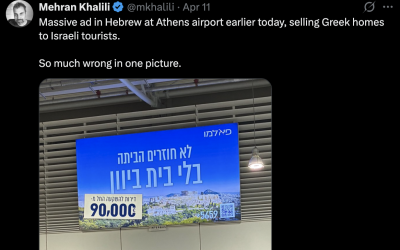
This plays not only on the legitimate Greek discontent over the gentrification of Greek real estate by foreign money. It also magnifies the accusation of “Zionist” money achieving a Greater Israel, not only in Cyprus but in the heart of Hellenism itself. It is true that Israelis have shown increasing interest in European real estate, not only in Greece and Cyprus but in Portugal, Spain, Italy, and Eastern Europe. Yet the statistics reveal, once again, the telltale signs of singling Israel out.
According to the Bank of Greece, in the 2025 figures for marketwide foreign capital flowing into Greek real estate and applications for the now infamous golden visa, Israelis were indeed part of the 59.4% of buyers from non-EU countries, but a small fraction of it, accounting for roughly 4.3% of the market. The rest broke down to 56% from China, 16% from Turkey, and 9.9% from Singapore. The Israeli figures match those from the US, the UK, the UAE, and even Lebanon. Yet Israel is again singled out as the potential takeover artist and land grabber.
This is the pattern, and this is the point. When one nation’s 4.3% share of a real estate market becomes an act of colonial expansion while another’s 56% barely registers, we are no longer in the realm of political criticism. We are in the realm of exceptionalism. The instinct to frame ordinary Israeli conduct as uniquely threatening, to inflate it beyond all proportion while ignoring identical or far greater behavior by others, is not an analytical framework. It is a reflex, one inherited from centuries of suspicion toward Jews. Recognizing it as such is not an attempt to silence criticism of Israel. It is a demand that such criticism meet the same standard of evidence and proportion we apply to everyone else. That, after all, It is not a high bar.